AI Agents for Marketing Agencies: What They Do and Cost
AI agents for marketing agencies draft content, run reports, and handle routine client work. See what they do, which to use, and what they cost.
AI agents for marketing agencies are software systems that plan and execute tasks on their own using large language models. They draft copy, summarize campaign reports, monitor competitors, and update client dashboards from the tools you already use. An agency runs them supervised, not hands-off.
Most writing on AI agents for agencies is theory from vendors selling subscriptions. This is the plain version, from someone who runs an automated marketing operation every day. It covers both sides: the agency putting agents to work, and the business owner deciding whether to hire an AI marketing agency.
TL;DR
- AI agents for marketing agencies plan a task, call the tools you already use, and finish the work: drafts, reports, monitoring, and client dashboards.
- Start with the report that repeats every month. Most of the budget in an agent project goes to the data behind the output.
- The tool stack runs from free to a few hundred dollars a month. Published AI agency retainers run $1,500 to $6,000 a month.
- Review time is a real cost line, and no vendor quote shows it.
- Ask who owns the ad accounts, the CRM, and the domain before you sign anything.
What are AI agents for marketing agencies?
AI agents for marketing agencies are programs that plan a task, call the tools you already use, and act until the job is done. They run on large language models from OpenAI, Anthropic, and Google. A chatbot answers a question. An agent finishes the job.
The OpenAI agent guide defines an agent the same way: applications that plan, call tools, and keep enough state to complete multi-step work. Anthropic’s guide to building effective agents draws the line that matters for buyers. Workflows follow predefined code paths. Agents let the model direct its own process and tool use. Plenty of agents on the market are workflows with a chat window on top. That is fine, as long as you know which one you bought.
MIT Sloan’s agentic AI explainer calls agents a new class of system that is semi or fully autonomous, able to perceive, reason, and act on its own. A spring 2025 survey from MIT Sloan Management Review and Boston Consulting Group found that 35% of respondents had adopted AI agents by 2023, and another 44% planned to deploy them soon. IBM reports that 50% of companies already using generative AI planned to run agentic AI pilot programs in 2025.
If you are new to the pattern, the AI agents for small business guide covers how the same agents fit a smaller operation.
Is an AI agent just a chatbot with more steps?
The difference is what the system can change. A chatbot reads your question and replies. An agent holds a task list and opens other software to do the work. No write access means you have a chatbot.
Read the permissions before you read the pricing page.
What is an AI marketing agency?
An AI marketing agency is a marketing firm whose core process runs on AI agents and automation instead of manual hours. The agents research, write, schedule, bid, and report. People set strategy and approve the work. The buyer pays for an outcome and a running system, usually on a monthly retainer.
Two firms can bill you the same $1,500 a month. One runs your account with agents. The other runs it with a person and a ChatGPT tab open. Darkroom’s definition page describes an AI marketing agency as one that builds its whole method around AI, machine learning, and automation, with AI as the foundation rather than a side task. The AI marketing agent is the tool that does the work. The agency is the firm that wires it into your accounts and answers for the output.
| What changes | AI marketing agency | Traditional agency using AI tools |
|---|---|---|
| What you buy | A running system and a monthly outcome | Hours, deliverables, and account management |
| Who does the work | Agents run the work, people set the rules | People run the work, AI helps on side tasks |
| How output scales | Software, so more volume costs little more | Headcount, so more volume costs more |
| Pricing shape | Monthly retainer, often with an onboarding fee | Retainer or project fee, quoted per scope |
| Where it breaks | Rules have holes, and tools change under the agent | Senior time spreads thin across accounts |
For a small business, the deliverable is a working channel and a number you can check monthly. Leads get followed up, ads get managed, content ships, and the report arrives on one page instead of forty. Small firms are early on this. Between September 2024 and August 2025, 7.6 percent of US businesses used AI at all, per the SBA’s small business AI adoption data. Most of your local market has automated nothing yet, so a working channel is still an edge.
Agent-run process changes the cost curve. Tool-assisted process does not.
How do AI agents help a marketing agency day to day?
AI agents help a marketing agency by absorbing the repetitive layer: content drafts, campaign reporting, social scheduling, email, competitive research, and client dashboard updates. The agency keeps strategy, client calls, and final approval. The agent runs the work that used to happen at 9pm.
IBM on AI agents in marketing lists the functions directly: customer engagement, content creation, campaign management, and performance analysis. Those map to the first agency agent implementations a typical agency starts with: content, social, SEO, email, ABM, and competitive research.
| Agency workflow | What the agent does | What the agency keeps |
|---|---|---|
| Client onboarding | Pulls CRM data, drafts the kickoff plan, builds the dashboard | The kickoff call and the scope |
| Content creation | First drafts, briefs, and channel variations | Voice, approval, final edit |
| Campaign reporting | Pulls the numbers, writes the summary, flags anomalies | The readout to the client |
| Competitive research | Monitors competitor moves and summarizes them | The strategy call |
| Email and social | Queues drafts on the set cadence | The send approvals |
I run a local SEO agency, and the automation that changed my week was putting follow-up on autopilot. My own outreach system sees roughly 200 form submissions a day, and the follow-up loop runs without me. The task owners underestimate most is reporting: everyone expects the agent to write copy, and the real win is the weekly deck nobody wanted to build. The pressure behind all of it is measurable. HubSpot’s 2026 marketing statistics page, quoting the State of Marketing report, found nearly 30% of marketers already report decreased search traffic as buyers turn to AI tools.
The agent does the mechanics. The agency keeps the judgment.
The 3-question ledger I run before a workflow gets an agent
I score every candidate workflow with the same 3 questions before it earns an agent.
- Does it repeat every week, or was last week a one-off?
- Does the data already sit in a tool I pay for?
- What does a wrong output cost me?
Two yeses and a low failure cost put the workflow in this month’s queue. A weekly task fed by messy data waits. An agent repeats a mess faster than a person does. My outreach follow-up went first because it repeats daily and the data already lands in a form tool. The manual version lost 3 handoffs, and every one was a place where a lead went cold. An agency loses the same way on a retainer, one silent week at a time.
A workflow that repeats weekly and reads data you already own is the one to automate first.
Which agency tasks should an agent handle first?
Start with client reporting. It repeats every month and pulls from tools you already pay for. A person reads the result before the client does. CRM enrichment and content repurposing fit the same shape.
| Agency workflow | What the agent finishes | Check before it ships | Start here? |
|---|---|---|---|
| Client reporting | Pulls the numbers, drafts the summary, flags what moved | A person reads the summary first | Yes |
| Content repurposing | Turns 1 deliverable into the channel versions | Voice and claims review | Yes |
| CRM enrichment | Fills missing fields on accounts before a pitch | Spot-check 10 records | Second |
| Project updates | Writes status notes from the task tool | The account owner approves the note | Third |
| Pitch and follow-up drafts | First drafts against your format | Pricing stays with a person | Third |
| SEO deliverables | Runs the on-page checks and drafts the fixes | A strategist sets the priority | Later |
The IBM guide puts reporting and performance tracking among the internal tasks agents take on first, along with content generation. Client onboarding has the same shape, since the intake and the kickoff doc both follow a template. Requests that fall outside the retainer are scope creep. An agent can log them, and a person still sets the price.
Rank the jobs by how often they repeat, then take the one with the shortest review.
What AI agent solutions fit an agency?
AI agent solutions for agencies come in three shapes. You buy a tool that does one job. You build on a platform you already pay for. Or a partner builds and runs the agents for you. The right one depends on who checks the client work before it ships.
| Solution | What you get | Who checks the output | Fits when |
|---|---|---|---|
| A single-job tool | One agent for one task, like reporting or social drafts | Your account manager | You have one workflow eating the hours |
| A platform build | Agents wired into your CRM and client accounts | Your team, on a review step you design | You run the same delivery for many clients |
| A managed build | A partner builds, runs, and fixes the agents | Both sides, on an agreed gate | Nobody in-house owns the wiring |
Execution on client work follows the same rule in every shape. The agent drafts and pulls the numbers. A person approves before anything reaches the client.
The tool itself is covered in AI marketing agent, which shows what one agent does inside a single business. Insurance agencies buy agents the same way, with stricter rules on client data, in AI agents for insurance agencies.
Pick the shape by who reviews the work, not by the feature list.
Which AI agents are best for a marketing agency?
The best AI agents for a marketing agency are the ones that own your highest volume, lowest judgment workflows: content creation, social media, SEO, email, ABM, and competitive research. Start with the workflow that costs you the most hours this month. Run it supervised, measure it, then expand.
| Agent type | What it runs |
|---|---|
| Content creation | Briefs, first drafts, and channel variations |
| Social media | Scheduling queues and draft variations |
| SEO and AEO | Keyword checks, content gaps, AI-answer optimization |
| Campaign drafts and list segmentation | |
| ABM | Account lists and multi-touch campaign coordination |
| Competitive research | Competitor monitoring and move summaries |
The platform matters less than what it can reach. The best agent is the one whose runtime already reaches your client data.
| Platform | What it does well for an agency | Pick it when |
|---|---|---|
ChatGPT (OpenAI) |
Drafting, research, analysis on a seat you already pay for | The work is text and a person stays in the loop |
Claude (Anthropic) |
Long documents, structured drafts, tool use | You are building the agent, not chatting with it |
Gemini (Google) |
Work inside Docs, Sheets, and Gmail | Your delivery already lives in Google Workspace |
HubSpot |
Acting on client and contact records in the CRM | The agent has to change records, not just read them |
Zapier |
Gluing apps together without an engineer | You want the first workflow live this month |
n8n |
Self-hosted workflows that run several models in one pass | You need control over data and cost |
HubSpot is the platform most of these workflows plug into, and its own site now lists Agent Hub as the home for building and managing agents inside the CRM. On the demand side, over 92% of marketers plan on or already use SEO optimization for traditional and AI-powered search, per the same State of Marketing data. An agency without an SEO or answer-engine agent is already behind the market it serves.
Pick by the data the agent can already reach. Good wiring on a cheap model beats a better model behind a wall.
Can off-the-shelf AI agents cover an agency, or is custom required?
Off-the-shelf AI agents cover most agency work: drafting, scheduling, reporting, and inbox triage, wired together with Zapier, Make, or n8n. Custom matters when the client work depends on your playbook, your data, or your reporting format. Start off the shelf. Go custom when the workflow is the product.
| What you are weighing | Off-the-shelf agent | Custom agent |
|---|---|---|
| Time to first output | Days | Weeks |
| Your delivery format | Close enough, then edited by hand | Built into the prompt and the checks |
| Client data access | Whatever the vendor connects | Your records, on your terms |
| Where it stops | Exceptions and edge cases | Where you stop maintaining it |
Anthropic’s guide to building effective agents makes the same call for builders: find the simplest solution that works, and only add complexity when the task needs it, because agentic systems trade latency and cost for better task performance. Their routing pattern sends easy questions to a smaller, cheaper model and hard ones to the capable model.
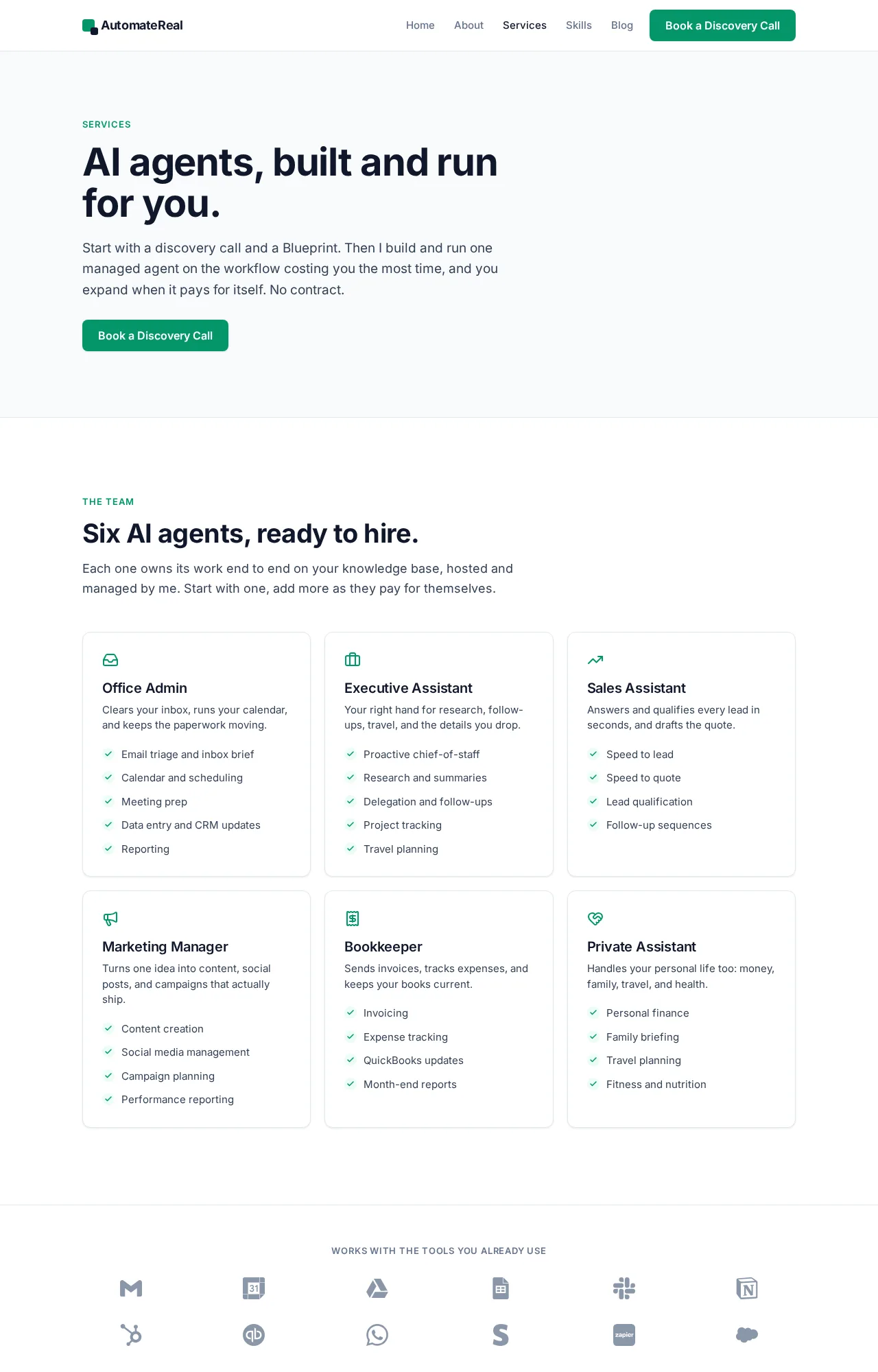
A 2025 paper from professor Kate Kellogg and her co-researchers, covered in the MIT Sloan explainer, built an agent that flags adverse events for cancer patients. The model was the easy part. In their report, 80% of the work went to data engineering and governance, plus stakeholder alignment and workflow integration. That is why the build matters more than the model choice. When the build is the work, the AI services page starts with the workflow drawn on paper before anything gets wired.
AutomateReal services
Custom work earns its cost when the workflow is what the client pays for.
How do AI agents connect to the tools an agency already runs?
Agents reach other software through tool calling and APIs. MCP is the open protocol that turns those connections into reusable pieces, so one build can plug into several tools and models.
The Model Context Protocol docs describe it as a standardized way to connect AI applications to external systems, and compare it to a USB-C port. The n8n docs put the same job from the workflow side: connect model providers, then add tools and memory.
Most agency builds stall in the same 2 places. Field mapping is the first. Tool A calls it a company, tool B calls it an account, and the agent has to know both labels mean the same record. Permissions are the second. An agent needs a scoped credential and a rule for a failed write. IBM shows how far one clean data source can go: its AskHR agent answers 94% of the company’s lower-level HR queries, per its write-up.
The field map is the build. Everything after it is plumbing.
The gate that sits before anything client-facing ships
Every client-facing output in my systems passes a named check before it leaves. A human in the loop only counts when it is written into the workflow as a step. Mine runs as 3 questions:
- Do the names and the numbers match the source record?
- Is each factual claim traceable to a page or a dashboard?
- Would I put my name on it?
The failures this review catches are small. A summary drops the one number the client asked about. A merge field grabs the wrong contact. MIT Sloan’s research on agentic AI found agents struggle with tasks humans do easily, such as handling exceptions, and their decision-making stays poorly understood.
I built the AI team that writes this site’s posts, and it shipped the same way: one task per agent, a reviewer stage that can reject a draft outright, and a test pass before anything publishes. My own agents failed the way the research says they would, on exceptions. Anyone selling you a decade of agent experience is selling you something. The stack is months old, and the honest builders say so.
Nothing ships until the check passes, and the check has a name.
How much do AI agents cost for a marketing agency?
AI agents for a marketing agency cost from zero to a few hundred dollars a month in software. Model subscriptions run from $20 a month up, and the automation glue runs from free to about $70 a month. The real cost is setup and review, not software.
- Model seats. Anthropic’s pricing page lists Claude Pro at $20 a month, Max from $100 a month, and Team at $20 per seat a month billed annually or $25 billed monthly. API usage bills per token. Anthropic’s pricing docs list Claude Sonnet 5 at $2 per million input tokens and $10 per million output tokens.
- Automation glue. Zapier pricing starts free with 100 tasks a month, then from $19.99 a month for Professional and $69 a month for Team. n8n’s pricing puts its hosted Starter at about 20 euros a month billed annually, with a self-hosted option that starts free.
- Setup. Someone has to wire the CRM, script the workflow, and write the guardrails. That is the line item that separates a $20 experiment from a working system.
| Cost line | What drives it | How to hold it down |
|---|---|---|
| Seats and API use | How many people run it and how often | Route easy steps to a cheaper model |
| Build | How many tools the workflow touches | Start with one tool and one output |
| Review | How much of the output a person still edits | Cut the job until review is a skim |
| Maintenance | Tool changes and prompt drift | One named owner per agent |
Kellogg has the line to keep in mind when you price this work, in the same MIT Sloan write-up. Reclaiming 20% of someone’s time is not a 20% labor-cost saving, she says. The hours come back as review and exception handling.
The line nobody quotes is review time. If the output needs a full edit, the work moved and the cost stayed.
How much does an AI marketing agency cost per month?
Most AI marketing agencies charge a monthly retainer. One published price list runs $1,500, $2,500, and $6,000 a month, and that firm adds a $1,750 one-time onboarding fee on a 6-month minimum engagement.
That onboarding fee covers a 30-day system build before the first campaign goes live, per the published AI agency pricing tiers. The retainers exclude media spend, so your ad budget stays on your own card. Cheaper routes exist, and a 2026 AI marketing cost tiers breakdown puts numbers on all of them:
| Route | Monthly cost | What you do |
|---|---|---|
| DIY tool stack | $100 to $400 | You run the tools, 8 to 15 hours a week |
| Freelancer hybrid | $700 to $1,500 | You hire help on one weak spot |
| Entry done-for-you | $500 to $1,000 | One channel, templated output |
| Mid-tier done-for-you | $1,500 to $2,500 | 3 or 4 channels, senior strategy time |
| Full-service done-for-you | $2,500 to $5,000 | 5 or more channels, weekly calls |
The same study names hidden costs, starting with setup fees of $500 to $3,000 billed after you sign. Per-channel add-ons run $200 to $500 each, and some firms pass platform fees through at a 10 to 30 percent markup. HubSpot Marketing Hub shows the price cliff most owners hit: $7 per seat on Starter, $800 a month on Professional, plus a $3,000 one-time onboarding fee, per this platform pricing breakdown. Ask for the all-in number before you sign, not after the contract arrives.
The retainer buys the system. Media spend and platform fees sit outside it.
What breaks in the first 30 days
Your rules will have holes, and the tools under the agent will change while you are still tuning. Expect a tightening loop, not a launch. An agent follows the rules you wrote, gaps included, so one bad rule repeats until you fix it.
- A rule with a hole, so the wrong reply goes out twice
- An approval step nobody owns, so work sits in a queue
- A platform that changes its price or its API mid-month
- A report nobody reads, which hides a channel that quietly died
When one of my own follow-up replies reads wrong, I tighten the rule it broke. My instruction was vague, and the agent followed it exactly.
Budget hours for the first month. The fee is the smaller line.
How do you tell a real AI marketing agency from a rebrand?
Ask for the account names, the report, and the approval step. An agent-run firm can show all 3 without a call. A rebrand shows a screenshot of a dashboard you cannot log into.
- Who owns the CRM, the ad accounts, the domain, and the data
- What the report shows: attribution, ROAS, and the path from click to sale
- Which platforms and agents run the work, by name
- What the onboarding fee covers, in writing
- How long the minimum engagement term runs, in months
The pages that define this term for most buyers skip the pricing part. One says pricing varies and stops there. The other lists pricing models with no dollar figures, per the business-model overview. That page does tell buyers to ask about GDPR and CCPA handling before signing, and that question is worth keeping.
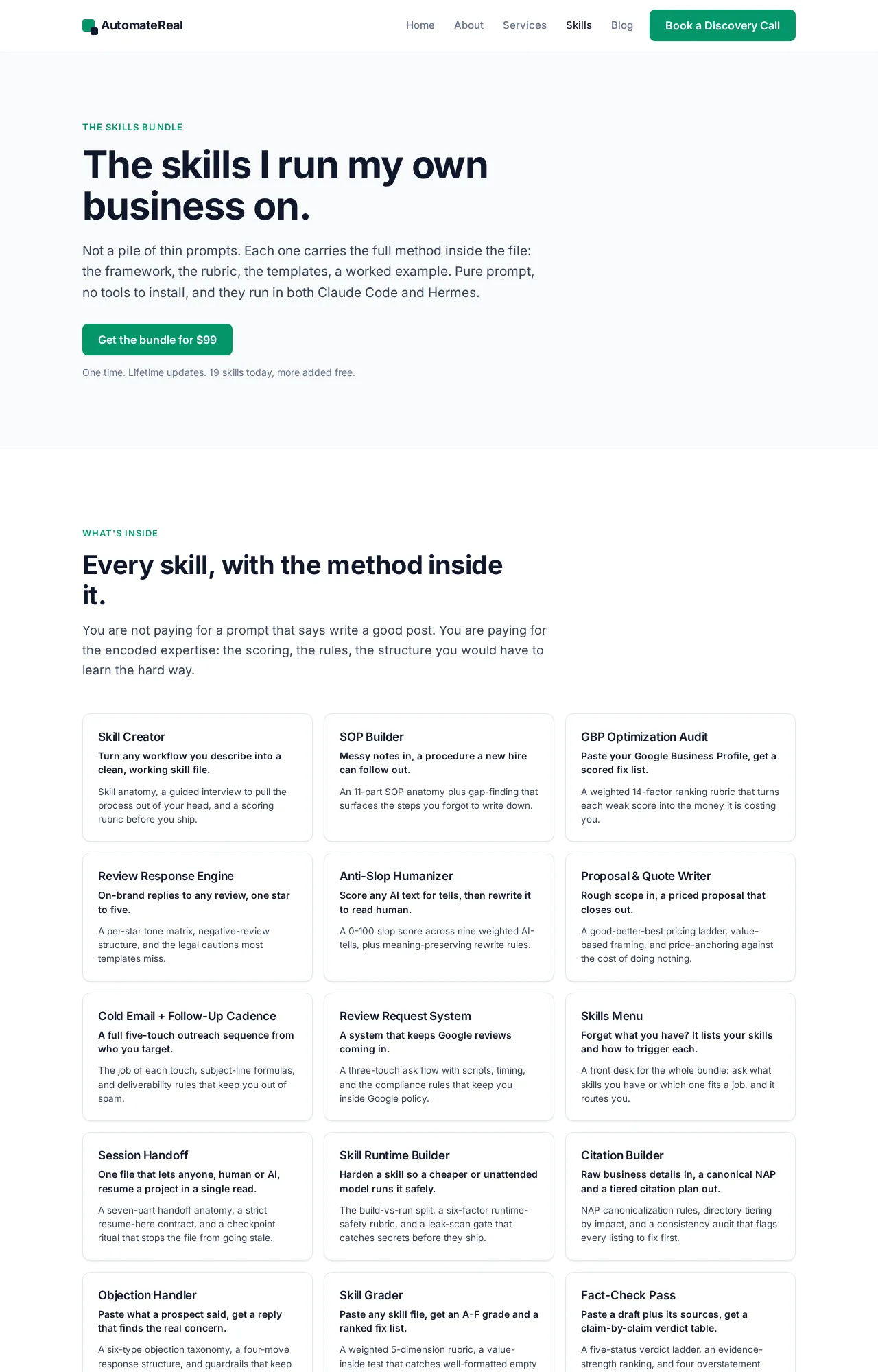
If you would rather run the work yourself, I sell the prompt skills behind my own pipeline in the skills bundle at $99, including the review prompts and the follow-up cadence I run. A retainer buys a system someone else runs.
AutomateReal skills
Ask for the account logins. A firm that keeps the proof in its own dashboard cannot be checked.
Related: AI agents for customer support
Related: AI agents for accounting firms
Related: Which AI Agent Should You Build First?
FAQ
How do AI agents integrate with the tools an agency already uses?
An agent plugs into your stack through APIs and no-code platforms like Zapier, Make, and n8n. It reads CRM data from HubSpot or your client trackers, writes to the tools that post and send, and reports back to the dashboards you already run.
What is the difference between an AI agent and a chatbot?
A chatbot answers what you ask it. An AI agent plans, calls tools, and completes multi-step work on its own. MIT Sloan research puts it simply: agents differ from chatbots because they integrate with other software and finish tasks with minimal supervision. The MIT Sloan explainer draws that line directly.
Do AI agents replace an agency’s staff?
No. Agents absorb the repetitive layer, and the team keeps strategy, client relationships, and approvals. The research shows agents still struggle with exceptions, which is exactly the work senior people do. The agency gets its evenings back, not a smaller headcount.
How long does it take to get the first agent live inside an agency?
Plan for weeks. The model wiring is the quick part. What sets the date is the data work behind the first output. One workflow on one clean data source is the fastest path to something live.
What should an agency never hand to an agent?
Keep the sign-off work with a person. The final price and the contract terms stay human. An agent can draft the options and flag the deadline.
Is an AI marketing agency worth it for a small business with a small budget?
Worth it when one channel is losing leads you can count. Run the cheap route while your hours are cheap, then move to a retainer when they are not. A small budget buys one channel done well, so pick the leak first.
What are the first questions to ask an AI marketing agency before I sign?
Ask who owns the accounts, and what the onboarding fee covers. Then ask about the minimum term, the platforms running the work, and who approves output before it ships. Finish with one request. Ask for a reference in your industry with real numbers attached.
If you want help finding the first workflow worth automating, book a discovery call and we map it in about thirty minutes. You keep the plan either way.