AI Accounting Software: What It Automates (2026)
AI accounting software automates bookkeeping, invoicing and reporting, and flags what needs a human. What it does, what it costs, and how to choose.
The receipts go in a folder. The bank feed keeps growing. By April the books are three months behind and nobody can say which line belongs to which job.
Most pages that rank for this phrase are written by companies selling accounting software, and none of them prints a monthly price. This page prints the prices, the parts that break, and the half hour of testing to run before you pay for anything.
AI accounting software uses machine learning to do the bookkeeping work. It reads receipts and invoices, categorizes transactions, reconciles bank feeds, and flags anything unusual for a person to check. Most tools plug into the ledger you already run, and none of them file your taxes.
TL;DR
- Software takes the reading, the sorting, and the matching. A person keeps the judgment, the audit trail, and the signature.
- Verified monthly prices:
Zoho Booksfree under its revenue cap. Xero$27 to $97 per month.FreshBooks$23 to $70 per month.Puzzle$30 to $120 per month.Zenifrom $549 per month.- The backlog costs more than the license. Puzzle lists catch-up bookkeeping from $300 for every month of books you never closed.
- Your record rules follow the files you keep. Employment tax records stay 4 years, and an invoice still needs a document behind it.
What is AI accounting software, and how is it different from bookkeeping software?
AI accounting software is bookkeeping software that reads its own documents. Plain bookkeeping software records what you type and waits. The AI layer reads the receipt, picks the account, writes the entry, and flags anything it cannot call.
The difference shows up in one task. In plain bookkeeping software you type the line and pick a category. In the AI version the line arrives with a category attached, and your job is to approve it or fix it.
Under the hood it is machine learning plus document extraction. Optical character recognition, usually shortened to OCR, turns a photographed invoice into text. A model then matches that text to an account in your chart of accounts.
Your general ledger, chart of accounts, and audit trail all stay. The IRS applies every rule for paper books to electronic ones. The same page answers the how long to keep business records question for each type of document.
The software changes who types the entry. The document behind that entry still decides whether it survives a review.
What can AI accounting software automate for a small business?
It automates the work with a document behind it and a rule you could write down. That covers receipt capture, categorization, bank reconciliation, invoicing, and payment chasing. Everything else still needs a person.
These are the AI agent examples most small businesses start with, in the order owners meet them.
- Receipt and invoice capture: OCR reads the document and fills the fields.
- Transaction categorization: the model picks an account from your posting history.
- Bank reconciliation: it matches most lines and queues the rest for a person.
- Accounts payable: coding, approval routing, and payment batches.
- Accounts receivable: invoices go out, and reminders follow on a schedule.
- Month-end close: a draft checklist and draft statements, not a signed set.
- Cash flow forecasting: a rolling view built from the connected accounts.
- Anomaly detection: duplicate vendors, odd amounts, and spend outside the usual pattern.
Every task on that list ends with a document and a repeatable decision. That pairing is the whole test for what can move off a desk.
I run that split on my own lead intake. Around 200 form submissions a day land on my outreach system without anyone typing them, and the rules I wrote once do the sorting. The rows that do not fit a rule reach a person.
The build, buy, or manage call is covered in AI agents for small business. The practice side of the same stack sits in AI agents for accounting firms.
If you can write the rule down, software can run it. If you cannot, the task is not ready to automate.
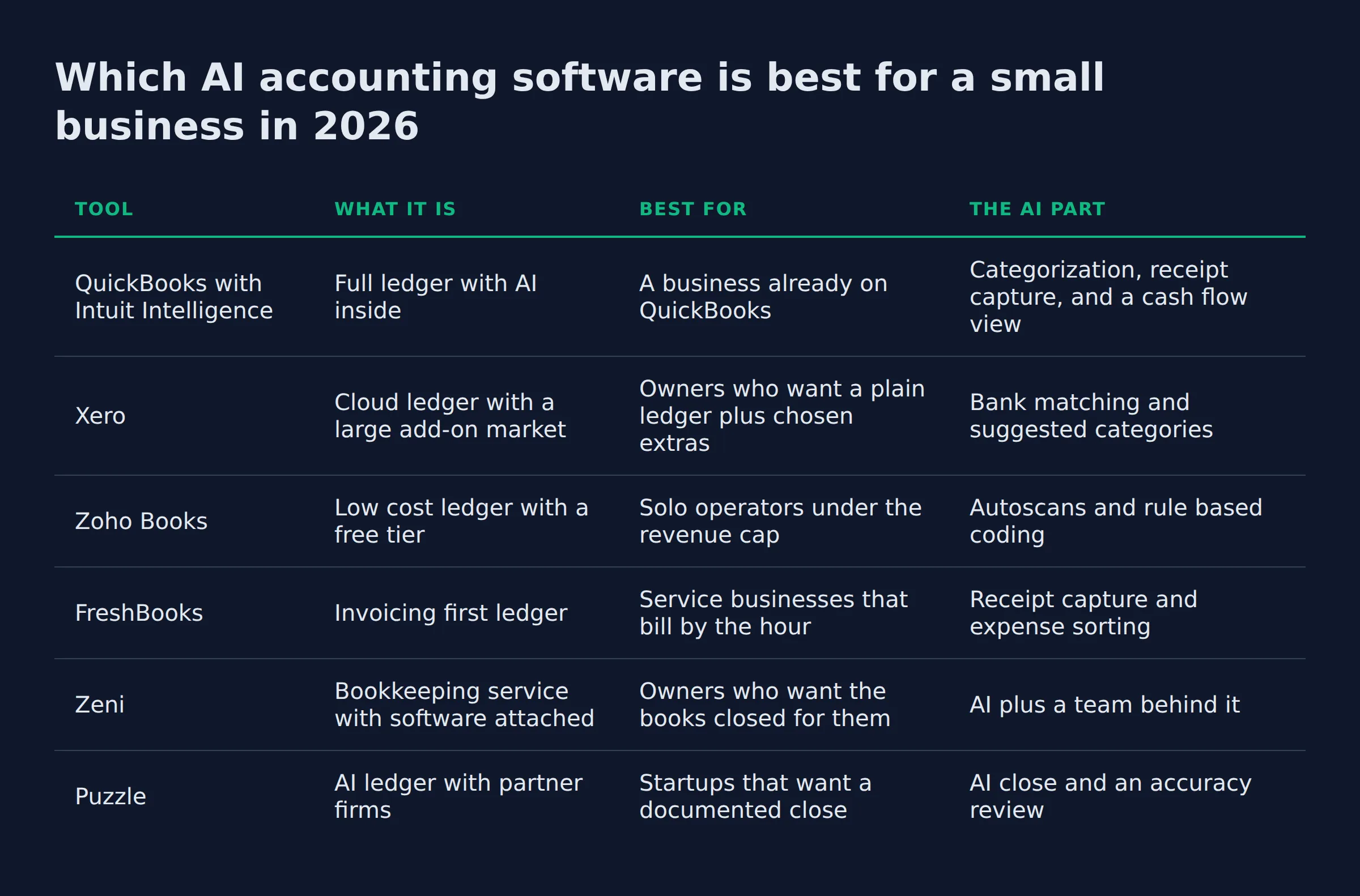
Which AI accounting software is best for a small business in 2026?
The best tool is the one that connects to the system you already run. For most small businesses that is QuickBooks, Xero, or Zoho Books. Pick the ledger first, then add a specialist for the task that still eats your week.
All three pages that rank for this phrase list tools for a company with a finance team. Here is the shortlist for a business with fewer than 10 people.
| Tool | What it is | Best for | The AI part |
|---|---|---|---|
QuickBooks with Intuit Intelligence |
Full ledger with AI inside | A business already on QuickBooks | Categorization, receipt capture, and a cash flow view |
Xero |
Cloud ledger with a large add-on market | Owners who want a plain ledger plus chosen extras | Bank matching and suggested categories |
Zoho Books |
Low cost ledger with a free tier | Solo operators under the revenue cap | Autoscans and rule based coding |
FreshBooks |
Invoicing first ledger | Service businesses that bill by the hour | Receipt capture and expense sorting |
Zeni |
Bookkeeping service with software attached | Owners who want the books closed for them | AI plus a team behind it |
Puzzle |
AI ledger with partner firms | Startups that want a documented close | AI close and an accuracy review |
The service lane runs next to the software lane. Zeni, Digits, Pilot, and Basis sell finished books with the tool underneath. Botkeeper, Docyt, and Bookeeping.ai work the same way at a smaller scale.
The specialist end covers one job each. Vic.ai and BILL handle accounts payable, Dext captures documents, Trullion works revenue, and Ramp covers spend and 1099 filing.
Integrations decide more than features do. The bank feed usually arrives through Plaid, and card sales arrive through Stripe or Square. Store revenue comes from Shopify, payroll from Gusto, and spend from Mercury, Brex, or Ramp. An integration list missing one of those connectors is a tool that will not run your business.
Sage Intacct and Microsoft Copilot appear on the enterprise lists, which tells you the feature set has climbed. ChatGPT gets used as a general assistant rather than a ledger. The practice tools sell to accountants rather than owners: Netgain, TaxDome, Scribe, and Gridlex. The niche end runs from Trullion and DualEntry for bill pay to Blue Dot.
For an owner, the choice usually comes down to 2 lanes. Lane one is an AI assistant for a small business that plugs into the ledger you already run. Lane two is a service that finishes the books for you.
If your business runs crews, add one more pass: job costing. Splitting a supply run across 3 jobs is a judgment call software will not make. Most owners end up reviewing those lines by hand.
Here is the 30 minute test I would run before paying for any of them.
- Minutes 1 to 10: connect the bank feed and read the first 50 lines. Count how many arrive with a category already chosen.
- Minutes 10 to 20: open last month’s uncategorized list. If it runs past a page, the account list is the project.
- Minutes 20 to 30: feed it 3 awkward lines, an owner draw, a split transaction, and a duplicate vendor. Anything it calls with confidence and gets wrong is the review work you just bought.
Pick the ledger you can connect, then test it on your own 50 lines before you pay.
What a month of AI bookkeeping really costs
Software runs from free to about $120 per month for a small team. Service tiers start near $549 per month. The backlog you bring with you usually costs more than the license.
| Option | List price | What the vendor page notes |
|---|---|---|
| Zoho Books | Free while under the cap | Free plan holds while annual revenue stays under $50K |
| Xero US | $27, $59, $97 per month | Regular prices, after the intro discount ends |
| FreshBooks | $23, $43, $70 per month | Lite, Plus, and Premium list prices |
| Ramp | $0 per user per month | Plus is $15 per user, with $0.65 per IRS filing |
| Puzzle | $30, $72, $120 per month | $149 one time migration, plus catch-up work |
| Zeni | From $549 per month | Setup fee applies, quote follows complexity |
Xero lists $27, $59, and $97 per month once the intro discount ends (Xero US pricing). FreshBooks lists $23, $43, and $70 for Lite, Plus, and Premium (FreshBooks pricing).
Zoho Books stays free while annual revenue is under $50K, with extra users at $3 each per month (Zoho Books pricing). Ramp starts at $0 per user, with a $15 tier and $0.65 per IRS filing (Ramp pricing).
Puzzle prices software at $30, $72, and $120 per month. A migration costs $149, and catch-up bookkeeping starts at $300 for each month of books you never closed (Puzzle pricing). Zeni quotes bookkeeping from $549 per month with a setup fee (Zeni pricing).
QuickBooks is the one I could not price. Its pricing page timed out twice when I checked, and its tiers move with promotions, so this page prints only the numbers I could load.
The subscription is the small number. Puzzle prices 11 months of backlog at $3,300 on its own catch-up line, and that bill arrives before the software proves anything. Add the hours your team spends on the exception queue each month.
The subscription is the cheap part of the switch. The backlog and the review hours are the real cost.
Does AI accounting software replace my bookkeeper or my CPA?
It replaces the typing, not the sign off. Categorization and reconciliation move to the software, so a bookkeeper’s day shifts to the exception queue. Your CPA keeps the tax position, the filing, and the signature that carries the liability.
Licensure is the wall. A model cannot hold a license, so it cannot take the responsibility that comes with the signature. That holds for a general AI virtual assistant as much as for a bookkeeping tool.
Financial work runs on documented review. The AICPA audit and assurance resources include published guidance on how auditors should handle AI in financial reporting.
The record rules stay with the owner. The IRS asks you to prove the income and deductions on a return. It also wants employment tax records kept for at least 4 years, per the IRS recordkeeping guidance.
The SBA assigns that work to the owner rather than to the tool. Its guide covers the choice between cash and accrual accounting, and it notes that private companies are not required to follow GAAP, per the SBA business finances guide.
Filing a 1099-NEC and deciding sales tax nexus stay closest to the owner. Tools help with the forms: Ramp lists $0.65 per IRS filing and free state filing (Ramp pricing). The nexus call is a research task, and it depends on where you have customers, staff, or stock.
The task level split has a longer version in whether AI will replace accountants, including the two official job forecasts.
Software takes the entry. The signature stays with the person who holds the license.
Telling real AI from plain automation before you switch
Real AI handles lines nobody wrote a rule for, and it reports how sure it is. Ask for a confidence score per line, a threshold you can set, and an audit trail you can export. Those three answers separate a model from a script.
Agentic AI is the word vendors use for software that picks its own next step. NIST publishes voluntary guidelines on trustworthy AI and tracks work on agentic systems, per NIST artificial intelligence.
Three questions do the sorting before you pay.
- Does it show a confidence score for every line, and can you set the threshold?
- Can you export the full audit trail back to your ledger?
- When it is unsure, does it ask, or does it guess and move on?
I hold my own agents to those questions. The pipeline that wrote this page runs research, planning, writing, and review as separate steps. A draft does not ship until the review stage passes it. When a draft fails, the review stage prints a fix list, and the fix list is the part I trust.
I also build the first version of a prospect’s site before they pay me anything. The fastest honest test of a build is to run it on real work, which is why the connect test matters more than the demo video.
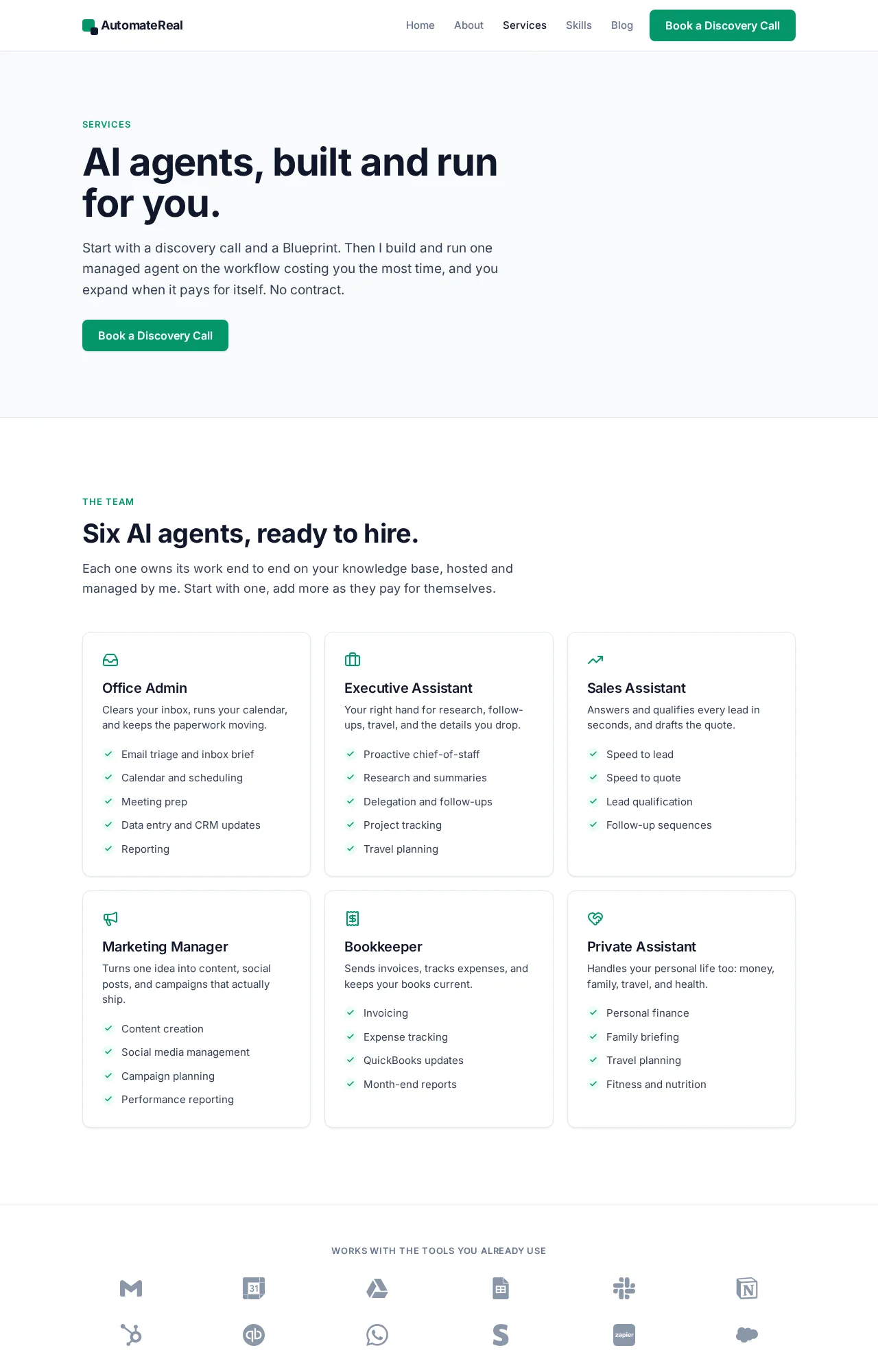
The AutomateReal services page
One more check on the vendor. Ask who reviews the output on a normal Tuesday. If the answer is nobody, the exception queue grows until it becomes somebody’s job.
Ask what happens when a line does not fit a rule. That answer tells you whether you are buying a model or a script.
FAQ
Can AI accounting software connect to the system I already use?
Yes, through an integration list or an API. QuickBooks, Xero, Zoho Books, and FreshBooks publish connector lists, and a free trial shows you the real list. Check your bank feed, your card processor, and your payroll provider first. One missing connector breaks the route.
Is there a free AI accounting software option?
Yes. Zoho Books stays free while annual revenue is under $50K (Zoho Books pricing). Its free plan caps invoices, expenses, and users rather than the calendar. Read the cap before you commit, because the cap is what ends free.
What is an AI bookkeeper, and is it the same as AI accounting software?
No. An AI bookkeeper is a service that combines software with people and delivers closed books. The software on its own is a tool you still operate. Zeni, Digits, Pilot, and Basis sell the service model.
When does switching to AI accounting software make no sense?
It makes no sense in three cases. The first is a cash business with a few dozen transactions a month. The second is an owner who cannot name the person reviewing the exceptions. The third is a business in the middle of an audit, or one with a messy year still to close. In all three, fix the account list and finish the open year before you shop.
Do I still need a human accountant if I use AI accounting software?
Yes, for anything with a signature on it. Software can draft a return and propose a position on a gray transaction. Filing, liability, and the tax call stay with a licensed person, which is where the CPA fee earns its place.
Start with the account list
One workflow, one clean ledger, one person on the exceptions. That is the whole move, and the software is the last piece of it. Run a free trial on your own 50 lines, and read the exception queue every week.
A build on the AI services page covers the workflow, the rules, and the approval gate that stops a wrong entry before it reaches your books. If you would rather run it yourself, all of my skills are bundled for $99 at the skills page.
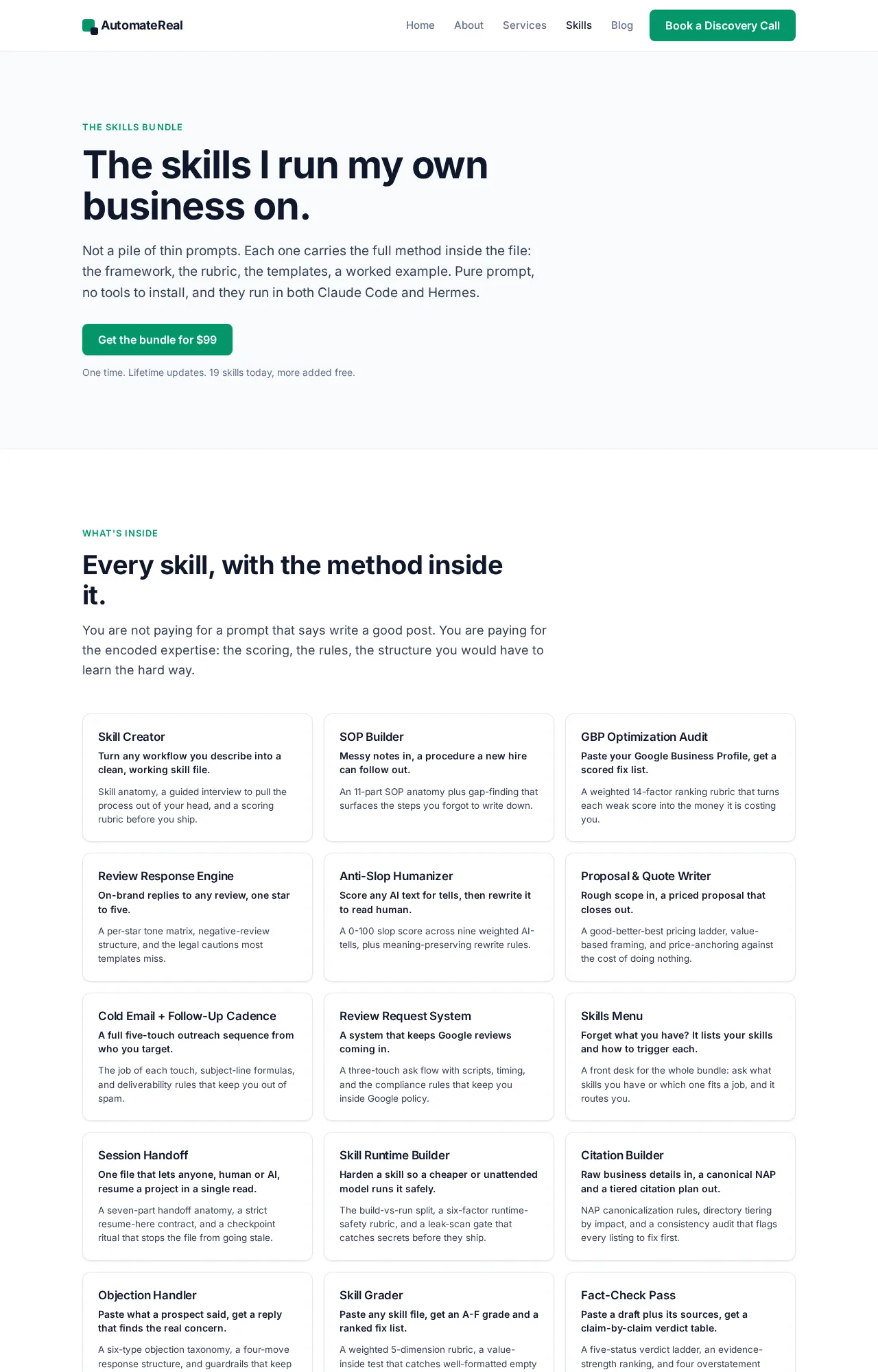
The AutomateReal skills page
If you want help picking that first workflow, a discovery call maps it in about thirty minutes.