Will AI Replace Accountants? What the Job Data Says
AI already categorizes, reconciles, and prepares most individual returns. What the official job data says about accounting work, and what stays human.
The question arrives with a deadline attached. Software reads the receipts, sorts the transactions, and drafts the return. If that is the job, the job is gone. If that is only the typing around the job, the job survives.
Most pages that answer it are written by a company selling accounting software or a school selling a course. This one holds the two official job numbers side by side, then covers what the demos skip: the lines the software gets wrong, and the person who catches them.
Will AI replace accountants? No, not the job, but yes to a large slice of the work. AI already categorizes transactions, reconciles accounts, and prepares most of an individual return. What stays human is judgment, accountability, the client relationship, and the signature on the filing. The roles that shrink first are clerks and entry level preparers.
TL;DR
- The US Bureau of Labor Statistics projects 5 percent growth for accountants and auditors through 2035, with about 115,300 openings a year (per the government projection).
- The World Economic Forum lists accountants and auditors among the fastest-declining roles to 2030 (per the jobs outlook).
- The two numbers do not cancel each other. One counts jobs, and the other counts tasks and employer intent.
- Software handles the data entry, the reconciliation, and most individual return prep. The signature stays with a licensed person.
Why does everyone think AI will replace accountants?
The visible half of the job is the automatable half. Data entry, document sorting, and reconciliation demo well and sell easily. Judgment and accountability are invisible in a demo, so nobody markets them.
Watch any product tour for an accounting agent. It reads a bank feed, matches the receipts, and produces a tidy ledger. That demo runs on the part of the job a client can watch being done.
For the full picture, see AI Accounting Software.
The adoption numbers feed the same story. Intuit commissioned a survey of 707 US accountants and bookkeepers, and 98 percent said they used AI with clients in the past 12 months, per the QuickBooks accountant survey. Intuit runs the page we are competing with and prints the same figure there, which is worth saying out loud.
Headlines finish the job. A return that assembles in minutes makes a better story than a rule about when to recognize revenue.
Fear follows the visible work, and the visible work is the part software does best.
What the demo never shows
Categorization quality follows the chart of accounts underneath, and that layer is years of habit rather than design. Real books are messier than the clean data in a product demo, and half the account names mean something only to the person who set them up.
No model fixes an account list that mixes supplies with equipment. The order I would work in is plain. Clean the account list, then hand the work to software. The tool is the easy part of the project.
The chart of accounts decides whether automation works. The account list is the part to fix first, and it is the part no demo shows.
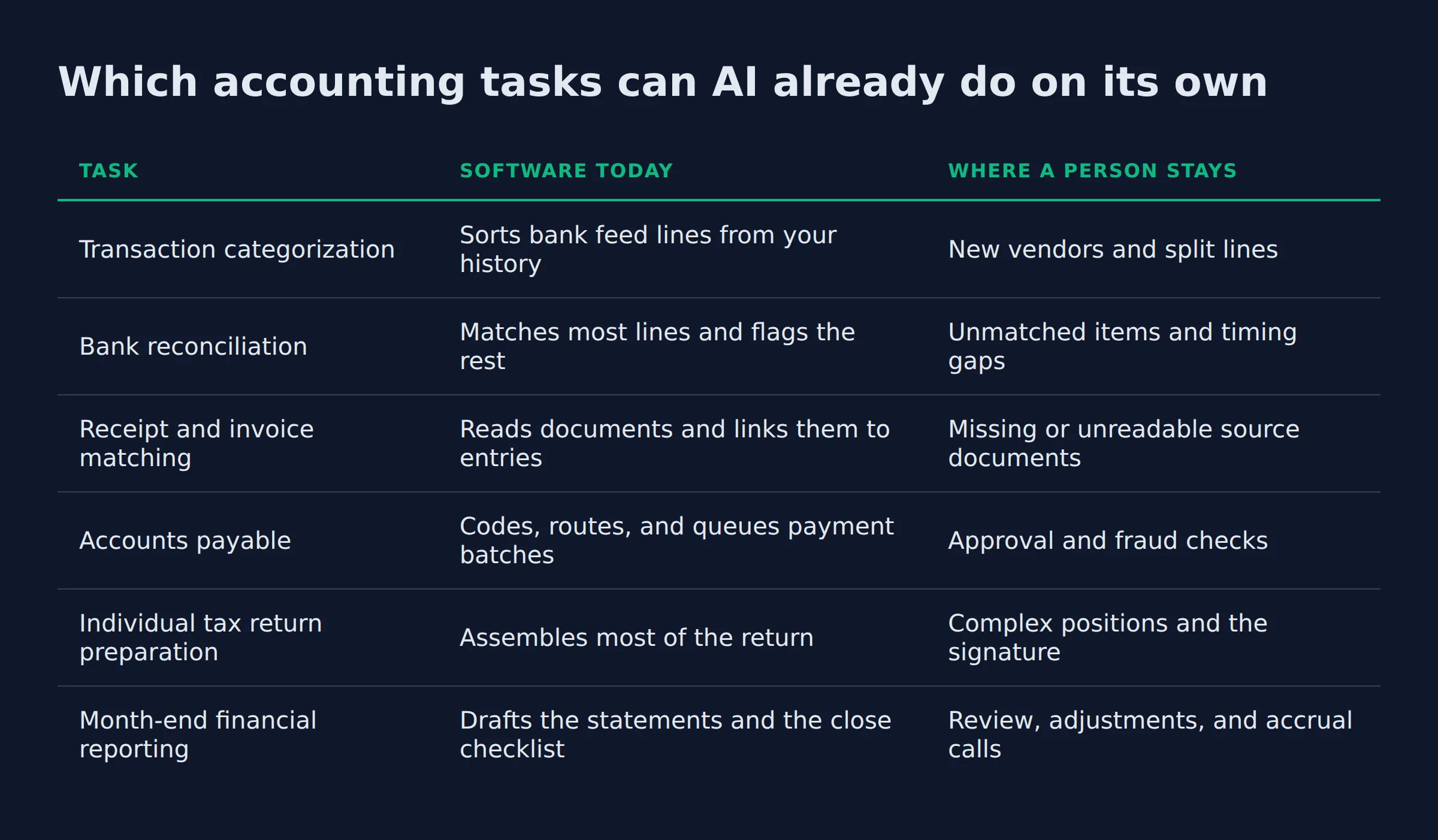
Which accounting tasks can AI already do on its own?
Software runs data entry, transaction categorization, receipt and invoice matching, and bank reconciliation today, in production rather than in a pilot. Add document review with optical character recognition. An AI accounting assistant sold inside a suite does the same work with less reach.
Under the hood this runs on machine learning and large language models, and natural language processing is what reads an invoice. Model Context Protocol is the connection layer an agent uses to reach the tools it acts through.
Every suite is shipping a version. The Big Four, Deloitte, PwC, KPMG, and Ernst and Young, build their own. Deloitte has DARTbot and PwC has Risk Link.
The suites a small firm already pays for ship the same features. Intuit Intelligence sits inside Intuit, and Xero, Sage, and Zoho Books follow.
The CPA.com 2025 AI in Accounting Report is the strongest document in this set, because the AICPA-affiliated publisher surveyed its own members. It reports that some firms automate over 80 percent of individual tax return preparation. Preparation time moves from hours to minutes, with a final human review, per the CPA.com report.
That report also carries Gartner’s forecast that 15 percent of daily accounting decisions will be made autonomously by AI agents by 2028. Read that as a direction rather than a measured result.
The field evidence points the same way. In a study of 79 small and midsize firms covering 277 accountants, generative AI tools shifted time off routine work. The month-end close ran around two weeks, per a field study of 79 firms. Firms without it took more than a week longer.
The paper behind that study comes from Chloe Xie at MIT Sloan and Jung Ho Choi at Stanford.
The same survey found that 62 percent of the accountants worried about errors and accuracy in AI-generated reporting. Adoption is wide at the same time. Data entry and processing led the use cases at 69 percent in the QuickBooks survey.
| Task | Software today | Where a person stays |
|---|---|---|
| Transaction categorization | Sorts bank feed lines from your history | New vendors and split lines |
| Bank reconciliation | Matches most lines and flags the rest | Unmatched items and timing gaps |
| Receipt and invoice matching | Reads documents and links them to entries | Missing or unreadable source documents |
| Accounts payable | Codes, routes, and queues payment batches | Approval and fraud checks |
| Individual tax return preparation | Assembles most of the return | Complex positions and the signature |
| Month-end financial reporting | Drafts the statements and the close checklist | Review, adjustments, and accrual calls |
The day to day job of these tools inside a firm is mapped in AI agents for accounting firms, along with what they cost.
Every task that moved had a document behind it and a rule that could be written down.
What does the official jobs data actually say?
Two official sources disagree, and both are worth quoting. The US Bureau of Labor Statistics projects 5 percent growth for accountants and auditors from 2025 to 2035, with about 115,300 openings a year. The World Economic Forum lists the same occupation among the fastest-declining roles to 2030.
The bureau’s number is an employment projection, and it runs against the fear. It puts the occupation ahead of the average for all jobs. The 2025 median pay is $83,680, per the government’s own projection.
The forum’s number counts something else. Employers were asked what they expect by 2030, and they named accountants and auditors among the shrinking roles. This is a survey of intent, not a headcount, per the Future of Jobs outlook.
One more thing about the bureau’s figure. The vendor page that ranks first for this question leans on the previous edition, about 124,200 openings a year through 2034. The current edition says about 115,300 over 2025 to 2035, so that page is one edition out of date on the number it builds its reassurance on.
There is no published count of accounting jobs that AI has eliminated so far. Job displacement numbers do not exist in any official series, so this page does not print a figure.
| Source | What it counts | Its number | What it does not say |
|---|---|---|---|
| US Bureau of Labor Statistics | Projected employment for the occupation | 5 percent growth, about 115,300 openings a year | Anything about tools or tasks |
| World Economic Forum | Employer expectations to 2030 | Accountants and auditors among the fastest-declining roles | Not a count of jobs lost |
A projection of jobs and a survey of employer intent are different instruments. Firms feel the second one first.
Which parts of the job can AI not take?
Judgment, accountability, and the client relationship stay human. Software can propose a position on a gray transaction. It cannot sign the filing, carry the liability, or sit with a client and defend the call. Licensure is the wall.
Practice before the IRS runs on Circular 230, and those rights attach to a licensed person. A CPA license brings state ethics rules and AICPA professional standards along with it, and the work carries ethical and regulatory duties that a piece of software cannot hold. A model has no license to lose, so the signature stays where the liability sits.
The accounting layer underneath matters just as much. The chart of accounts, the accrual or cash basis choice, and GAAP where it applies are all set by a person. Software applies those decisions well and invents them badly.
Agentic AI changes who picks the next step. It does not move the name on the statements, and every entry still needs an audit trail back to a source document.
Profit and loss, balance sheet, and cash flow each end the month with a person accountable for them. That accountability is the part a client pays for.
The software can take the position. It cannot take the responsibility, and clients pay for the second one.
The exception queue is the part vendors never demo
Every run hands back a short list of lines it cannot call. Watch for owner draws and personal spend on a business card. Add split transactions and duplicate vendors under slightly different names. Then add accruals the bank feed never shows, the adjustments that need a journal entry, and sales tax edge cases.
The 62 percent accuracy worry from the field study lands here. These lines are where the review time goes, and they are the reason a person stays in the loop.
I run a production agent that reads long bid documents and pulls the fields out of them. It removes duplicate rows and routes one record per job into a team chat. Nobody touches it during the day.
Two things went wrong in week one. It let a duplicate row through, and it aimed a link at a directory page instead of the posting a person could apply through. Inside my own operation that was noise.
In front of a client it would have been a real problem. The fix was an approval gate plus 1 check. Does this row match exactly 1 job, and does this link open the live posting?
A confidence score does the sorting. A high score goes straight through, and a low score waits for a person. That is the human in the loop control the NIST AI Risk Management Framework asks for, and it is the same review a CPA already runs on a junior’s work.
My own lead intake runs on that rule. Around 200 form submissions a day arrive without anyone typing them, and a person handles the exceptions. Rules decide the easy rows, and the hard ones reach a human.
The review gate is the product. A confidence score decides which lines reach a person, and which ones the software closes alone.
Do clerks and entry level accountants go first?
The honest measure is task exposure. Clerk work and entry level prep carry the highest share of tasks software already runs. Those seats shrink first, and the first year of an accounting career changes shape.
The forum’s clerical list is the tell. It puts administrative assistants and other clerical roles at the top of the same declining group, per that outlook. Accountants and auditors sit on the same list, further down.
Rank the roles by how much of the day is a written rule.
| Role | Exposure to software | Why |
|---|---|---|
| Accounting clerk | Highest | Rules, forms, and repetition with a document behind each one |
| Payroll clerk | Highest | Mostly a schedule and a checklist |
| Entry level staff accountant | High | Learns on the work that moved first |
| Bookkeeper | High, uneven | Categorization and reconciliation, with exceptions left over |
| Senior accountant | Moderate | Judgment and client calls fill more of the day |
| Controller | Low | Owns the close policy and signs off on it |
| CPA and firm owner | Lowest | License, liability, and the client relationship |
A tax preparer’s season carries the highest volume, and routine returns are the first thing the software takes. A CFO keeps the policy, the forecast, and the banker relationship.
The awkward part is the training ladder. Entry level work is where people learn the shape of a clean general ledger, and that is the work that moved first. Firms that handle it well rotate juniors onto the exception queue early, where the judgment lives.
The work that grows is advisory. Clients want answers in real time, and a person explains what the numbers mean. Upskilling runs alongside it, because reading exceptions is a different skill from typing entries.
Read the exposure column as task counts. The seat that only typed is the seat that shrinks.
What should a small firm actually do this year?
Sort every recurring task into 3 buckets. Software candidates leave a document behind and follow a written rule. Judgment calls need a person. A filing or a signature needs a licensed person. Run the software on the first bucket only.
Here is the 90 day sequence I would run.
- Days 1 to 30: pick 1 recurring workflow and fix the chart of accounts behind it first.
- Days 31 to 60: run the software on that workflow with a review gate, and log every correction.
- Days 61 to 90: write the corrections that came back twice into rules, and route the rest to a person for good.
Anything you correct by hand twice is a rule you have not written down yet. That written rule is how a demo turns into capacity.
The trade press already carries the case studies. Four practices with fewer than 10 employees use AI to expand capacity and research faster. They also use it to talk with clients, per how small firms actually deploy it. None of those firms hired an AI team to get there.
The build, buy, or manage decision is covered in AI agents for small business.
Correct the same entry twice and you have found a missing rule. Write the rule, and the software stops needing you on that task.
How do you run this work without adding headcount?
Wire 1 workflow, keep a person on the approval gate, and volume grows without a new seat. What stays with the firm is the review, the exception list, and the client conversation.
One workflow runs end to end with a review step, and volume that used to need a hire moves through software. That is the work on the AI services page. A build there covers the workflow, the rules, and the approval gate. That gate stops a wrong entry before it reaches a client.
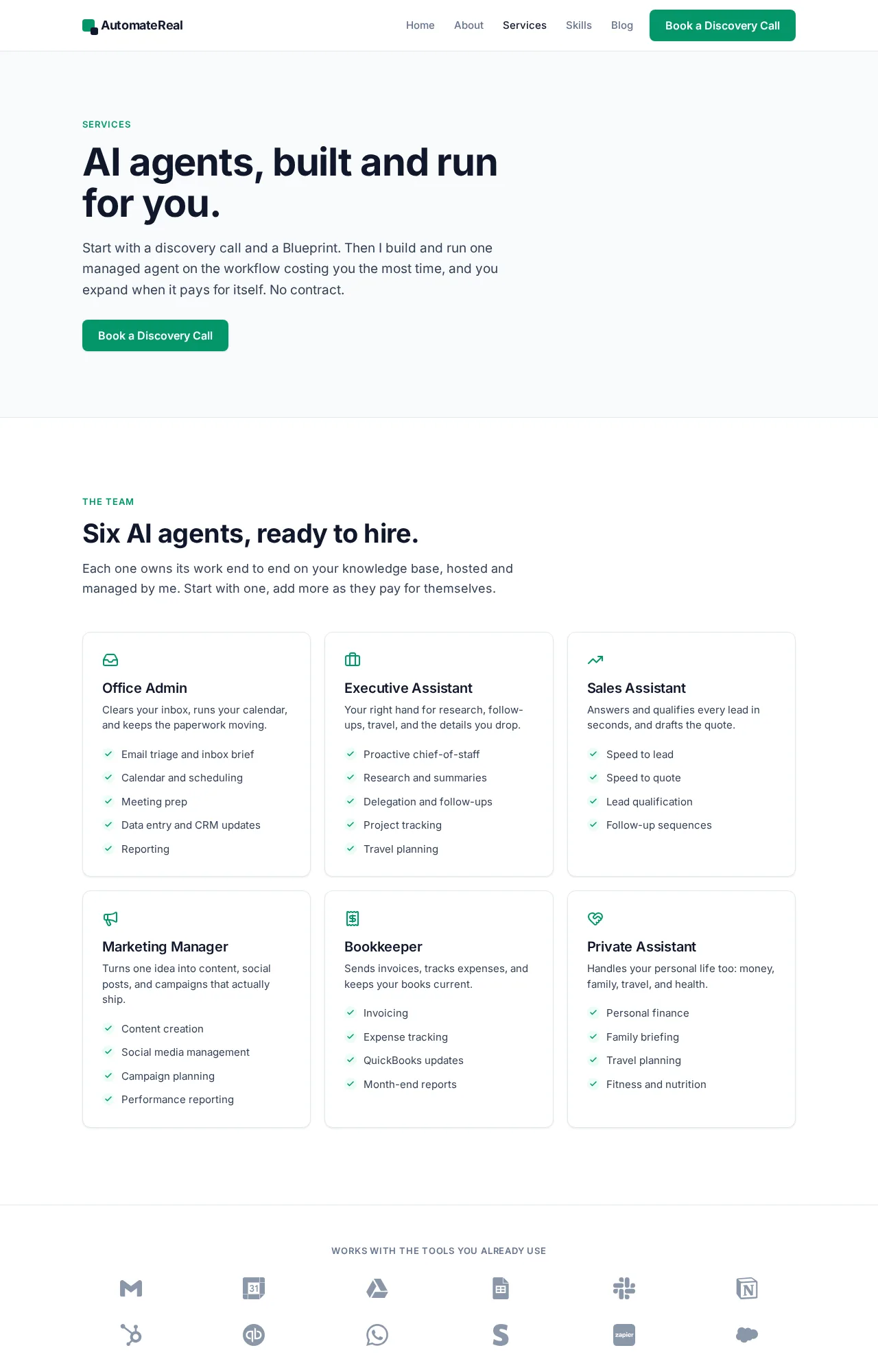
The AutomateReal services page.
If you would rather run it yourself, all of my skills are bundled for $99 at the skills page, which is the do it yourself end of the same setup.
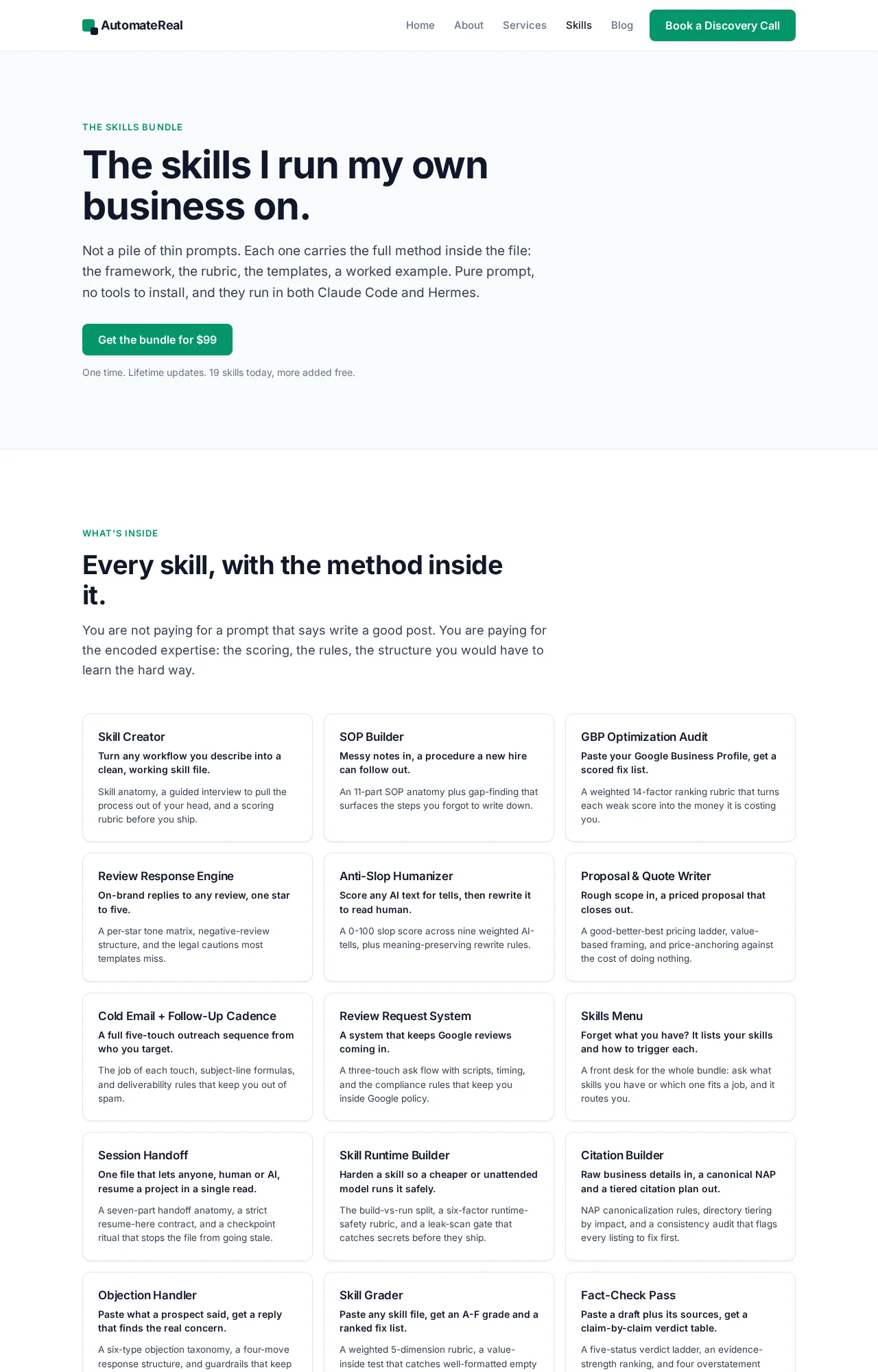
The AutomateReal skills page.
I have not installed agents inside an accounting firm, and I say that plainly. What I run is my own operation, where intake and follow up finish without me.
I will not print a per month model cost for someone else’s books, because I have not run a ledger end to end. Hours saved is the number I can stand behind.
Vendor pages describe what the software can do and stop there. The question that decides the purchase is who reviews the output on a busy Tuesday. That answer has to be a named person inside the firm.
One wired workflow with a review gate beats a toolbox. Start with the task you fix twice a week.
If you want help finding that first workflow, a free discovery call maps it in about thirty minutes.
FAQ
Which accounting tasks are most vulnerable to AI, and which are not?
Data entry, transaction categorization, bank reconciliation, invoice processing, and routine individual return prep moved first. Payroll, sales tax across states, accruals, and any call that needs judgment or a signature stay with a person.
Will AI affect entry level accounting roles and career paths?
Yes. Entry level work holds the highest share of tasks software runs, so those seats shrink and the first year changes. The people who move up fastest learn the review side early, where the exceptions land.
Can AI prepare and file my tax return on its own?
Prepare, largely yes. File, no. Some firms automate over 80 percent of individual return preparation, per the CPA.com 2025 AI in Accounting Report, and a person reviews and signs before anything reaches the IRS.
Is it safe to let AI software categorize and reconcile my books?
With a review gate, yes. Ask for the SOC 2 report that covers the vendor’s data security, and the retention window. Keep write access limited, and read the exception queue every week. The software proposes entries, and a person signs them.
What should an accountant do to stay relevant, and does a small firm need to hire an AI person?
Learn the review side and own the exceptions. A firm under 10 people rarely needs a dedicated AI hire. The Journal of Accountancy case studies show small practices running this with the staff they already have.