Best AI Receptionist for Small Business (2026 Prices)
Five AI receptionists, real October 2026 prices: plan, included calls, overage rate, contract term, and which one fits a small service business.
The phone rings while your hands are full. The caller waits, hits a voicemail box, and dials the next name on the list.
I build AI systems for a living, and I do not sell a receptionist, so nobody here gets ranked first because they paid me. Every price below comes off the vendor’s own page, read on 25 October 2026, with the date printed next to it.
The best AI receptionist for most small service businesses is Goodcall at $79 a month for 100 unique callers. The bill does not move with talk time. Dialzara gives you the most control from $29 a month. Smith.ai adds live human backup from $300 a month. Ruby stays the human baseline at $250 for 50 minutes.
On 25 October 2026 I read the top results for this phrase. Six of the 8 pages were published by a company that sells the receptionist it ranked. Every one of those put itself first. None of them turned a price into cost per answered call, which is the only number that decides your bill.
TL;DR
- The meter sets the bill. The same 300 calls cost $129 on Goodcall Growth, $500 on Smith.ai’s AI-first tier, and $2,100 when a person answers every call.
- Dialzara’s cheapest fit for that same month is $349, because minutes are its meter.
- Smith.ai is the only vendor here that sells an AI and a person on one ladder, with human-first starting at $300 for 30 calls.
- The cheapest paid flat price is Marblism at $24 a month on the yearly option. Smith.ai also prints a $0 tier for 25 calls.
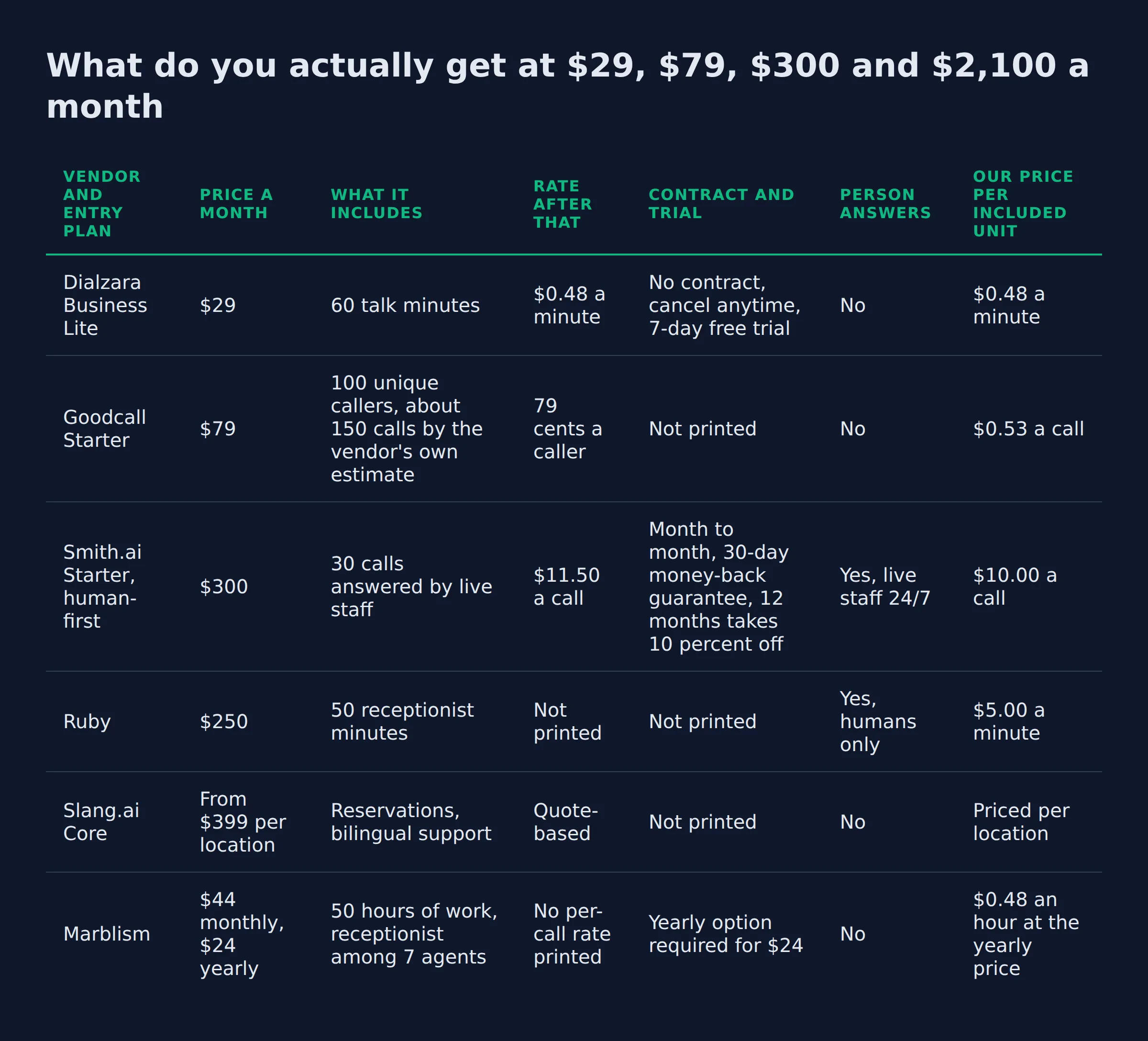
What do you actually get at $29, $79, $300 and $2,100 a month?
$29 buys 60 talk minutes on Dialzara. $79 buys 100 unique callers on Goodcall. $300 buys 30 calls answered by people on Smith.ai, and $2,100 buys 300 of the same. The sticker hides the unit, and the unit decides your busy month.
Those 4 prices sit on 4 different meters, so they are not comparable as numbers. Divide each by what it includes and the gap turns into something you can check in a minute.
Half these vendors describe the same product as an ai answering service for small business. Their pages also put the ai agent cost for small business anywhere from $24 a month to $2,100 a month. That is a wide spread for what sounds like the same phone line.
The table below uses each vendor’s entry plan, so the comparison starts at the cheapest thing you can buy.
| Vendor and entry plan | Price a month | What it includes | Rate after that | Contract and trial | Person answers | Our price per included unit |
|---|---|---|---|---|---|---|
| Dialzara Business Lite | $29 | 60 talk minutes | $0.48 a minute | No contract, cancel anytime, 7-day free trial | No | $0.48 a minute |
| Goodcall Starter | $79 | 100 unique callers, about 150 calls by the vendor’s own estimate | 79 cents a caller | Not printed | No | $0.53 a call |
| Smith.ai Starter, human-first | $300 | 30 calls answered by live staff | $11.50 a call | Month to month, 30-day money-back guarantee, 12 months takes 10 percent off | Yes, live staff 24/7 | $10.00 a call |
| Ruby | $250 | 50 receptionist minutes | Not printed | Not printed | Yes, humans only | $5.00 a minute |
| Slang.ai Core | From $399 per location | Reservations, bilingual support | Quote-based | Not printed | No | Priced per location |
| Marblism | $44 monthly, $24 yearly | 50 hours of work, receptionist among 7 agents | No per-call rate printed | Yearly option required for $24 | No | $0.48 an hour at the yearly price |
Prices read from the vendors’ own pricing pages on 25 October 2026. The last column is our arithmetic, not the vendor’s. The “not printed” cells mean the page says nothing, not that the rate is zero.
Smith.ai runs a second ladder on a separate page. Its AI-first plans are Free at $0 for 25 calls, Pro at $150 for 75 calls and Enterprise at $500 for 300 (Smith.ai AI-first pricing).
The $300 row above is the human-first ladder, where staff answer (Smith.ai human-first pricing). Same company, same 300 calls, and the difference is $500 against $2,100 depending on which mode answers.
Goodcall
- Best for: a solo owner with one line and a steady call count, where a surprise invoice is the main fear.
- Price: $79 a month for 100 unique callers, which the vendor estimates at about 150 calls (Goodcall call pricing).
- What it includes:
- A demo agent built from your own site.
- No per-minute charge, which the page states as “no per-minute charges”.
- Overage: 79 cents for each extra caller.
- Term: the page prints no contract length. On the trial it answers “Is there a free trial? Better: a free demo agent” (Goodcall call pricing). Get the contract length in writing before you pay.
- The differentiator: a 9-minute call costs the same as a 2-minute one, because minutes never enter the bill.
- The weakness: you are buying headroom in people. A campaign that brings 150 new callers costs $39.50 over the plan in overage, on our arithmetic.
Dialzara
- Best for: an owner who wants to edit the script without opening a ticket, and whose calls run short.
- Price: Business Lite is $29 for 60 minutes, and the page is marked “Pricing as of 2026” (Dialzara pricing).
- What it includes:
- Talk minutes rather than calls.
- 3 tiers above Lite, at $99, $199 and $349.
- Third-party work through Zapier or Make.
- Overage: 48 cents a minute on Lite, dropping to 35 cents on Elite.
- Term: no contract, cancel anytime, 7-day free trial.
- The differentiator: the cheapest per-minute ladder in this set, and the most tiers to land on.
- The weakness: 60 minutes is about 20 calls at 3 minutes each, so $29 is a trial size rather than a month. Dialzara also prints a done-for-you service from $1,500 a month, quoted.
Smith.ai
- Best for: a business where a person must answer, and one booked call is worth more than $10.
- Price: Starter is $300 for 30 calls on the human-first ladder, where live staff answer (Smith.ai human-first pricing).
- What it includes:
- Live staff around the clock, free on every plan.
- Your existing number ported at no charge.
- Lead qualification built from your own questions.
- Booking into Calendly, Acuity or Appointy at $1.50 a call.
- Overage: $11.50 a call on Starter, $10.50 on Basic, $8.50 on Pro.
- Term: month to month, with a 30-day money-back guarantee. A 12-month commitment takes 10 percent off.
- The differentiator: the escalation path is staffed by people, so a strange call has somewhere to go.
- The weakness: at $10 a call, a 300-call month is $2,100. That is more than 26 hours a week at the median receptionist wage, before you count what else a receptionist does.
Ruby
- Best for: an owner who wants a human voice and whose calls are short.
- Price: $250 for 50 minutes a month, $395 for 100, $720 for 200, $1,725 for 500 (Ruby plan minutes).
- What it includes:
- Human receptionists on every plan.
- Chat plans from $143 for 10 chats, if the website needs covering too.
- Overage: not printed on the page we read.
- Term: not printed.
- The differentiator: every minute is a person, with no AI layer to argue with.
- The weakness: 50 minutes is about 17 calls at 3 minutes each. That is a light week, not a month, for $250.
Slang.ai
- Best for: a restaurant taking reservations over the phone, in 2 languages or 97.
- Price: Core from $399 per location, Premium from $599 per location (Slang.ai pricing).
- What it includes: reservation handling, with bilingual support in Core and 97 languages in Premium.
- Overage and term: quote-based, so nothing to print.
- The differentiator: the page names one job, the restaurant reservation, and the entry plan already carries bilingual support.
- The weakness: the price is per location. Three sites start at $1,197 a month, and no plan here includes a human.
Marblism
- Best for: an owner who wants the lowest paid entry price and can work inside a bundle.
- Price: $44 a month monthly, or $24 a month on the yearly option (Marblism pricing).
- What it includes: 50 hours of work a month, with a receptionist agent among 7 AI employees.
- Overage: no per-call rate printed. 50 hours covers about 1,000 calls at 3 minutes each, on our arithmetic.
- The differentiator: the cheapest paid entry into a working phone line this week.
- The weakness: the receptionist is one agent in a bundle, so nobody is tuning your phone line as a product.
The build you own, which is what we sell
- Best for: an owner who wants to keep the current number and stack, and have a person wire the call flow.
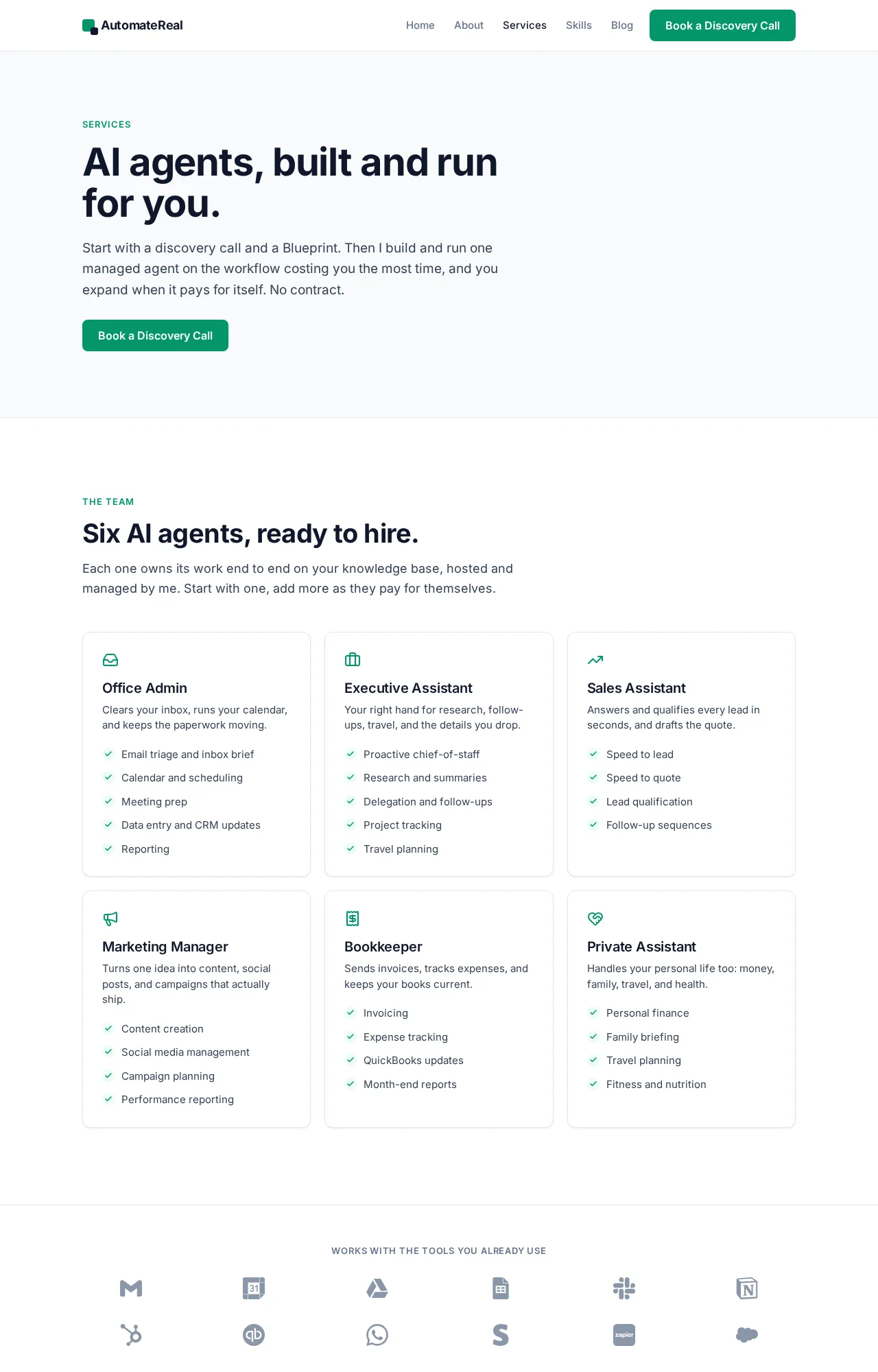
- Price: quoted after a scope call. The AI services page prints no price, and we will not invent one here.
- What it includes: one call workflow built for your call types, with the transfer rule, the fallback and the transcript destination written down.
- The weakness: it costs more than a $29 self-serve plan, and setup takes a conversation before anything answers the phone.
 AutomateReal services
Two vendors I could not price on 25 October 2026. Upfirst’s pricing page returned an empty body to us, and rosie.ai served a bot check instead of a price. Neither number appears anywhere on this page, because neither number was read that day.
How did we compare these AI receptionists?
I compared 4 things on the page you sign. The price per included unit and the meter after that volume decide the bill, and the exit terms and who answers decide the rest.
I have not run a receptionist line in production, so I score nothing on features I have not seen.
Every vendor here is an ai agent example for a small business, and each answers a phone rather than a form. Each criterion below is something a phone bill exposes, and you can check it before you pay.
- Price per included unit, not the sticker. $79 for 100 callers is 79 cents a caller. $300 for 30 calls is $10 a call. That division is our arithmetic, and it is the only fair comparison across 4 different meters.
- What the meter does after the included volume. A generous entry plan with a brutal overage rate is a trap. The rate matters more than the included volume in any month that goes well.
- The exit terms. Contract length, trial, and whether the number ports out with you. A cheap plan that holds your number hostage is expensive.
- Whether a person can pick up. This single feature decides what the plan is for. A plan with human backup is a staffing product. A plan without one is a filter.
I read each vendor’s pricing page myself on 25 October 2026, including both of Smith.ai’s ladders, and wrote down what each one printed. The blanks turned out to matter as much as the numbers. A vendor that will not print a contract term will not print it in the sales call either.
I run my own intake system at about 200 form submissions a day, and it taught me the rule this page rests on. The meter that looks generous in month one is the one that stings in month four. That is when a campaign doubles your volume and the plan was sized for last year.
If you want the wider version of that argument, it lives in AI agents for a small business.
Which AI receptionist is cheapest, and what does cheap cost you?
Smith.ai prints a $0 tier for 25 calls a month, the only free plan in this set. The cheapest paid flat price is Marblism at $24 on the yearly option. Dialzara’s $29 buys 60 minutes, so the cost past the included volume decides your year.
Here is every plan from those vendors, in one sheet, with the rate that applies the moment you pass the included volume.
| Vendor and plan | Price a month | Included volume | Rate after that | Our price per included unit |
|---|---|---|---|---|
| Dialzara Business Lite | $29 | 60 minutes | $0.48 a minute | $0.48 a minute |
| Dialzara Business Pro | $99 | 220 minutes | $0.45 a minute | $0.45 a minute |
| Dialzara Business Plus | $199 | 500 minutes | $0.40 a minute | $0.40 a minute |
| Dialzara Business Elite | $349 | 1,000 minutes | $0.35 a minute | $0.35 a minute |
| Goodcall Starter | $79 | 100 unique callers, about 150 calls | 79 cents a caller | $0.53 a call |
| Goodcall Growth | $129 | 500 unique callers, about 750 calls | 26 cents a caller | $0.17 a call |
| Goodcall Scale | $299 | 2,000 unique callers, about 3,000 calls | 15 cents a caller | $0.10 a call |
| Smith.ai AI-first Free | $0 | 25 calls | $3.00 a call | $0.00 a call |
| Smith.ai AI-first Pro | $150 | 75 calls | $2.00 a call | $2.00 a call |
| Smith.ai AI-first Enterprise | $500 | 300 calls | $1.67 a call | $1.67 a call |
| Smith.ai human-first Starter | $300 | 30 calls | $11.50 a call | $10.00 a call |
| Smith.ai human-first Basic | $810 | 90 calls | $10.50 a call | $9.00 a call |
| Smith.ai human-first Pro | $2,100 | 300 calls | $8.50 a call | $7.00 a call |
| Ruby | $250 | 50 minutes | Not printed | $5.00 a minute |
| Ruby | $395 | 100 minutes | Not printed | $3.95 a minute |
| Ruby | $720 | 200 minutes | Not printed | $3.60 a minute |
| Ruby | $1,725 | 500 minutes | Not printed | $3.45 a minute |
| Slang.ai Core | From $399 per location | Reservations, bilingual | Quote-based | Priced per location |
| Slang.ai Premium | From $599 per location | Reservations, 97 languages | Quote-based | Priced per location |
| Marblism | $44 monthly, $24 yearly | 50 hours of work | No per-call rate printed | $0.48 an hour at the yearly price |
Plans as printed on 25 October 2026. Our arithmetic column divides the price by the included volume. Smith.ai’s AI-first ladder sits on a different page from its human-first ladder, so the tab you pick sets your rate.
Look at the Dialzara ladder first. The gap between $0.48 and $0.35 a minute is 27 percent, and it decides whether a plan fits. A 900-minute month on Pro bills $405 with overage. Elite covers the same month for $349.
The tier above can cost less than the overage on the tier below, and no pricing page says so.
Goodcall behaves the other way, because the meter is people. Starter at $79 covers about 150 calls. Growth at $129 covers about 750, which is 5 times the volume for $50 more. An owner who buys Starter and grows into 300 calls pays $158, which is $29 more than the plan built for that volume.
Smith.ai is the strange one, because the same company sells 2 ladders. At 300 calls its AI-first tier bills $500. At 300 calls with a person answering, the same company bills $2,100. That is a 4.2 times difference for the same volume, decided by one setting.
The free question comes up every time. Smith.ai’s AI-first page prints a Free tier at $0 a month for 25 calls, then $3.00 a call after that. It is the only free plan in this set. The other 5 vendors print no free tier. What they give away is the look: a 7-day trial at Dialzara, and a demo agent at Goodcall.
Which AI receptionist is best when a person has to answer the phone?
Smith.ai is the pick when a person must answer, because live staff sit on every plan from $300 for 30 calls. Ruby is the same idea sold as minutes, at $250 for 50. The gap is the price of certainty: $10 a call on Smith.ai against 53 cents on Goodcall.
That is the ai receptionist vs answering service split, and it is a staffing decision wearing a software label. An answering service with people on the line does not need your script to be perfect. It needs a person who can improvise.
The older version of this was an IVR, or phone tree, which routed a caller by keypad and hoped. An agent asks a question and routes on the answer, which is the same job with better questions.
Where it still fails is the warm transfer. Handing a caller and their context to a person at the same moment is harder than it sounds. A blind transfer drops them into a queue with no context, so they start over.
Smith.ai splits its pricing into 3 handling modes. AI-first puts its agent on the call at $2.00 a call. Human-first puts staff on the line at $10.00 a call. Hybrid sits between the two, and the rate changes with the tab you pick, so read the tab you are signing up for.
The rule to write down before you buy: a caller gets one handoff. It lands on a person, or on a voicemail box that a person checks inside 15 minutes. Every extra transfer is a chance to drop the call. The caller does not know the difference between a smart transfer and a broken one. They only know they told their story twice.
Ruby’s numbers make the trade visible. $250 for 50 minutes is $5 a minute. At 4 minutes a call, that is 12 calls a month.
For a business where the phone is the product, that budget line is small next to a lost $4,000 job. For a shop where most calls ask what time you close, it is silly money.
How does an AI receptionist compare with a $38,010 a year receptionist?
A receptionist at the median US wage costs $38,010 a year, or $18.27 an hour, before benefits. At 300 calls a month the same volume bills $129 on Goodcall Growth and $2,100 on Smith.ai human-first Pro, decided by the meter. The software is cheaper, and it answers only the phone.
The wage figure comes from the US Department of Labor’s O*NET summary for receptionists and information clerks, occupation 43-4171.00 (median receptionist wage). Divide it by 12 and the monthly cost is $3,167.50, on our arithmetic, before a single hour of benefits.
If you are still deciding whether you want an assistant at all, AI virtual assistant covers the definition and the human-versus-software call.
Here is what 300 calls a month of 3 minutes each actually bills, on every plan in this set.
| Plan chosen for a 300-call month | What the month bills | Why that number |
|---|---|---|
| Marblism | $24 or $44 | 15 of the 50 hours of work are used, so the volume fits one plan |
| Goodcall Growth | $129 | 500 callers covers the 200 unique callers behind 300 calls |
| Goodcall Starter | $158 | 100 callers included, 100 extra at 79 cents |
| Dialzara Business Elite | $349 | 1,000 minutes covers 900 talk minutes |
| Dialzara Business Pro | $405 | 220 minutes included, 680 extra at 45 cents |
| Smith.ai AI-first Enterprise | $500 | 300 calls included |
| Smith.ai AI-first Free | $825 | 25 calls included, 275 extra at $3.00 |
| Ruby, 500-minute plan | At least $1,725 | 900 minutes runs past the plan, and no overage rate is printed |
| Smith.ai human-first Pro | $2,100 | 300 calls included |
| Smith.ai human-first Starter | $3,405 | 30 calls included, 270 extra at $11.50 |
Our arithmetic from the vendor rates printed on 25 October 2026, at 3 minutes a call and Goodcall’s own 1.5 calls per caller ratio.
A human receptionist costs $3,167.50 a month and handles all 300 calls with judgment. That includes the mail, the walk-ins and the rep who wants to talk to the owner. The cheapest plan here handles the calls only. The expensive one costs more than the salary while handling less. That is the honest trade, and it is why the question is never “AI or human”.
The realistic answer for most owners is one of these agents plus the person you already have, with the agent taking after-hours and overflow. The savings come from the calls nobody was answering, not from a salary you cut on day one.
Which one fits your business?
Match the plan to the constraint that hurts most: the meter you can predict, the handoff you need, and the exit you can live with. Most small service businesses end up on a per-caller plan, and anyone who needs a person on the line pays by the call.
One line each, because the case picks the plan.
- Solo owner, one phone, price first: Goodcall Starter at $79 for 100 callers, since a long call does not move the bill.
- Team that wants to edit the script itself: Dialzara Pro at $99 for 220 minutes, and the 7-day trial to write the script first.
- A person must answer: Smith.ai Starter at $300 for 30 calls, or Ruby at $250 for 50 minutes if the calls are short.
- Restaurant taking reservations: Slang.ai Core from $399 per location, where the job is a booking and not a conversation.
- Cheapest paid flat price: Marblism at $24 a month on the yearly option, with the receptionist inside a 7-agent bundle.
- Cheapest way to test the category: Smith.ai’s AI-first Free tier at $0 for 25 calls. It costs nothing and shows how an agent sounds on your own line.
- Medical or dental office: none of the 6 vendors printed a business associate agreement on a pricing page. The BAA check comes before any recommendation here.
- A line you want built around your own call types: the AI services page covers that route, quoted after a scope call.
The vertical version gets asked constantly. For home services the deciding factor is after-hours overflow. For dental it is the BAA and the recall flow. For restaurants it is whether the agent can hold a reservation slot.
A business with a large Spanish-speaking customer base should check the Spanish line in writing. At Slang.ai, bilingual support sits in the entry plan rather than above it (Slang.ai pricing).
The best ai virtual receptionist for your trade handles your most common call. The best ai receptionist for small business is the one whose meter matches your call pattern. That is what the list above sorts on, and it is a different vendor in each of those 3 cases.
What do AI receptionists still get wrong?
The failures I would expect first are ordinary. An agent misses a name, mishears an address, or loses a caller in a transfer that lands in an unmonitored voicemail box. None of that shows up in a vendor demo, so test it before you port your number.
The intake systems I run break in boring ways. A form field gets renamed, the follow-up still fires, and it fires with a blank name for a week before anyone notices. A phone agent has the same exposure with worse manners, because the caller hears the mistake in real time.
The checks that matter, in the order I would run them:
- HIPAA and the business associate agreement. A BAA is a contract, not a feature. Ask for the signed document before a demo, and keep asking if the answer is a web page.
- SOC 2 Type II. Ask for the report, not the badge on the homepage. It tells you whether anyone outside the vendor has looked at how they hold call data.
- Recording and transcript handling. Who owns the transcript, how long it is kept, and whether you can export it when you leave. Get the answer in writing.
- TCPA and consent for outbound calls. If the plan dials out, the FCC holds that a call using an artificial or prerecorded voice falls under the TCPA. Callers using that technology must get prior express consent from the person called (the FCC ruling on AI-generated voice calls). Inbound answering is a separate question.
- 10DLC registration for text follow-up. If the agent texts a caller, ask whether the sending number is registered. An unregistered campaign gets filtered, and you will never see the failure.
- Number porting. Who owns the number, what the port costs, and what happens to it if you cancel. Smith.ai prints free porting, and the others print nothing.
- AI disclosure. Some callers can tell and some cannot, and the greeting is where you decide what they hear. Ask what the default script says.
That list is longer than any vendor’s feature page, and every item on it is a question. A vendor that answers all 7 in writing is a vendor worth a trial.
How do you test one before you pay?
Run 3 calls before you pay. Call from a noisy car and give a real address. Call again and talk over the greeting. Call a third time and ask for a person. Then read the transcript and count the handoffs. A demo that survives all 3 earns the trial.
The trial is where the decision gets made, whether you buy a plan or build an ai agent for a small business. Do it with your own phone and your own worst call, not the vendor’s demo line.
The flow around the call matters as much as the voice on it. Missed-call capture and voicemail transcription recover the calls nobody picked up. Appointment reminders and no-show follow-up protect the bookings the agent made. Both are parts a demo never shows, so ask which come with the plan and which cost extra.
The 3 numbers you need before any of this are on your last phone bill. Call volume for a month, average call length, and the share of calls that arrive after 5pm. Every plan on this page can be priced from those 3 numbers in about 10 minutes. No vendor will do it for you, because the answer sometimes beats their entry tier.
Then hold the trial to the invoice. Ask what the overage would have been on your real volume last month and get the number in writing. A 7-day trial on 60 minutes tells you how the agent sounds. It does not tell you what August costs.
If you want your own numbers run against these 6 plans, a discovery call does it in about thirty minutes. Bring the phone bill. I will tell you which plan beats it, including when the answer is the line you already have.
 AutomateReal skills
FAQ
Is there a free AI receptionist for a small business?
Yes, one. Smith.ai’s AI-first page prints a Free tier at $0 a month for 25 calls, billed $3.00 a call after that (Smith.ai AI-first pricing). The other 5 vendors print no free tier. Dialzara gives 7 days and Goodcall builds a demo agent. Marblism at $24 a month on the yearly option is the cheapest paid flat price.
Can an AI receptionist book straight into Google Calendar, Calendly or my CRM?
Some can, and the pricing pages rarely say which ones. Smith.ai lists Calendly, Acuity and Appointy for booking. It lists HubSpot, Salesforce and Clio for CRM, and charges $1.50 a call to book (Smith.ai human-first pricing). Dialzara lists Zapier and Make for the same job (Dialzara pricing). Ask for the list in writing, then test one real booking before you port your number.
Will callers know they are talking to an AI, and do I have to tell them?
Most callers work it out inside a sentence or two, so the greeting should say it. I am not your lawyer on disclosure. The FCC ruling I cite covers consent for AI-generated outbound calls, not what an inbound greeting must say. Ask what the vendor’s default script says.
Do I have to change my business phone number to use one?
Usually no. Porting moves your existing number onto the new system, and Smith.ai prints free porting on its pricing page. Ask 3 things in writing before you sign: whether the number stays yours, what the port costs, and what happens to it when you leave.
Is Rosie cheaper than the plans on this page?
I could not read Rosie’s price on 25 October 2026. rosie.ai served a bot check instead of its pricing page. Upfirst’s page came back empty to us. No figure for either appears here. A list that prints those numbers without a read date is guessing.
Does an AI receptionist work for a dental or medical office under HIPAA?
None of the 6 vendors printed a business associate agreement on a pricing page I read. A BAA is a contract, so it comes before any patient data touches the system. Ask for the signed BAA and the SOC 2 Type II report before you sit through a demo.