What It Costs to Build an AI Agent (2026 Price Ranges)
Real 2026 numbers: a small business agent costs $5,000 to $25,000 to build and $100 to $600 a month to run. See the cost breakdown and hidden costs.
Two quotes for the same inbox agent can land $6,000 apart, and neither builder is guessing. They counted different hours.
That gap is the story of agent pricing. Software prices sit on a vendor page where you can look them up. Hours sit inside the quote where you can’t see them.
A custom agent for one small business task is quoted at $5,000 to $25,000. Freelancers charge $1,500 to $5,000 and large agencies $80,000 to $300,000. Running it costs $100 to $600 a month. Setup hours drive the price, not software: a Copilot seat is $21 a month and model usage is cents per task.
Most pages on this keyword quote ranges at a funded software startup. This one starts from the bill a 5-person operator would actually pay, so the hours stay visible.
TL;DR
- One task, one owner: $5,000 to $25,000 to build and $100 to $600 a month to run.
- A dev-shop program with 5 phases adds up to $50,000 to $150,000, and most of that is wiring.
- Model tokens are the small cost. 3,000 runs of a 4,000-token prompt is $42 a month on Sonnet 5.5 and $2.10 on Haiku 5.5.
- Upkeep runs 15 to 25 percent of build cost a year, and most of it is hours nobody invoices.
What does it cost to build an AI agent in 2026?
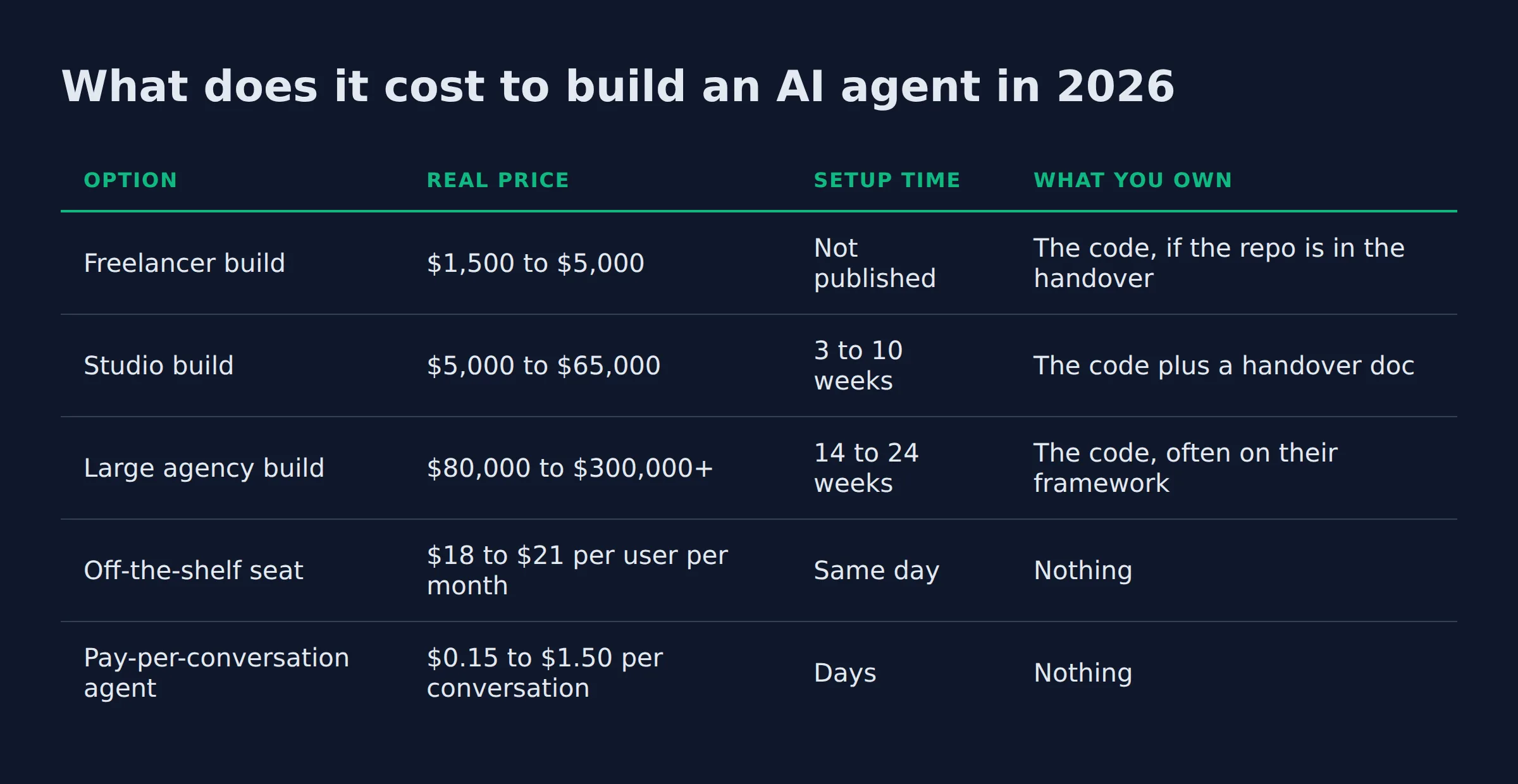
One small business task costs $5,000 to $25,000 to build. Freelancers quote $1,500 to $5,000, studios $5,000 to $65,000, and large agencies $80,000 to $300,000+. The studio tier runs 3 to 10 weeks. Large agency programs run 14 to 24 weeks.
The spread in AI agent development cost tracks who does the wiring. Those 3 tiers are published AI agent pricing tiers, and big shops charge for coordination.
| Option | Real price | Setup time | What you own |
|---|---|---|---|
| Freelancer build | $1,500 to $5,000 | Not published | The code, if the repo is in the handover |
| Studio build | $5,000 to $65,000 | 3 to 10 weeks | The code plus a handover doc |
| Large agency build | $80,000 to $300,000+ | 14 to 24 weeks | The code, often on their framework |
| Off-the-shelf seat | $18 to $21 per user per month | Same day | Nothing |
| Pay-per-conversation agent | $0.15 to $1.50 per conversation | Days | Nothing |
Every price in that table comes from a vendor or agency page. The studio and agency setup times are the published tier table itself. The freelancer tier publishes no timeline at all.
Microsoft 365 Copilot Business pricing sets the seat row at $21 per user a month, or $18 on yearly billing.
The last row is the per-conversation range vendors price, $0.15 to $1.50. That same page reports one production build running at $0.02 to $0.10 a conversation, which is that build’s own cost and not a list price.
Now convert a price to hours and the quote stops being mysterious. The median software developer wage is $65.38 an hour, or $135,980 a year, as of 2025. That number is a wage. It’s not a billing rate, and no agency sells labor at it.
Agencies bill labor plus overhead and margin, and US contract rates run from $40 to $180 an hour by role. So the wage is the floor under the quote. At that floor, $5,000 is 76 hours of work and $25,000 is 382 hours.
A $60,000 studio quote is about 918 hours at the median wage, which is 5 months of one person’s time. Ask which hours those are before you argue about the total.
What are you actually paying for when you build one?
Six lines make up a build: orchestration, integrations, memory, retrieval, guardrails and a review console. Published per-part prices run from $2,000 to $9,000 each. The 6 total $14,500 to $37,500 on a mid-tier project.
Here is the AI agent development cost breakdown by part, at the module prices one agency publishes alongside a $24,000 project.
| Line item | What it covers | Published range per module |
|---|---|---|
| Orchestration and state machine | The loop, the routing, retries, and what happens when a step fails | $2,500 to $6,000 |
| Tool calling and API integrations | Each system the agent calls, plus its auth, rate limits and error codes | $3,000 to $9,000 |
| Memory and state | What the agent keeps between runs, and where that lives | $2,000 to $5,000 |
| RAG pipeline (retrieval-augmented generation) | Chunking, embeddings, and the vector database behind retrieval | $2,500 to $7,000 |
| Safety guardrails and validation | Refusals, allowlists, PII redaction, and the human-in-the-loop check | $2,000 to $4,500 |
| Human review console | The screen a person uses to approve or fix a run | $2,500 to $6,000 |
Those 6 ranges are published per module. They add to $14,500 at the floor and $37,500 at the ceiling. At the median wage, the $24,000 project that table sits inside is about 367 hours of work.
The same parts price 3x to 4x higher under a per-phase quote. Discovery is $5,000 to $15,000 on that phase schedule. Integration is $20,000 to $50,000. The 5 build phases total $50,000 to $150,000. The phase version folds several parts into one number and adds discovery and QA work on top.
Splitting by part is the more useful view when you are cutting cost. You can delete a part, and a one-task build deletes 4 of the 6.
Agent type sets the part count. A rule-based or goal-based agent with 1 tool is the cheap shape. An agentic AI build with a multi-agent system and a RAG agent per role is the expensive one. That spread is why published cost by agent type runs from $20,000 to $500,000+.
Testing is the line that hides in the phase version. Every change means rerunning the same prompt set, and that set grows as the agent meets real inputs. Nobody quotes it as a line because it never finishes.
Integrations carry the widest range in any quote, so count the systems before you compare 2 bids.
Where the integration line eats the quote
Integration is the widest line in both splits. It runs $3,000 to $9,000 as a module and $20,000 to $50,000 as a phase. Every system you connect has its own login and its own limits. Each one fails in its own way, and often with no warning.
I run my own lead capture at about 200 form submissions a day. The model call in that system is a few lines of code. Most of the work sat in the handoffs between the form, the sheet and the follow-up sequence, where a silent failure costs a lead.
Two questions sort a bid faster than any rate card. How many systems does the agent touch, and which of them has no test environment? A build that touches 4 systems with no sandbox is a different project from a build that touches 1. The 2 quotes can still look similar.
Phone systems are the usual overrun. You cannot test a call flow without a number that rings, so the integration gets built against docs and debugged in production. A CRM has a sandbox and a booking tool has an API key. A phone system has a person waiting on the line.
Count the systems, then ask which one has no sandbox. That answer sets the price, and it has nothing to do with which model you pick.
What does it cost to run an AI agent every month?
Direct running cost is $100 to $600 a month at 5,000 to 25,000 runs. Model tokens are the line you can price exactly. A 4,000-token prompt run 3,000 times costs $42 a month on Sonnet 5.5 and $2.10 on Haiku 5.5 at published rates.
The $100 to $600 band is the range one agency publishes for 5,000 to 25,000 workflow runs. AI agent cost per month breaks into 4 lines, and each one has a list price you can check.
| Line | What moves it | List price to check |
|---|---|---|
| Model tokens | Input length, output length, and which model answers | Sonnet 5.5 at $2 and $10 per million, Haiku 5.5 at $0.10 and $0.50 |
| Prompt caching | Whether the stable part of the prompt is cached | Cache read $0.10 per million, cache write $2.50 |
| Vector database | Index size and reads per run | Pinecone’s pricing page puts Builder at $20 a month, $0.33 per GB, and reads at $16 to $18 per million |
| Hosting and orchestration | Runs per month, and minutes per run | n8n’s pricing page charges 20 euros a month billed annually for 2,500 executions |
Here is the arithmetic behind that capsule. 3,000 runs at 4,000 input tokens is 12 million input tokens a month. Output at 600 tokens a run adds 1.8 million. At Claude API per-token pricing of $2 and $10 per million, the month costs $42.
Run the same work on Haiku 5.5 at $0.10 and $0.50 and the month costs $2.10. Same task, same volume, a 20x gap in the bill. Model routing is worth more than any negotiation with a vendor, and the same arithmetic works on OpenAI’s models at their own per-token rates.
Caching is the second lever. A cache read on Sonnet 5.5 bills at $0.10 per million. Fresh input is $2, and a write costs $2.50, per the same Claude pricing page. Cached input on the example falls from $24 a month to $1.20.
Tool definitions ride in that same prompt, so they count. The Claude pricing docs put a declared browser toolset at about 6,600 extra input tokens on every request. That is why tool count and context window size belong in your cost model.
Then the hours arrive. Upkeep runs 15 to 25 percent of build cost a year in the published phase table. A $5,000 build carries $750 to $1,250 a year. A $25,000 build carries $3,750 to $6,250.
The token bill is the small number. The hours that keep the agent running are the cost that decides whether it survives year 1.
What does an AI agent cost for a small business?
A 5-person business running one task should plan on $5,000 to $25,000 to build and $100 to $600 a month to run. That build is 76 to 382 hours at the median wage. A seat tool covers a task inside its own walls for $21 a month.
The AI agent cost for a small business sits at the low end of every number above, and scope discipline is why. One task has a written input and a written finish line. The price moves when the answer to “what does it do” is “whatever the customer needs”.
For the full picture, see Custom AI Agent Development Company.
A one-task build keeps 2 of the 6 lines from the table above. It keeps orchestration and 1 integration, and drops the hosted vector store, the memory service and the custom console. A sheet and an inbox cover the review step at this size, and the owner is the reviewer.
That review step is the one place a small team wins on cost. A human-in-the-loop check on 20 runs a day takes minutes, and it needs no console to run it. How to build an AI agent walks the pieces in order, and AI agents for a small business covers which tasks pay back first.
I build free sites for prospects before they pay, and that scope conversation is the same one an agent build needs. Name the 1 job, skip the rest, and put the saved money into the integration that has no sandbox.
Write the task with an input and a finish line. A vague task is what turns a $6,000 build into a $30,000 one.
Is it cheaper to build an AI agent or buy one?
Buying is cheaper for one task at small volume. Vendor pay-per-conversation pricing runs $0.15 to $1.50 a resolution. At 3,000 runs that bills $450 to $4,500 a month. A custom build costs $5,000 to $25,000 up front and wins when no vendor sells your workflow.
Run the build vs buy crossover before you pick a side. Take a $15,000 build with $200 a month in running cost. Spread over 2 years that is $9,900 a year. Over 5 years it is $5,400 a year.
At the $0.15 vendor floor, $9,900 a year buys 66,000 resolutions, or 5,500 a month. Spread over 5 years, the same spend buys 36,000 a year, or 3,000 a month.
At $1.50 a resolution the same money buys 6,600 a year, or 550 a month. A 5-person business rarely runs any of those volumes on one task.
| Option | 2-year cash | Best when |
|---|---|---|
| Custom build | $15,000 to $25,000 plus $4,800 running | The workflow needs systems a vendor cannot reach |
| Seat tool | $504 per user at $21 a month | The task already lives inside that tool |
| Pay-per-conversation | $10,800 at 3,000 runs a month on the $0.15 floor | Volume is low or spiky |
| Build with a maintenance plan | $5,000 to $25,000 plus 15 to 25 percent a year | You want the build and the upkeep handled |
Published TCO tables deserve a second read. One agency puts a subscription at $46,420 over 2 years and a custom build at $30,760 in its TCO table.
Look at the year split underneath. That buy side works out to about $1,800 a month in year 1. The build side works out to $24,640 in year 1 and $6,120 in year 2. The comparison holds at a subscription near $1,800 a month. It flips below $825 a month, which is the $9,900 yearly build cost split by 12.
Ownership is part of the price. A subscription leaves you with nothing to own, and a custom build hands you the code, which is the asset in any TCO table. Copilot Studio sits between the 2: you build inside Microsoft’s tool and rent the seats.
Build pays for access to systems. At the $0.15 vendor floor, a $15,000 build needs 3,000 to 5,500 runs a month before volume justifies it.
The 3-check cost audit I run before signing
Three checks catch most of a bad quote. Each one is a question you can put in a single email.
- Write the task as 1 sentence with an input and a finish line. If it needs “and” twice, you have 3 projects wearing one name.
- List every system the agent touches, and mark the ones with no test environment. Those carry the overrun.
- Ask for the monthly bill at your run count, with the model name and the token estimate on it. A per-run estimate beats a range.
Then ask about the kill switch. What happens when a run fails, when the model returns nonsense, or when the spend passes a cap? An agent with no cap is a subscription you cannot stop.
My own stack gets the same test before I pay for anything. I price a tool at my real monthly volume, and I run the cheapest model that clears the job. The gap between 2 models on a fixed task shows up in the bill and nowhere else.
If you would rather price the hours with someone, our AI services page sets out what a fixed-scope build covers.
 AutomateReal services
A quote without a run count and a model name is a guess with a signature line.
What hidden costs show up after launch?
After launch the bills are review hours, reruns after a model change, and an integration that breaks quietly. Add a compliance review once personal data reaches the prompt. None of these appear on a build quote, and all of them land on the owner.
AI agent maintenance cost is where a cheap build loses its edge. The work has a name in bigger shops, LLMOps, and it never shows up as a line item.
- Model changes. A version update can shift output enough to break a downstream step, so the prompt set gets rerun and retuned. That work lands on whoever owns the agent.
- Integration drift. An API changes a field or a limit and the agent fails on a slice of runs. Quiet failures are easy to miss for a week.
- Review labor. Someone reads the bad runs. At 20 runs a day that is minutes. At 2,000 runs a day it is a role.
- Compliance. A SOC 2 or GDPR review arrives once customer data enters the prompt, and compliance work sits in the top price tier of every published range.
- Observability. Logging and traces are how you find a failed run, and they are the line most quotes leave out.
Give the agent an owner who reads the failures each week. An agent nobody watches costs more than one that fails loudly.
How do you cut the cost without breaking the agent?
Four moves cut the bill: cheaper routing, cached prompts, less scope, and a tested kill switch. Prompt caching alone turns $24 of input into $1.20 at Claude Sonnet 5.5 list prices. None of them needs a rewrite.
- Cache the stable part of the prompt. Reads bill at $0.10 per million on Sonnet 5.5 against $2 for fresh input, and writes cost $2.50.
- Route the easy steps to a cheap model. Haiku 5.5 at $0.10 and $0.50 per million sits 20x under Sonnet 5.5 at $2 and $10 for the same task.
- Cut scope you cannot test. Fewer tools per run means fewer tool definitions in the prompt and less context to pay for.
- Test the kill switch on purpose. Fire a failing run and confirm the cap stops it before a loop does.
My own SEO pipeline routes models this way. The stages that fetch and sort text run on a cheap model, and the drafting stage gets a stronger one. Input is where most of the bill lives, so a cheaper AI agent build starts with the prompt.
 AutomateReal skills
For a 1-task build, Zapier or Make.com covers the orchestration. You pay a plan tier instead of an engineering week.
The framework matters less than the bill suggests. LangChain, LangGraph, LlamaIndex and CrewAI all call the same paid APIs. The bill follows tokens and tool calling, so pick the one with the fewest moving parts. A state machine you can read in 200 lines still beats a framework you can’t debug at 2am.
The vector store is another line you can shrink. pgvector is a free extension for Postgres, and Pinecone’s Builder plan runs $20 a month. The choice comes down to ops time.
Cache first, then route, then cut scope. All 3 moves lower the bill without touching the orchestration.
FAQ
Can you build an AI agent for free?
Yes for a demo. Free model tiers and a local script cost $0 in cash, and that version proves the idea. A production agent costs money in tools and review hours, so free means you run it yourself.
How much does an AI agent cost per month for a small business?
$100 to $600 in direct running cost at 5,000 to 25,000 runs. Upkeep adds 15 to 25 percent of build cost a year. A low-volume agent on Haiku can run for a few dollars a month in tokens.
How long does it take to build an AI agent?
A studio build takes 3 to 10 weeks and a large agency program takes 14 to 24 weeks. The freelancer tier publishes no timeline, so you have to ask. The integrations set the date more often than the model work does.
Do I need a developer to build an AI agent?
A seat tool that already does the task, no. A custom agent that touches your CRM, calendar and inbox needs one for the wiring and the guardrails. You can still own scope and the review step.
What is the cheapest way to get an AI agent running?
Start with a seat in a tool you already pay for, then add a pay-per-conversation vendor for 1 task. Build custom when the workflow needs systems those tools cannot reach, and start with the smallest task you can write down.
If you have a quote and want a second read on the hours, a discovery call takes about 30 minutes. We go through it line by line.