Agentic AI Explained for Small Business Owners (2026)
Agentic AI is software that pursues a goal, not a prompt. What it does, how it differs from generative AI, what it costs, where a human stays in the loop.
My first production agent put the same bid in the team chat twice. It also linked a directory page where an apply link belonged. Both defects shipped in week one. That agent still runs every morning, with a human check added in front of it.
Agentic AI is software that pursues a goal instead of answering a prompt. It plans the steps, uses the tools you already pay for, takes the action, and checks the result. Generative AI writes a draft when asked. An agent decides what to do next and does it, so hand it one low-risk job and keep a human gate.
For named products and prices, see top AI agents in 2026.
Most pages on this term come from research houses and software vendors. They define the category well and never name a job an owner can hand over this week. This is the operator’s version.
My own Search Console shows 596 impressions and 1 click across the site in the last 28 days. Not one of those queries is “agentic ai” yet. The queries that do land are the plain ones, like “ai agents for marketing” at 18 impressions and an average position of 69.
TL;DR
- Agentic AI plans the steps, uses your tools, and finishes the job. Generative AI waits for a prompt and writes.
- 35% of surveyed organizations had adopted AI agents by 2023, and another 44% planned to deploy, per MIT Sloan.
- Both national cyber agencies say the same thing: start small, on low-risk tasks. Pick one weekly job that fails cheaply.
- The tool is the small cost. The setup month and the upkeep are the numbers that decide the outcome.
What is agentic AI, and how is it different from generative AI?
Agentic AI is software that sets a goal, plans the steps, uses tools, and acts until the job is done. Generative AI produces content when you ask it to. NIST’s definition of agentic AI covers systems that decide independently, learn from interactions, and adapt to change.
The word carries weight because the systems act. MIT Sloan describes the agentic AI age as already running at scale in the economy. That line comes from Sinan Aral, a professor of management, IT and marketing at MIT Sloan. The systems he means perceive a situation, reason about it, and take an action.
The split from generative AI is at the finish line. IBM draws the line on agentic AI versus generative AI. Generative models create text, images, video, and code. Agentic systems plan and carry out a multi-step workflow with some level of autonomy. The same vendor lays out the agentic loop as perception, reasoning, and goal setting. Then decision-making, execution, and a check on the result.
Owners are not waiting for the category to settle. A spring 2025 agent adoption survey from MIT Sloan Management Review and Boston Consulting Group found 35% of respondents had adopted AI agents by 2023. Another 44% planned to deploy.
Nvidia’s Jensen Huang told CES 2025 that enterprise agents would be a “multi-trillion-dollar opportunity,” according to MIT Sloan’s write-up of that keynote. Microsoft, Salesforce, and Google all sell agent products now.
Generative AI hands you a draft. An agent files the finished record.
How is agentic AI different from an AI agent, a chatbot, or plain automation?
An AI agent is one worker on one job. Agentic AI is the coordinated system of agents, tools, and checks around it. A chatbot answers turn by turn in a chat window. Plain automation fires a fixed action from a fixed trigger.
Google Cloud makes the distinction concrete: agentic AI versus AI agents works the way a toolbox works. The agents are the individual tools, and agentic AI is the coordinated use of them. One agent handles one task, while agentic AI runs several to finish a workflow.
Stanford HAI’s definition adds the mechanics. Agentic AI sets or interprets goals, and it plans and sequences actions. It uses tools like web browsers, code, or APIs, and it adapts as it goes. A purely reactive chatbot only responds turn by turn.
The vocabulary underneath is not settled, and the surrounding terms cause most of the confusion. Start from the contested definition, since Wikipedia notes there is no universally agreed-upon meaning of an AI agent. If you want the wider map, skills versus MCP versus agents sorts out how those three fit together. NIST’s wording and the Stanford wording describe the same behavior from two angles.
Plain automation is the oldest of the 4. It cannot weigh a new case, so a form field that moves breaks the whole job.
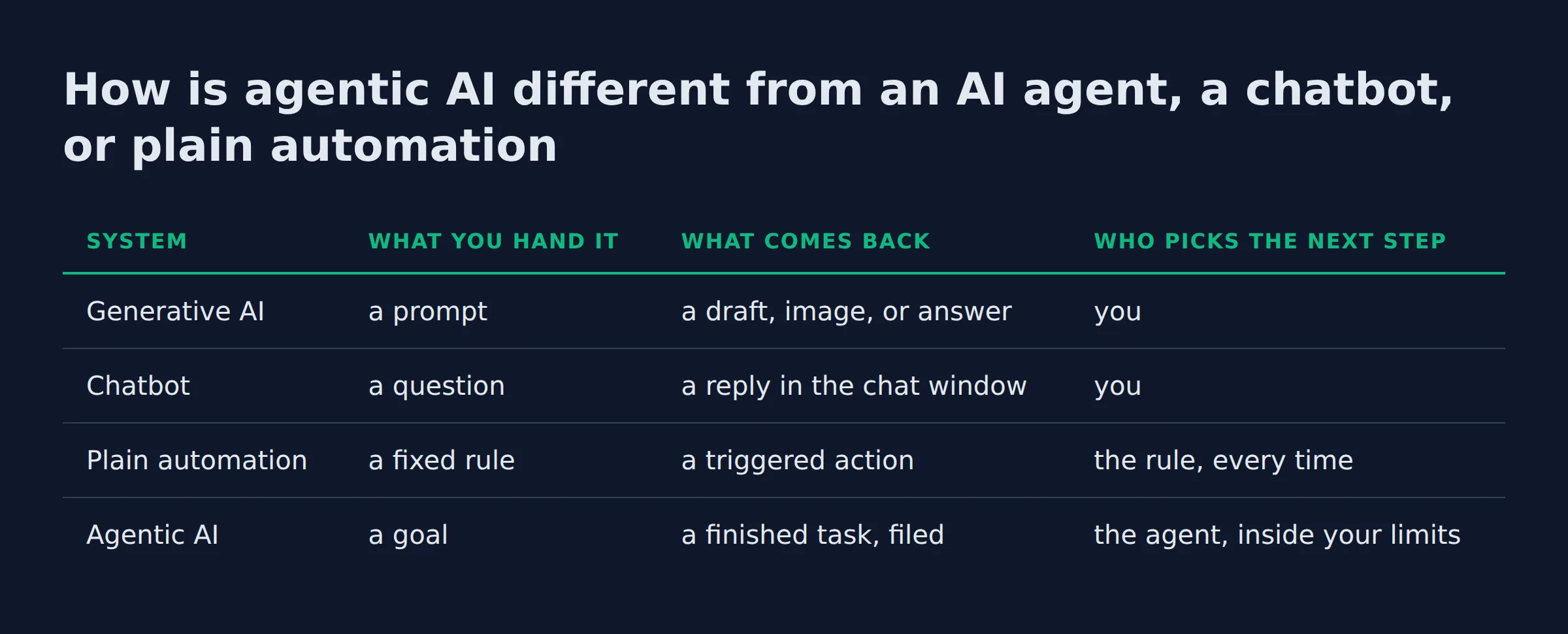
The 4 systems look like this side by side.
| System | What you hand it | What comes back | Who picks the next step |
|---|---|---|---|
| Generative AI | a prompt | a draft, image, or answer | you |
| Chatbot | a question | a reply in the chat window | you |
| Plain automation | a fixed rule | a triggered action | the rule, every time |
| Agentic AI | a goal | a finished task, filed | the agent, inside your limits |
One agent is a tool. Agentic AI is the shop around it.
What can agentic AI actually do for a small business?
For a small business it runs one recurring workflow end to end. It reads the input, pulls the fields, checks them against your rules, and files the result where your team already works. It fits work that repeats weekly, follows rules you can write down, and fails cheaply.
Owners ask whether this is a big-company tool. The Census business survey answers with firm-size numbers: overall AI use across US businesses ran between 17% and 20% from December 2025 to May 2026. Firms with 250 or more employees hit 37%, and firms with 100 to 249 employees hit 32%. Under 20% of firms with 4 or fewer employees reported any AI use at all.
What holds small firms back is the setup month and the upkeep. A seat on a no-code builder costs less than the weekly coffee run. Large firms have someone whose job includes owning that work. A 5-person company has an owner who is already at capacity.
The work an agent takes is the part with no judgment in it. That means the reading, the copying between systems, and the filing. The judgment stays with you, and so does the call on what happens when the input is wrong.
A home-service owner feels it on the local surface first. A share of that visibility runs through Google Business Profile, which is a separate surface from your website, and the local pack is where the call starts. Review generation sits in the same place, because the reviews attached to that profile get read before anyone dials.
Pick the workflow first, then the tool. The first job should repeat weekly and fail cheaply.
What are real examples of agentic AI at work?
Real agentic AI shows up as a daily job nobody has to start. A document reader files one clean record per item. A follow-up loop sends the next message and stops when a person replies. The output lands in the tools your team already opens.
Google Cloud lists live examples in lending, retail, and support. IBM points at multiagent systems that pass work between specialist models. AWS describes the multi-agent patterns where a supervisor model splits a question across helpers.
The one I run is smaller than any of those. It reads long bid documents each morning and pulls out the fields I care about. Then it deletes duplicate rows, and it routes one record per job into a team chat. My part is the 2 minutes of reading that follows the drop.
The same shape fits a service business. A quote request arrives, the agent gathers the details an estimator needs, and it drafts the reply for a person to send. After the job, a review request goes out and the agent tracks who responded.
My sibling post on AI agents for small business carries the full job catalog, including the jobs that need a person in the middle.
Each of these examples writes into a tool a person already opens.
The 3-question test I run before handing over a workflow
Every workflow I hand to an agent has to pass 3 questions. One failure and I keep doing it by hand.
- Does it run at least weekly? A job that happens twice a year will not earn back the setup.
- Can I write the right answer in one sentence? If the correct output needs a paragraph to explain, the agent will drift.
- If it gets it wrong, does a person catch it before a customer or a price is affected? That one decides the order.
That test is why the bid workflow went first. A wrong record lands in a team chat where a person reads it. It never lands in a client’s inbox.
The national guidance lands in the same place. The UK NCSC tells organizations to start small with agentic AI, use agents only on low-risk tasks, and apply security controls from day one. It is joint international guidance, so agencies on both sides of the Atlantic read the same rule.
If you cannot name the person who catches a wrong output, the workflow is not ready.
How do you run one, a platform, a developer, or a managed service?
There are 3 routes. A platform seat you build on yourself, a developer who builds around your process, or a managed service that builds it and keeps it running. The first 2 leave the upkeep with you, and that upkeep is where most owners stop.
The platform route works when you enjoy the tinkering. You pick the tool, wire the workflow, and own the fix when an app changes. A no-code builder makes the first version fast.
The developer route works when the workflow mirrors how you already operate. You pay for the build, then for hosting and model calls, then for each change after that.
The connection layer is the part nobody explains. Model Context Protocol is how an agent reaches the tools it acts through, which is why your workflow matters more than the large language model (LLM) inside it.
The managed route folds the build and the upkeep into one number. That is the route I run for owners who want the outcome, and it is what the AI services page covers. The fix is the part owners underestimate, and it is the reason the other routes stall.
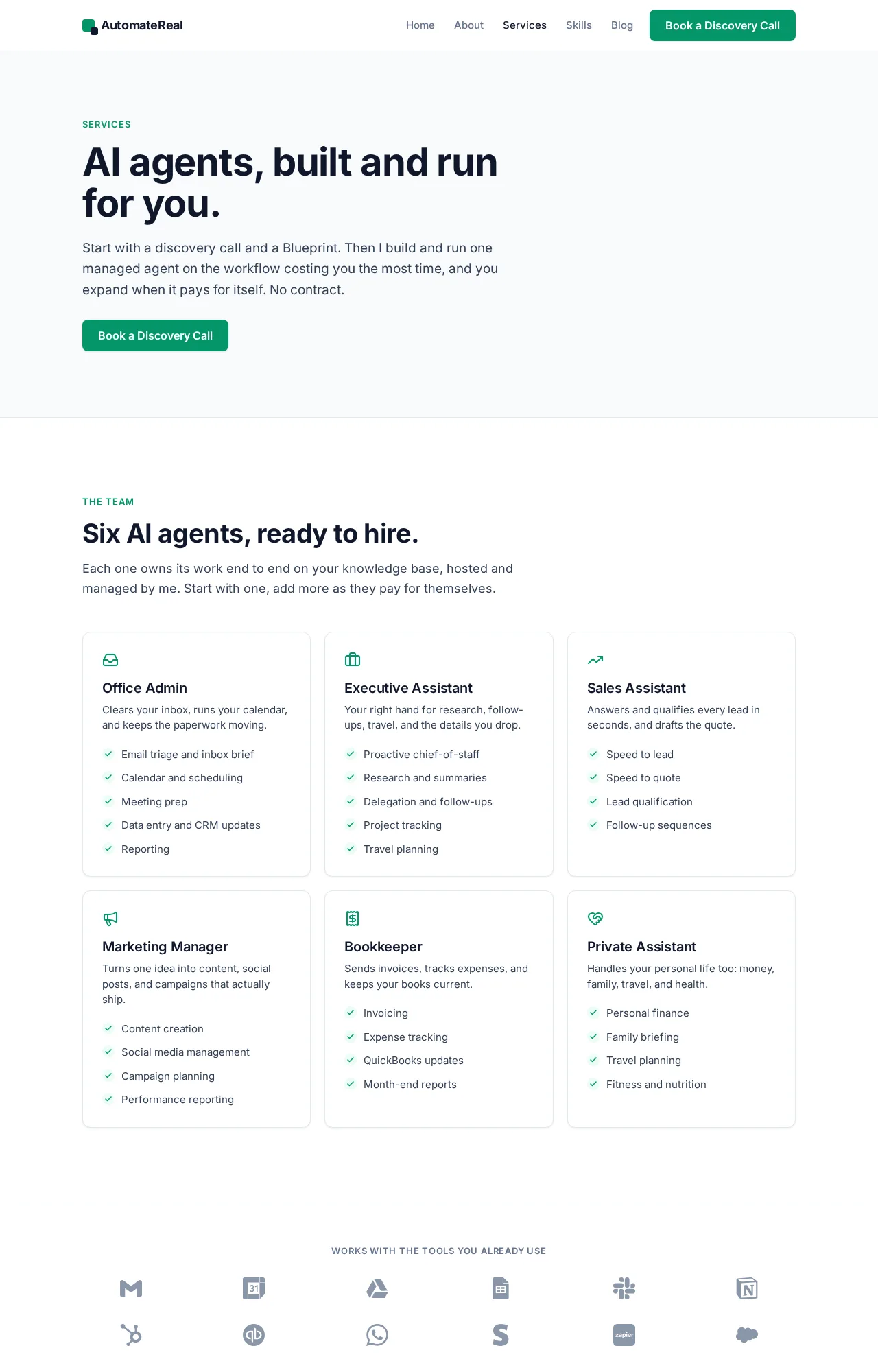 AutomateReal services
| Route | What you pay for | Who owns the fixes | Fits |
|---|---|---|---|
| Platform seat | the seat, plus your hours | you | owners who like tinkering |
| Custom build | build time, then hosting and model calls | you or the developer, if retained | one workflow that mirrors how you work |
| Managed service | one monthly number for the build and the upkeep | the provider | owners who want the outcome |
The connection to your existing tools decides more about the outcome than the model behind it.
How to test an agent before you trust it with real work
Feed the agent old work you already finished. Then compare its output to what you actually did.
- Use a batch with known answers, including the messy cases from last month.
- Watch for invented values. An agent that fills a field it could not read is the loudest warning you will get.
- Time the review step. If checking the output takes longer than doing the task, fix the workflow.
Old work is the cheap test because the exceptions are already baked into it. A vendor demo runs on clean data and a scripted path, which tells you what happens on a good day. Point the agent at your own documents too, so it answers from your files instead of guessing at the general case.
The test takes an afternoon. It also tells you what the agent does when a field is missing, which is the case that decides whether the workflow holds.
A demo shows you a clean day. Old work shows you a missing field.
What does agentic AI cost a small business, and can it be free?
Free covers the tool, and no-code platforms and open-source builders both offer that route. The workflow still costs you model calls, setup hours, and upkeep. The bill comes due when an API or a page layout changes under the agent. For the tools that write rather than act, see generative AI for small business.
Here is the honest version of my own numbers. I can tell you what my systems do and what I stopped paying a person to do. I cannot hand you a clean invoice per workflow, because my agents ride API plans I already pay for.
Three cost lines are worth tracking before you start.
- Model calls. Predictable, and they scale with how often the workflow runs.
- The setup month. The tuning that makes the workflow correct on real inputs.
- Upkeep. The fix when a tool, an API, or a page changes shape under the agent.
What I measure is the human side, because the ROI that matters is hours returned. My follow-up system takes in about 200 form submissions a day, and every one of them gets a reply path without me touching it. Free tools leave that work with you.
If you want to build the prompts yourself, the skills I sell at automatereal.com/skills are all skills for $99. They cover the marketing, SEO, and copywriting jobs I run in my own business. That is the cheapest honest starting point I know, and it still leaves you the wiring.
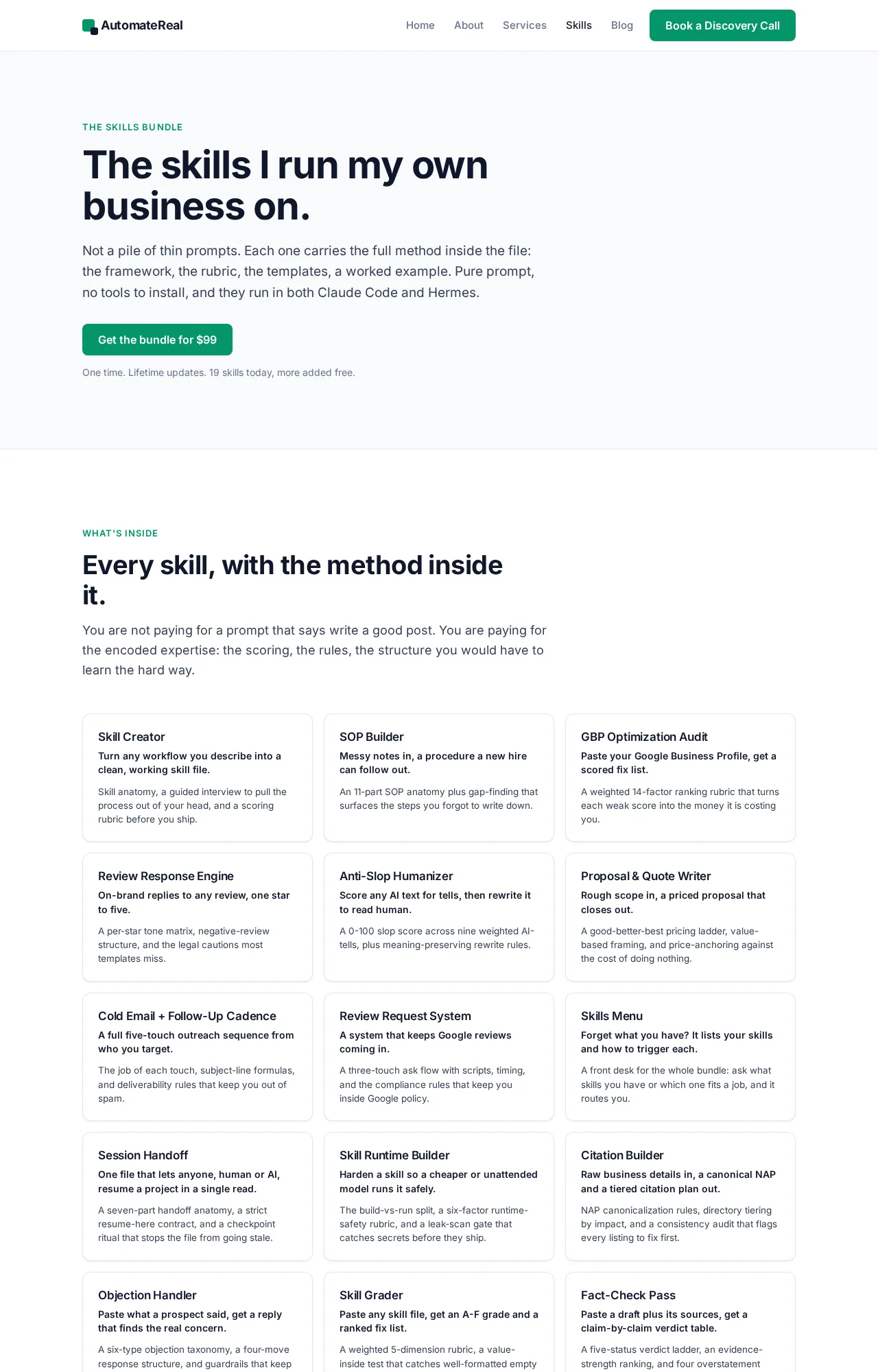 AutomateReal skills
The setup month is the entry price. Budget for it before you pick a tool.
Where does agentic AI go wrong, and what has to stay with a human?
Agentic AI fails in 3 predictable places. It invents a value, it acts without asking, and it breaks quietly when a tool changes. The fix is one human gate placed before anything customer-facing ships or any record leaves the box.
My first agent hit 2 of those 3 in week one. It wrote the same bid into the team chat twice, and it linked a directory listing where the apply-able posting belonged. A person caught both in review, and that review step now sits in front of every record before it ships.
The cyber guidance is blunt about the approval part. Canada’s Centre for Cyber Security published careful adoption of agentic AI as its guidance title, and the first warning is about approval. Agents can take actions without explicit human approval, which raises the risk of insecure actions happening without oversight.
The same guidance recommends graduated autonomy, so an agent earns independence only after it holds up on low-risk work. It also covers threat modeling, because the agent itself is a new way into your systems.
The gate is where NIST’s framing helps. The NIST AI Risk Management Framework asks teams to govern, map, measure, and manage AI risk. It names human oversight as a control you design in. The access limits you set around the agent are the other half of that.
The quieter failure is the one that scares me more. IBM’s page describes an agent told to maximize engagement that starts favoring misleading content. Wikipedia keeps a section on the same problem under agentic misalignment. A goal stated loosely gives the agent room to land on an answer you never wanted.
The failure that hurts is the quiet one. A loose goal sends the agent somewhere you never intended.
For a managed version, see the AI services page.
Related: Generative AI for Small Business: What It Does and Costs
Related: Which AI Agent Should You Build First?
Related: AI Agents Examples: Real Use Cases for Small Business
Related: gemini agent mode
FAQ
Which AI agent is best for a small business?
There is no best agent in the abstract. The right one drops into the workflow you already run every week, next to the tools you already pay for. Judge it on the first job it finishes without you, and on how fast a person can check that job.
Can I get an AI agent for free?
Free tiers exist on most no-code platforms, and open-source builders cost nothing to download. Free covers the software. The setup month and the upkeep stay yours, and those 2 costs decide whether the agent survives past month 2.
Is agentic AI safe to run in a small business?
Safety comes from scope and from the gate. Keep the agent on low-risk work, give it the least access the job needs, and put a person in front of anything customer-facing. Both the UK NCSC and Canada’s cyber centre publish that same advice, and it holds for a 3-person company.
Does agentic AI work with the tools I already use?
Usually, if the tool has an API or a supported connector, and Model Context Protocol is the common way an agent reaches it. Where a tool has no connection, the agent stops at the edge of it and hands the job back to you.
Is agentic AI just a buzzword for automation?
Agentic AI names a real difference. Plain automation fires a fixed action from a fixed trigger. An agent reads the situation and picks the next step. It takes that step, so the same workflow handles inputs you never wrote a rule for.
If you want help finding that first workflow, a 30-minute discovery call maps it against the tools you already run.