AI Business Ideas 2026: What Actually Works
A sourced list of AI business ideas for 2026, the build path behind each one, and which ideas a solo operator can ship without a dev team.
Most lists of AI business ideas for 2026 stop at the noun. You get a page of receptionists and copilots with no build path behind them, and no answer for who fixes the thing when it breaks.
This one comes from the operator side. The build paths below come from automations I run in my own business, and every number here has a source you can open.
AI business ideas for 2026 keep working in 3 shapes. Vertical agents own one workflow inside one industry. Productized AI services sell on retainer, and narrow micro-SaaS tools stay small on purpose. General chatbots and thin wrappers fail. Pick one industry, one repeated task, and ship in weeks.
TL;DR
- Three idea shapes still pay: vertical agents, productized AI services, and narrow micro-SaaS.
- The failure mode repeats: a general chatbot with no named buyer and no distribution.
- Pick one industry, name one repeated task, and run the first version where you can watch it daily.
What makes an AI business idea worth building in 2026?
An AI business idea is worth building when one industry pays for one repeated task and the work runs without you watching it. The idea breaks when the buyer is everyone, the task is vague, or the output needs a human fix every day.
That bar is easy to state and hard to clear. The small business statistics from the SBA advocacy office count 36.2 million small businesses in the U.S. (SBA Office of Advocacy, February 2026). Of those, 82.3 percent have no employees at all.
A one-person firm has no software budget line and no IT department. It does have a week full of tasks it repeats.
Census survey data on AI use by small firms shows how early this market is. AI use across all businesses sat between 17 and 20 percent from December 2025 through May 2026 (Census Bureau, AI use at U.S. businesses).
Fewer than 20 percent of firms with 4 or fewer employees used it at all.
A buyer who can name the task and the cost of missing it is worth more than a clever model.
Three checks separate a buildable idea from a hobby project:
- One buyer you can name without saying “SMBs”.
- One task that happens weekly and costs money when it slips.
- One output a person can approve in under a minute.
Cost stopped being the blocker years ago. Inference for a GPT-3.5 level system fell more than 280-fold between November 2022 and October 2024, per the Stanford AI Index. Hardware costs dropped about 30 percent a year over the same stretch.
Both pages that currently rank for this keyword say AI got cheap. Neither names a source for it, so here is one.
The 3 questions I ask before I build anything
My own lead follow-up runs itself, and it carries about 200 form submissions a day. That system taught me more about what sells than any idea list does, because volume punishes every vague step.
If nobody owns the fix when the agent is wrong, the build is not ready to sell.
So I ask 3 questions before writing a line of config:
- Who answers when the agent gets it wrong?
- What does the owner do every morning for the first 2 weeks?
- Can I show the result in one number?
If the answers are “nobody”, “nothing”, and “not yet”, the idea is a demo. The tell on a live call is a buyer who wants the human removed from the loop in week one. I turn that work down, because the first bad output lands on the owner’s reputation and mine.
Which AI business ideas are actually working right now?
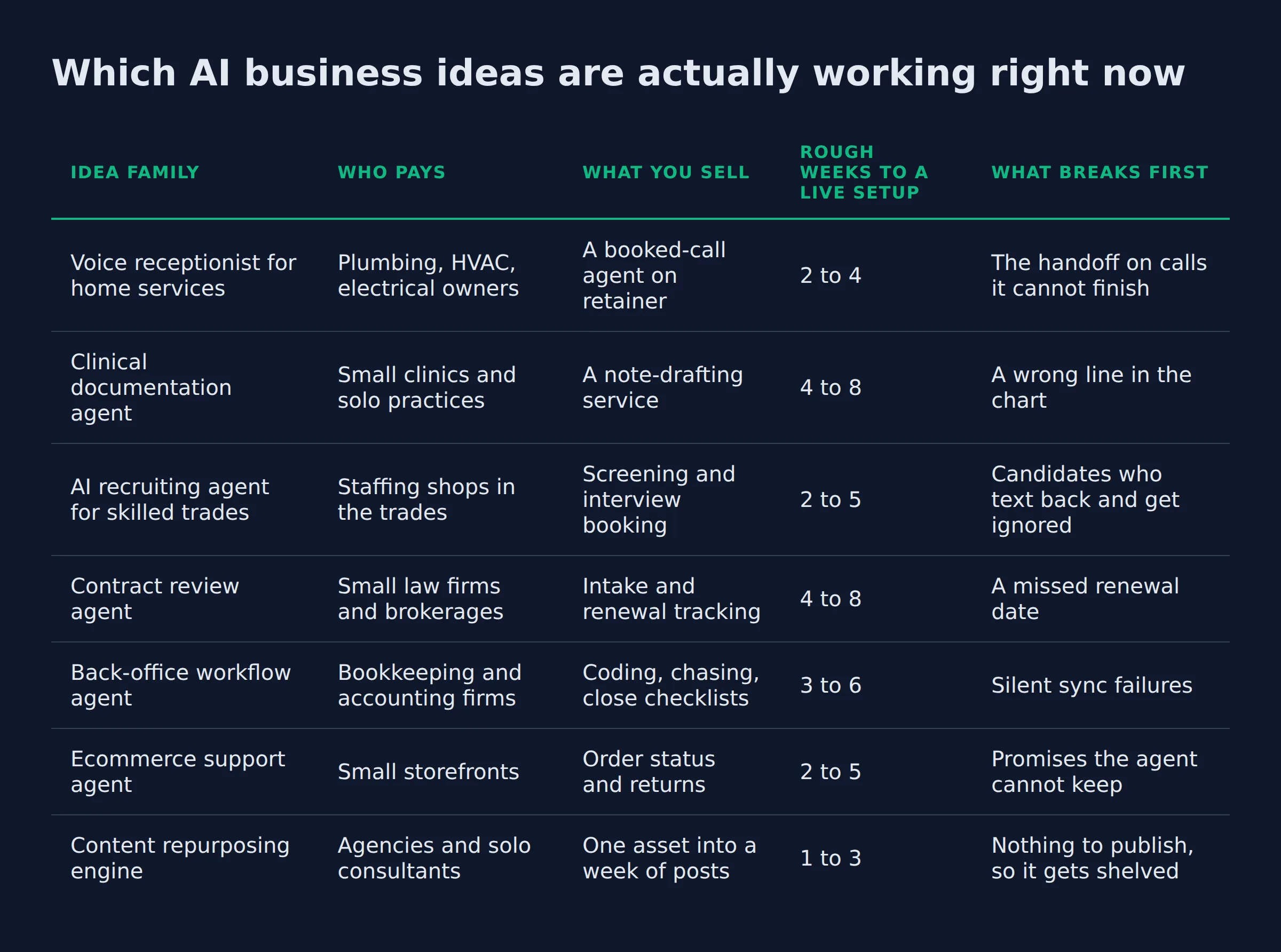
The ideas that pay in 2026 all sell one named task to one industry. Voice agents that book home-service calls have buyers today. So do documentation agents for small clinics and back-office agents for accounting firms, because each one replaces work a person already does.
The fastest way to sort them is by who signs the check and what breaks first.
| Idea family | Who pays | What you sell | Rough weeks to a live setup | What breaks first |
|---|---|---|---|---|
| Voice receptionist for home services | Plumbing, HVAC, electrical owners | A booked-call agent on retainer | 2 to 4 | The handoff on calls it cannot finish |
| Clinical documentation agent | Small clinics and solo practices | A note-drafting service | 4 to 8 | A wrong line in the chart |
| AI recruiting agent for skilled trades | Staffing shops in the trades | Screening and interview booking | 2 to 5 | Candidates who text back and get ignored |
| Contract review agent | Small law firms and brokerages | Intake and renewal tracking | 4 to 8 | A missed renewal date |
| Back-office workflow agent | Bookkeeping and accounting firms | Coding, chasing, close checklists | 3 to 6 | Silent sync failures |
| Ecommerce support agent | Small storefronts | Order status and returns | 2 to 5 | Promises the agent cannot keep |
| Content repurposing engine | Agencies and solo consultants | One asset into a week of posts | 1 to 3 | Nothing to publish, so it gets shelved |
The week ranges are my own scoping ranges from pricing this work, not survey data. The last column is the one to read twice, because that column is where the money leaks.
The voice work sells fastest in 2026, because a missed call is a loss the owner already tracks.
Turning one of these into a running agent is a build, not a purchase. Knowledge, guardrails, and daily watching come before the demo, and that work is what our AI services page covers.
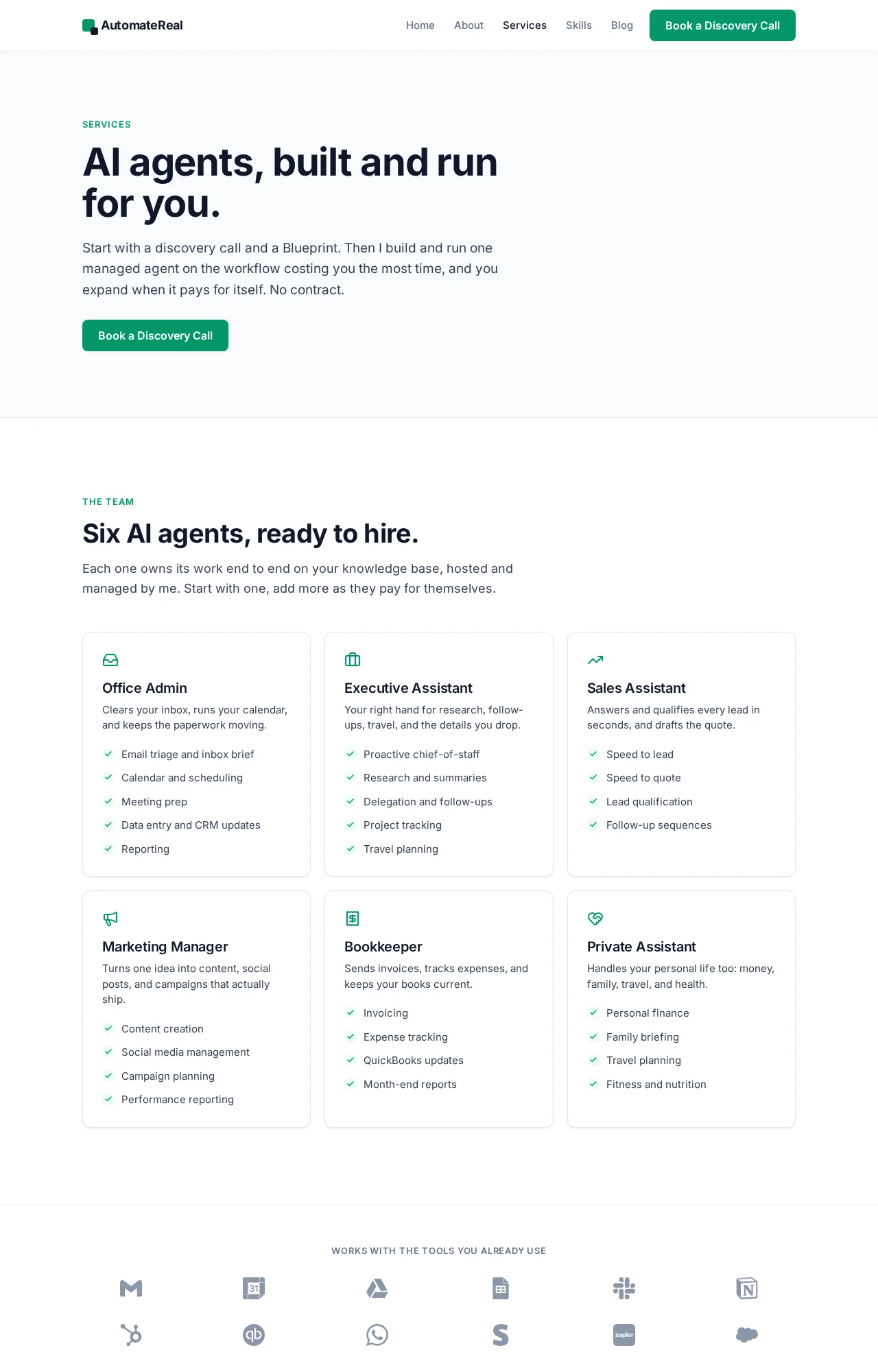
The AI services page where these builds get scoped.
The vertical AI copilot is the same shape with a chat window in front of it. GoDaddy’s version of this list ties its second idea set to its own Airo AI Builder, which reads as a product pitch. Take the first set as a starter menu.
AI receptionist for home service companies
A home service owner knows exactly what a missed call costs. The agent answers, qualifies, and books into the calendar through the Google Calendar API.
Retell and Vapi both sell voice AI this way. Retell prices pay-as-you-go voice from $0.07 to $0.31 per minute (Retell pricing). Its own worked example lands near $0.11 per minute once the stack is added up.
GoDaddy calls this idea a local business AI assistant. The job is the same either way. Capture the inbound call, book the slot, and route the rest to a person.
The part the idea lists skip is the handoff. Someone has to own the calls the agent cannot finish, and that person is usually the owner for the first month.
Clinical documentation agent for small clinics
Therapy groups and small practices pay for notes. The agent drafts from the session and the clinician approves. A wrong line in a chart is a clinical and legal problem, so the approval step is the product.
The NIST AI Risk Management Framework is voluntary and dates from January 2023. It gives you the review vocabulary your buyer’s insurer will ask about.
AI recruiting agent for skilled trades
Staffing shops for electricians and HVAC techs live on the phone. The agent screens applicants, texts back within a minute, and books interviews into the dispatcher’s calendar. Speed is the whole offer, so measure it and quote it.
Contract review agent for small legal shops
Small firms and brokerages still track renewals in a spreadsheet. The agent reads intake documents, pulls the clause that matters, and flags dates. A person signs off on every flag. Contract lifecycle work is a thin niche with real budget, because a missed renewal costs more than the retainer.
Back-office workflow agent for accounting firms
Bookkeeping firms drown in receipt chasing and month-end checklists. Once an agent touches money, Plaid, QuickBooks, or Xero access turns a demo into a liability. Start read-only and log every write.
Ecommerce support agent for small storefronts
Where-is-my-order and return questions fill most of a small store’s inbox. The agent answers from the order system and escalates the rest. Watch refund promises, because a generous model plus a stale policy equals chargebacks.
Content repurposing engine for agencies
One webinar into a week of posts is the easiest sale on this list. It is also the easiest to shelve, because agencies buy output and then forget to feed it.
What are the best AI agent business ideas?
The best agent ideas sell one decision loop inside one industry. Booking for home services and claims triage for insurance agencies work because the buyer can name the task. So does follow-up for B2B sales, where a missed lead has a price.
The model layer stopped being the differentiator. Open-weight models closed most of the gap with closed models, from 8 points to 1.7 points on the Stanford AI Index benchmarks.
The margin sits in the workflow layer, because the model layer is a commodity you can rent.
An agentic workflow is a loop with 4 steps. Read the request, call a tool, check the result, then act or escalate. A working stack looks like this:
- A workflow runner such as
n8n,Zapier, orMakefor the steps and the glue. - A RAG layer (retrieval augmented generation) so answers come from the buyer’s own documents, not the open web.
MCPconnections for the tools the agent has to touch.- An approval gate before anything reaches a customer.
ChatGPT from OpenAI, Claude from Anthropic, and Gemini from Google all handle the reasoning fine. A GPT-4 class model is a rented input that anyone can buy. Where the buyer’s data lives matters more than which logo you pick. If you want the mechanics, our post on how to build an AI agent walks the build order.
Which AI business ideas are realistic for beginners?
Beginners do best where the buyer already spends money and the output is short. A missed-call text-back or a review request sequence goes live in days. Neither needs model training, and both cost less than a phone bill to run.
Start with the cheapest stack that works, then add voice when someone pays for it.
| Layer | Cheapest real option | Price on the vendor page | What it buys |
|---|---|---|---|
| Workflow runner | Zapier Free |
$0 per month, 100 tasks included | A first workflow automation you can test today |
| Paid runner | Zapier Professional |
From $19.99 per month | Unlimited Zaps and premium apps |
| Self-hosted runner | n8n Pro |
50€ per month billed annually | Unlimited users and workflows |
| Voice agent | Retell pay as you go |
$0.07 to $0.31 per minute | Live calls without a phone system |
| Speech to text | Deepgram Nova-3 |
$0.0048 per minute | Turning call audio into text |
| Text to speech | Retell platform voices |
$0.015 per minute | A voice the caller will tolerate |
Every rate in that table comes off the vendor’s own page, checked at writing time for Zapier, n8n, Retell, and Deepgram. A beginner build with a voice front end lands in the low hundreds per month at low volume.
One trade, one city, one workflow beats a broad platform every time for a first build.
No-code builders such as GoDaddy’s Airo AI Builder will get a first version online without a repo. An MVP with 2 steps and one form is enough to test demand.
Before you build for real, check Capterra and G2 for what already exists. Read Upwork listings to see what buyers pay people to do by hand today. The communities in r/SaaS and r/indiehackers are blunt about what churns, which is more useful than another idea list.
How do you come up with and validate your own AI business idea?
Mine your own week for a task you repeat and dislike, then describe it to 5 businesses in one industry. If they use the same words back, you have a product. If every one of them describes a different mess, you have a consulting job.
A validation loop that costs almost nothing:
- Write down the 3 tasks you did twice this week.
- Call 5 buyers in one industry and ask what happens when that task slips.
- Sell a 30-day pilot before you build the full version.
- Count one number for 30 days, then decide.
Five buyer calls tell you more than a hundred hours of building.
I run this loop on my own business before I quote any build. When nobody describes the same task twice, the work turns into productized consulting instead of a product.
AI business ideas generator sites such as StartupIdeasDB, bigideasdb, and ideaproof.io are fine as prompt fuel. Treat every stack and price they print as unverified until you open the vendor page. That is the rule I used for the table above.
If you are unsure an agent is the right shape, read AI agents for small business. It covers where a plain automation does the job for less.
What the first month actually looks like
The demo is week one. Months are the part nobody writes about, so here is the plain version of what an agent needs after it sells.
An agent earns its keep in month 2, when the owner stops checking it and nothing has gone wrong.
Six things run quietly in the background, every week:
- Inbound capture, so no call or form sits unattended.
- A booking and dispatch step that writes to the real calendar.
- An approval gate before anything reaches a customer.
- An error log review, where a human reads the failures out loud.
- An escalation path for the calls and emails the agent refuses to guess on.
- A monthly review with the owner, where the count gets checked against reality.
I lost 2 days to a silent failure in the first automation I built for my own business. It double-submitted a form, and nobody noticed because nobody was reading the log.
Since then the rule is boring and cheap. One daily glance at failures, and a weekly count against the source. Every job I take on has to accept that routine, or the agent drifts and the trust goes with it.
What sinks most new AI businesses in the first year?
New AI businesses sink on distribution. The model is the part that works. Founders ship a decent tool to an audience they never built, then discover the buyer is comparing them to a subscription already on the card. Thin wrappers die first, because the platform ships the same feature for free.
The base rates back that up. The SBA Office of Advocacy puts 5-year survival for new employer establishments at 49.2 percent on average from 1994 to 2022. Only 33.9 percent reached 10 years.
In 2023, about 1.3 million establishments opened and 1.2 million closed.
A wrapper dies the month the platform ships the same feature, so build where the buyer’s own data lives.
The failure list is short and familiar:
- No distribution, so the tool never meets a buyer.
- Wrapper risk, because the feature is one release away from free.
- No data moat, so nothing improves after the first month.
- A TAM slide (total addressable market) wide enough to hide the absence of 10 real buyers.
Claims carry legal weight too. The FTC’s small business guidance states that advertising must be truthful and non-deceptive. Advertisers also need evidence to back their claims (FTC business guidance). If your page says the agent books every call, you need the number behind it.
For a managed version, see the AI services page.
Related: Which AI Agent Should You Build First?
Related: Top AI Agents in 2026: What They Do and What They Cost
Related: Agentic AI Explained for Small Business Owners
FAQ
Can you start an AI business with no coding skills?
Yes, if the first version stays narrow. A Zapier or n8n workflow, a Twilio number, and a hosted voice platform get a working agent live without a repository. Coding helps when you sell to a technical buyer or need custom data access.
How long does it take to get the first paying customer?
With a handful of direct conversations in one industry, a solo operator can usually sell a pilot inside a month. The build is rarely the delay. Getting attention is, because nobody knows your name yet.
Is it too late to start an AI business in 2026?
No. Census data puts AI use under 1 in 5 U.S. businesses in 2026, and firms with 4 or fewer employees sit below 20 percent of their group. The buyers exist and most of them are local.
Do you need a technical co-founder?
Only if the idea needs custom models or deep integrations. Most paid ideas run on hosted tools, so a technical partner is optional early. What you cannot skip is the person who owns the buyer conversation.
Which idea should a solo operator start with if they can only do one?
The voice receptionist for one trade in one city. The pain is measurable, the build is short, and the owner already pays a person to answer the phone.
Picking your first one
If you want help finding that first workflow, a discovery call maps it in about thirty minutes. The tools I use to scope and ship this work are on the skills page. All the skills in the bundle go for $99.
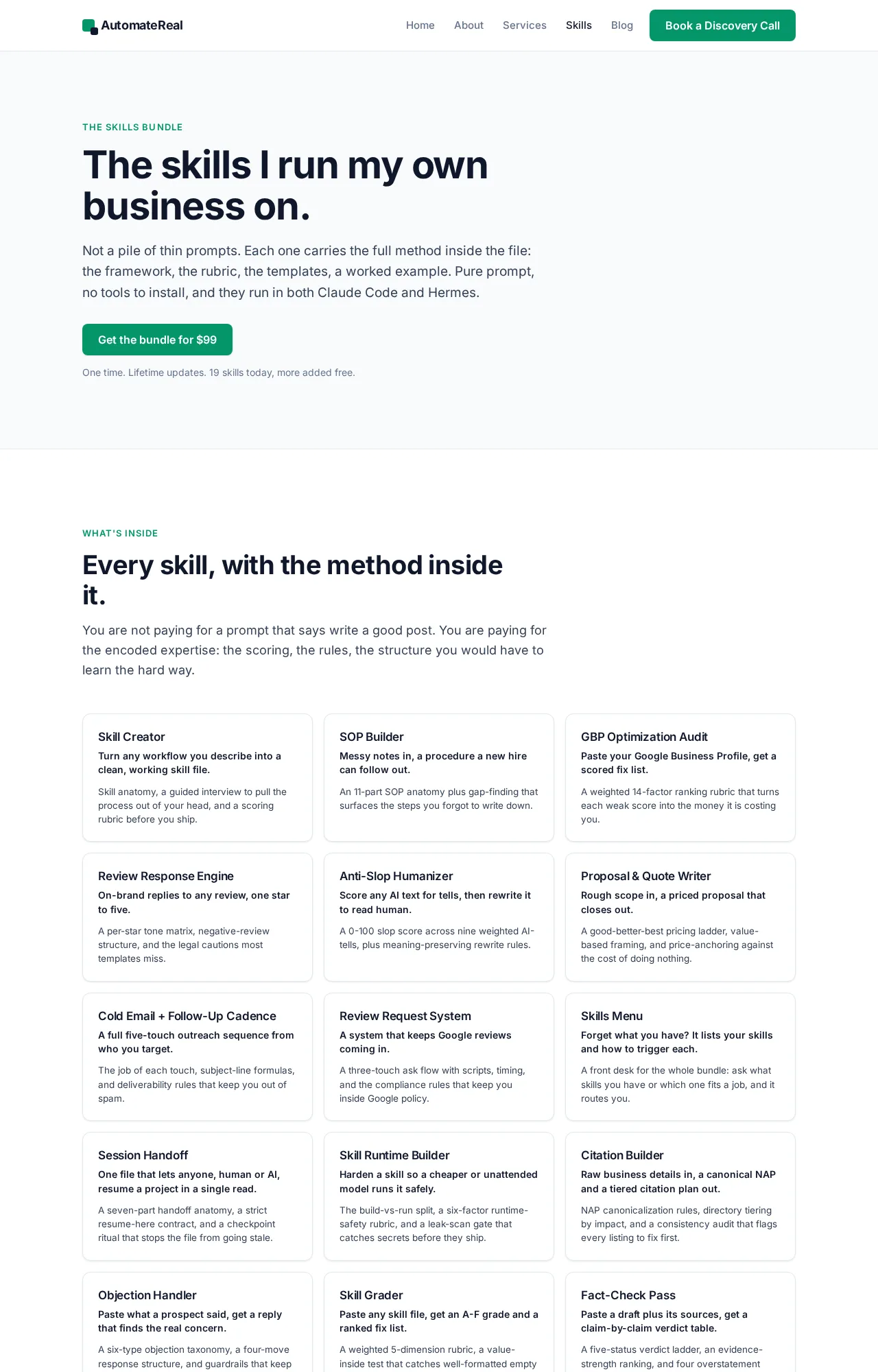
The skills bundle at AutomateReal.