AI Voice Agents for Small Business: Cost, Fit, Setup
AI voice agents answer the calls a small business misses. What one costs per booked job, which calls to hand over first, and the contract questions to ask.
The call comes in at 6:40 on a Tuesday, while both hands are inside a panel. It rings out, the caller hangs up, and the job goes to the next name on the results page.
An AI voice agent for a small business answers or places the calls you miss. It listens to the caller and decides the next step. It books the job, then hands off to a person when it is unsure. Typical plans run $79 to $300 a month before overage.
Both pages that rank for this phrase are published by companies selling the agent they put first. This one comes from the operator side. The failure list is here, the bill is divided into cost per booked job, and every price carries the date I read it.
TL;DR
- Fewer than 3 percent of callers sent to voicemail leave a message (missed call statistics).
- On my 1 in 3 booking assumption, Goodcall’s $129 plan works out to $0.17 an answered call and $0.52 a booked job (Goodcall call pricing).
- Smith.ai’s human-first Starter plan runs $10.00 an answered call, or $30.00 per booked job (answered call pricing).
- A $1,200 average missed call covers about 9 months of that $129 plan.
Which calls should a small business hand to a voice agent first?
Start with the calls that die in voicemail: after-hours and the hours a crew spends mid-job. Keep pricing arguments and emergencies with a person, and give the agent 30 days on those hours only.
The case rests on what happens to a missed call. Fewer than 3 percent of callers sent to voicemail leave a message, per Invoca’s research on this missed call statistics page.
The unanswered share is larger than most owners guess. Invoca analyzed 60 million calls and found 27 percent of inbound calls to home services businesses going unanswered, per its call data. That is about 1 call in 4.
Each of those calls holds a job. Home services loses about $1,200 on an average missed call, and a replacement job can clear $3,500.
Your Google Business Profile feeds the same line. The call button on the profile dials the number you publish. A ring-out at 6:40 reads as a closed shop to the next person searching the same service.
The ai agent examples for small business that get demoed are usually chat windows. Chat waits for someone to type. A caller at 6:41 does not.
The handoff rule that decides whether the agent keeps the customer
Hand off mid-call, not with a callback promise. The rule fires on 3 triggers. A caller who wants a number the agent cannot quote gets a person. So does a caller who asks twice, and any call that sounds like a safety issue.
I do not sell a voice agent, so I will not claim a year of call recordings. What I do run is automated follow-up on my own lead flow, at about 200 form submissions a day, and the same rule holds there. Automation owns the first reply. A person owns anything that needs judgment.
That rule came from reading transcripts. When an automated reply kept talking past the point where the question turned personal, the failure was visible in the first 2 lines.
A voice agent fails the same way in a different medium. The caller says they need to speak to someone, and the agent answers with another appointment slot.
Ask the vendor for a call where a caller talks over the agent. Barge-in is the setting that lets a caller interrupt, and it is the difference between a conversation and a walkie-talkie. Response latency is the other half, because an agent that pauses before every answer sounds like a bad long-distance line.
Both are testable in a demo call. Neither shows up on a pricing page.
Which small businesses get paid back fastest?
High job values pay back first, which puts HVAC and roofing ahead of a low-ticket booking. One booked job at $1,200 covers about 9 months of a $129 plan. Volume is what makes the same plan work for a cheaper job.
The arithmetic is job value divided by month, and it is not close at the top. One $1,200 booking covers 9 months of Goodcall’s $129 Growth plan (Goodcall call pricing). A $3,500 replacement covers that same plan for more than 2 years.
The agentic ai for business case is easiest to make in HVAC, where an 11pm emergency call is a booking rather than a message. The agent work there looks different from a receptionist answering a general line, which is why AI agents for HVAC companies treats dispatch as the first job.
A front-desk hire is the other bench. The median receptionist salary was $38,010 a year in May 2025, or $18.27 an hour, before benefits. Goodcall at $129 a month is $1,548 a year.
A dental front desk gets its return from appointments that would have rung out, so the plan has to be sized to call volume rather than to job value.
What does an AI voice agent cost per booked job?
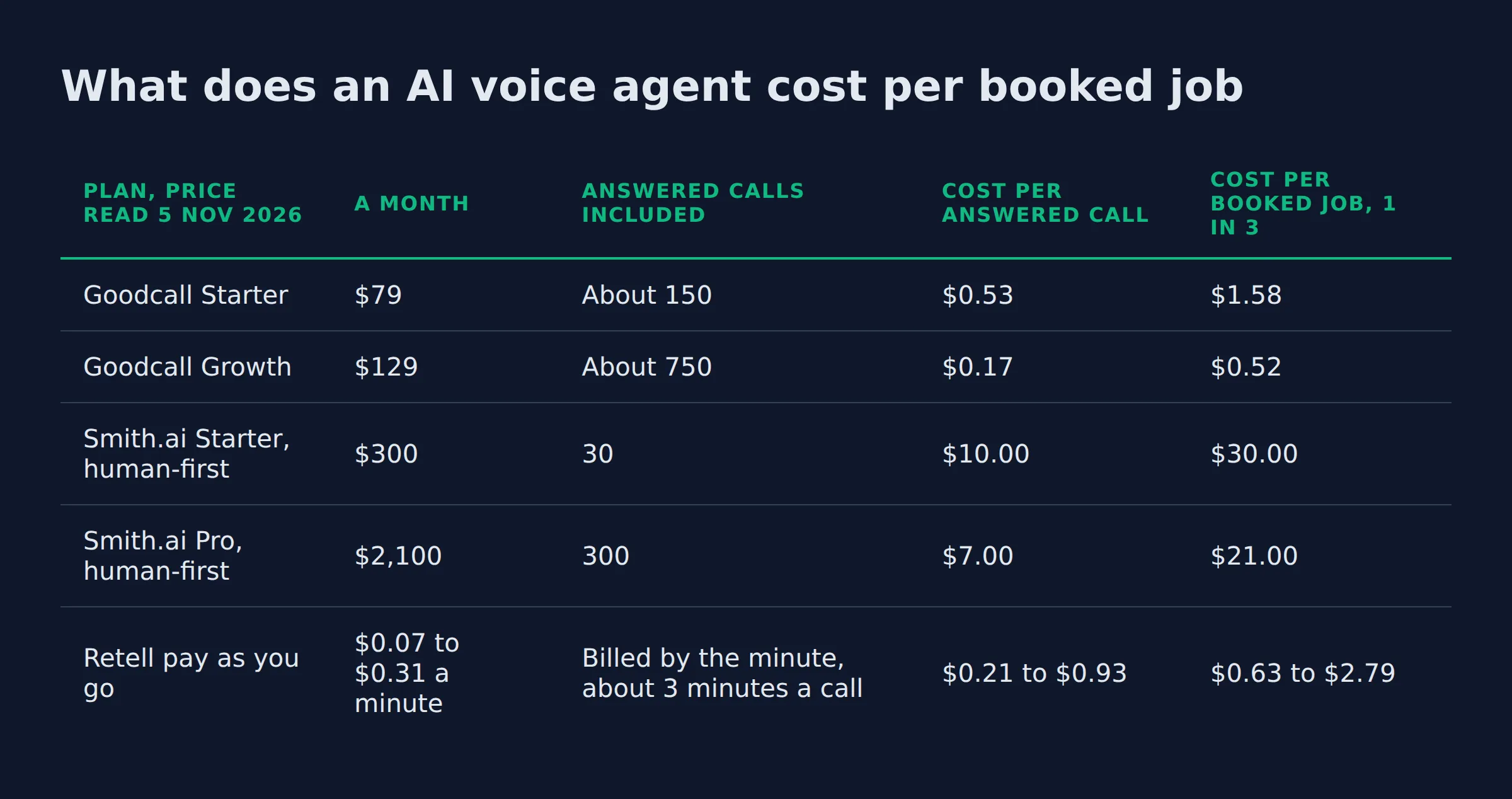
Divide the monthly plan by the answered calls it includes, then by the share that book a job. Goodcall’s Starter plan lands at about $0.53 an answered call and $1.58 a booked job. Smith.ai’s human-first Starter lands at $10.00 and $30.00.
Owners ask about the ai agent cost for small business per month. The useful answer is per booked job.
| Plan, price read 5 Nov 2026 | A month | Answered calls included | Cost per answered call | Cost per booked job, 1 in 3 |
|---|---|---|---|---|
| Goodcall Starter | $79 | About 150 | $0.53 | $1.58 |
| Goodcall Growth | $129 | About 750 | $0.17 | $0.52 |
| Smith.ai Starter, human-first | $300 | 30 | $10.00 | $30.00 |
| Smith.ai Pro, human-first | $2,100 | 300 | $7.00 | $21.00 |
| Retell pay as you go | $0.07 to $0.31 a minute | Billed by the minute, about 3 minutes a call | $0.21 to $0.93 | $0.63 to $2.79 |
Prices read from each vendor’s own page on 5 November 2026. The last 2 columns are my arithmetic. The booked-job figures assume 1 in 3 answered calls books a job, which is a planning number and not a measured average. Retell bills by the minute, so I priced a 3-minute call.
The booking rate is the assumption that moves the most. At 1 in 3, Smith.ai’s $10.00 answered call becomes a $30.00 booked job. At 1 in 6 it becomes $60.00, and at 1 in 2 it becomes $20.00.
Overage is the second lever. Smith.ai charges $11.50 for each call past 30 on Starter (answered call pricing). Goodcall charges 79 cents for each unique caller past 100 (Goodcall call pricing).
The per-minute mechanics behind those numbers, and the question of whether a synthetic voice keeps a caller on the line, are covered in conversational AI voice agents. This page stays on the bill.
What breaks in month one
Month one breaks at the calendar first. The transfer number goes next, and the summary that should reach the CRM never arrives.
- The calendar. The agent books into a calendar nobody owns, and 2 jobs land at 9am on the same crew.
- The transfer. The agent escalates to a phone that rings out at 7pm, and the caller lands back in the voicemail the agent was meant to catch.
- The summary. The transcript never reaches the CRM, so nobody follows up on a call the agent handled well.
- The script. The agent quotes a price band that changed in week 2, because no one owns the price lines.
I run 4 checks on any recording before an automation talks to a paying customer, and the same 4 apply here.
- Did it finish the job it was given.
- Did the handoff fire at the right moment.
- Did the summary carry what the next person needs.
- Did it say anything that was not true.
Week one is also where an integration fails quietly. A Zapier or Make step stops writing to the CRM, and nobody notices until a caller says the confirmation never arrived.
Build it, buy a platform, or have the whole thing managed?
Build on a platform when you have your own developer and unusual call flows. Buy a hosted product when you need a working line this week. Go managed when nobody on your team can fix a broken transfer at 9pm.
Most ai agents for small business are sold as a subscription, which makes this decision smaller than it looks. There are 3 paths.
| Path | What you own | Setup | A month | Who fixes a failed call at 9pm |
|---|---|---|---|---|
| Build on a platform | The prompt, the number, the integrations | Days to a few weeks | $0.07 to $0.31 a minute | You |
| Hosted product | A login and a script | An afternoon | $79 to $2,100 depending on plan | The vendor |
| Managed service | A contract and a phone number | A project | Quoted on every page I read | The vendor, if the contract says so |
Setup times are my estimate, not vendor claims. No pricing page I read on 5 November 2026 printed a managed price.
A build assembles 3 parts: a phone line, a transcriber, and a voice. Twilio sells the Voice API for the line, Deepgram sells speech-to-text, and ElevenLabs sells text-to-speech.
Retell and Vapi package those parts behind one dashboard. Retell’s AI voice agent pricing prints $0.07 to $0.31 a minute and includes 20 concurrent calls on pay as you go, with no cap on the enterprise plan.
Concurrent calls decide your busy hour. The 21st simultaneous call is a different tier or a busy signal, and your Monday morning is the test.
Goodcall sells the finished line. Its AI answering service price is $79 for 100 unique callers, $129 for 500, and $299 for 2,000.
Only new callers move that bill, so a campaign that brings 500 shows up in it.
My own rule on a first line: buy the smallest plan that covers your worst week, then read the overage for 2 months before you sign a year.
The longer vendor list runs from CloudTalk and Aircall to Rosie AI, My AI Front Desk, and Allo. Those are compared one at a time in best AI receptionist for small business.
The managed path costs the most and hides the most. You are buying a team to own the script, and the contract decides whether they own the failures too.
The contract questions to ask before you port your number
The number is the asset. The contract should say who holds it and what leaving costs. It should also say who fixes a dropped call.
- Number ownership. Ask whether the number sits on your account or the vendor’s, and what a port costs when you leave.
- Concurrent calls. Get the cap in writing, plus what the line does on the call past it.
- SIP and carrier. A platform that accepts a SIP trunk lets you keep your carrier and move the number later.
- Outbound calls and consent. The FCC’s February 2024 ruling on AI voices put AI-generated voices under the TCPA’s artificial voice rules. A call the agent places therefore needs the prior express consent of the called party. Artificial voice messages also carry identification and disclosure duties.
- Patient data. Where health information touches the line, ask for a signed HIPAA business associate agreement and a SOC 2 report before the demo.
Inbound consent is older ground, and conversational AI voice agents covers it. Outbound is where the FCC ruling bites hardest, because the agent starts the call.
How do you test a voice agent before it takes a real call?
Run your 20 worst calls through it before a real caller hears it. Use the angry callers and the mumbles. Use the ones who ask for a person. Score the booking and the handoff. Score the summary it writes.
Most demos use a clean call. A caller who is polite and speaks in full sentences says almost nothing about a Tuesday morning.
Record every test call and listen back at speed. The recording shows 3 things a clean demo hides:
- The pause before an answer.
- The sentence where the agent lost the thread.
- The detail the summary dropped.
If you are searching how to build an ai agent for a small business, the testing loop is the part that decides whether it ships. Keep the agent on a test number until 20 calls pass.
AutomateReal skills
The switch is a forward rather than a port, so week one stays reversible.
FAQ
Can one voice agent answer two calls at the same time, and what happens on the third?
Yes, up to the concurrent call limit on your plan. Pay-as-you-go plans include a fixed number of simultaneous calls, and the call past that cap meets a queue or a busy signal. Ask which one applies before you forward a full day of calls.
Can it take a deposit or a card payment on the call?
Sometimes, and it is the last question to ask. A payment on the call means a card number entering a system you may not control. Send a payment link by text after the call, and the card data stays with your processor.
Does it work for a bilingual business, and how does it switch language?
Only where the plan includes the second language, and the switch needs testing on a real call. Ask how it happens: language detection on the caller’s first sentence, or a setting per phone number. Platforms differ here, so ask for a recording of a call in that language. A wrong guess mid-booking costs more than a transfer to a person who speaks it.
How much do I have to write before it can answer a real caller?
One page covers the first version: services, service area, hours, prices you will say out loud, and the handoff rule. Expect 2 rounds of edits after the first 20 test calls.
Will a voice agent help or hurt how my business shows up on Google?
Google documents no ranking factor for answer rate. What a live answer changes is whether the caller stays with you instead of tapping the next profile in the map pack. The profile’s call button dials the line the agent answers, so the leak it fixes is the one you already paid to create.
If you want a second pair of eyes on the script before the number moves, a discovery call maps which calls to hand over first. It also shows what the plan costs per booked job. The call takes about thirty minutes. The AI services page shows how that build runs, from the knowledge sheet to the first live transfer.
AutomateReal services