Conversational AI Voice Agents: What They Do and Cost
Conversational AI voice agents answer and place calls, understand speech, and book work. What one costs per minute and where it breaks in a small business.
A missed call is the most expensive thing an owner never sees. Fewer than 3 percent of callers who reach voicemail leave a message. Invoca measured 27 percent of home services calls as missed, and the compiled figures name Invoca and CallRail as the researchers (compiled missed-call data).
Most pages about conversational AI voice agents are written by the companies selling one. This page comes from the operator side, with the per-minute math and the parts that break after launch.
A conversational AI voice agent is software that answers or places a phone call. It understands what the caller says and decides what to do next, then replies in speech. It runs on three parts: speech recognition, a language model that plans the action, and a voice that talks back. It books, routes, and escalates.
TL;DR
- A voice agent is speech recognition, a planning model, and a voice, wired into one phone number.
- It differs from an IVR and a chatbot by holding a conversation and finishing a task.
- Pay-as-you-go voice runs $0.07 to $0.31 per minute before model and speech costs.
- What sinks a first launch is the handoff and the month-one upkeep, not the voice quality.
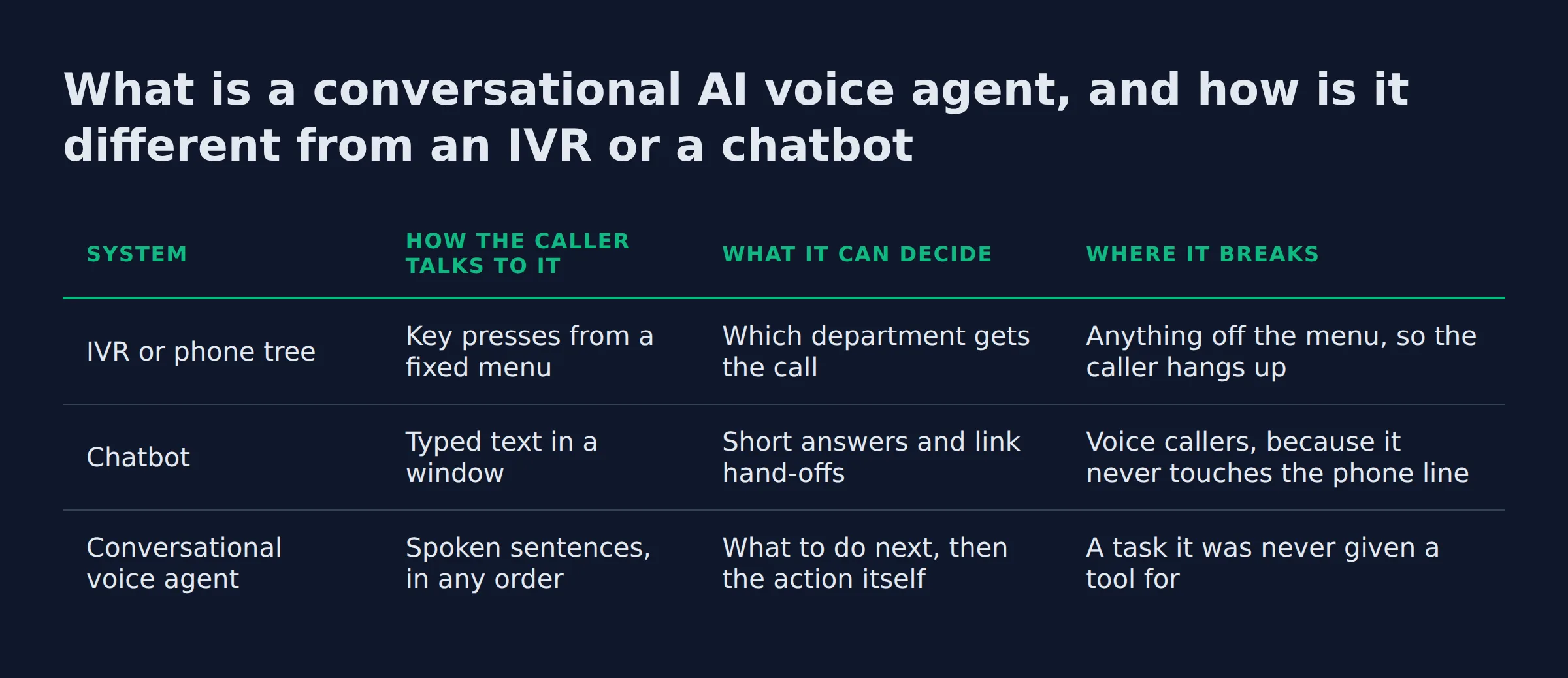
What is a conversational AI voice agent, and how is it different from an IVR or a chatbot?
A conversational AI voice agent holds a spoken back-and-forth. It decides the next step and finishes a task such as booking a job. An IVR plays a fixed menu of key presses, and a chatbot works in text. The voice agent adds speech in, a plan, and an action out.
The difference shows up the moment a caller says something the menu never listed. An IVR (interactive voice response) answers with a phone tree. Press 1 for sales, press 2 for support. It has run that job since the 1990s, and it still cannot handle “move my Tuesday job to Friday”.
A chatbot fails on a phone line for a simpler reason. It never touches the call audio at all.
| System | How the caller talks to it | What it can decide | Where it breaks |
|---|---|---|---|
| IVR or phone tree | Key presses from a fixed menu | Which department gets the call | Anything off the menu, so the caller hangs up |
| Chatbot | Typed text in a window | Short answers and link hand-offs | Voice callers, because it never touches the phone line |
| Conversational voice agent | Spoken sentences, in any order | What to do next, then the action itself | A task it was never given a tool for |
OpenAI’s own guide describes the category in one line. Voice agents “let users ask questions and complete tasks” by speaking with your application (OpenAI voice agents guide).
Owners searching for an ai assistant for small business usually mean one of two things. One is a text helper inside their tools. The other is a phone agent that answers when they cannot. This page covers the second, and our post on the AI virtual assistant covers the definition and the human-versus-software call.
The test is one sentence. Say something the menu never listed, and see which system can answer.
How a voice agent works, from the ring to the booked job
Every voice agent runs the same loop. Speech recognition turns the caller’s audio into text. A language model decides the next move, and text to speech reads the answer back out.
The chain under that loop has five links:
- Telephony brings the call in over
SIPorWebRTC. - Speech recognition, or speech to text, writes down what the caller said.
- The language model reads the natural language and plans the next step.
- Text to speech answers out loud.
- A tool call writes the booking into your calendar.
Those links come from named vendors. Twilio carries telephony, Deepgram runs speech to text, and ElevenLabs or Cartesia supplies the voice.
OpenAI’s guide lays out the three ways a voice agent can be wired (the three ways a voice agent can be wired). A speech-to-speech model runs the whole turn on its own. A realtime session keeps a live connection open. A chained pipeline lets you control each stage.
The chained pipeline is the one you can debug. The speech-to-speech model is the one that tends to sound best. Most small builds start on the chained pipeline, because a wrong answer is easier to find when you can read the text step.
Latency decides whether any of that feels natural. The same guide tells builders to measure response timing and how the agent yields to interruptions (OpenAI’s notes on measuring response timing).
Speech recognition, a planning model, and text to speech are the 3 parts. The wiring between them is the part you can tune.
What can a conversational voice agent do for a small business?
A voice agent answers every call and handles the common questions. It books and reschedules jobs, routes urgent calls to a person, and calls back the leads that never reached anyone.
The job list maps to work an owner already does by hand:
- Answer after hours, when nobody can pick up.
- Qualify the caller and write the booking into the calendar.
- Route an urgent call to a person right away.
- Call back the missed and abandoned calls as outbound work.
- Chase estimates and review requests on a schedule.
Some vendors market the same thing as an AI receptionist. The job is the same either way, and the owner still pays a person to answer the phone today.
Invoca reached its 27 percent missed-call figure by analyzing more than 60 million home services calls, so the gap is measured at scale (compiled missed-call data). Under 3 percent of the voicemail callers left a message at all.
The market is early. Only 3.8 percent of US businesses used AI to produce goods and services when the Census published that figure on November 28, 2023 (the Census business survey). The date matters, because the line is old and the trend is up.
The SBA’s guidance for small business makes the plain case. AI tools can solve common problems, and owners should weigh the risks next to the benefits (SBA’s AI guidance for small business).
Owners shopping for ai agents for small business want a number they can check, and a phone line gives them one. It is also one of the clearest ai agents examples, because the work is easy to count.
For the full picture, see Best AI Receptionist for Small Business.
I run my own follow-up on autopilot, and it takes about 200 form submissions a day. A voice line is the same shape with a microphone in front of it. The work is answering, deciding, and logging.
AutomateReal skills
If you run a trade, our page on AI agents for home service businesses covers dispatch and booking at the trade level. This page stays on the voice ground.
The agent does the job you already pay a person to do. It answers, decides, and books.
How human a voice agent sounds, and what still breaks the illusion
Latency is the tell. A voice agent that pauses too long before it replies reads as a machine, and the smaller giveaways follow the same path.
The breaks that callers notice:
- A gap of more than a second before the reply starts.
- Talking over the caller instead of yielding when they interrupt. That yield is called barge-in.
- Missing a name or a street heard over background noise.
- Flattening an accent the model was never tuned for.
- Losing the thread of a turn after the caller changes the subject mid-sentence.
The agent can also invent a booking slot that is not open, which the vendors call a hallucination.
ElevenLabs advertises sub-500 millisecond latency and 70 plus languages for its conversational AI (ElevenLabs conversational AI). That is the vendor’s own number, not a third-party test, so treat it as a target.
A voice agent also cannot read a room. Sentiment and tone help a little, and neither replaces a person who can hear that a caller is upset.
Most virtual assistant ai examples you can try are text tools. The voice ones are where the illusion gets tested, and where turn-taking matters most.
Plenty of callers just want the job booked fast. A quick plain agent wins that caller over a perfect voice every time.
Speed is most of the illusion. A fast reply covers more small defects than a fancier voice model.
What does a conversational voice agent cost per month?
A pay-as-you-go voice line bills by the minute, not by the month. Retell prints $0.07 to $0.31 per minute. The bill moves with answered minutes, peak concurrent calls, and how long the agent talks.
No page in the top results prints a total monthly cost for one small business line. Published vendor pricing is the only honest source, so I priced the drivers instead, the way I price any workflow.
Anyone comparing the best ai agents for business automation lands on the same question. What does one line cost each month, and what moves that number.
The 4 numbers that set the bill:
- Answered minutes a month, which is call count times average length.
- Peak concurrent calls, meaning how many lines ring at once at 9am.
- Agent talk time, which sets the text to speech cost.
- Escalation rate, meaning the share of calls that end with a person.
The published rates turn those drivers into a range. At Retell’s printed $0.07 to $0.31 per minute, 300 answered minutes a month runs $21 to $93 before model calls (Retell pricing). Retell also includes 20 free concurrent calls, so a small shop under that peak owes nothing extra for capacity.
ElevenLabs prices speech in credits on a plan ladder that runs from free to $990 per month at the Business tier (ElevenLabs pricing). Text to speech burns 1 credit per character. Speech to text burns 330 credits per minute. The pool is shared across the vendor’s products, so a busy voice line eats into everything else on the plan.
| What you pay for | The published rate | What to watch |
|---|---|---|
| Answered minutes | Retell: $0.07 to $0.31 per minute |
Minutes answered, not calls placed |
| Concurrent calls | Retell: 20 included free |
Peak simultaneous calls, billed per line beyond that |
| Text to speech | ElevenLabs: 1 credit per character |
How long the agent talks, not the caller |
| Speech to text | ElevenLabs: 330 credits per minute |
Minutes transcribed, silence included |
| The platform plan | ElevenLabs: free to $990 per month |
Seat count and one shared credit pool |
Scoping the honest total for one line is the kind of work our AI services page takes on, because the number tracks your call volume and not a price list.
AutomateReal services
The monthly bill follows answered minutes, peak concurrent calls, and talk time. A per-minute rate alone tells you little.
Which voice agent should a small business pick, and which one should it avoid?
Pick the option whose billing shape matches your call pattern and whose docs you can follow. For most small shops that means a pay-as-you-go voice API for the phone layer and a hosted platform for the speech.
Most top ai agents lists rank on features, and skip the fit question. Directory pages such as G2 and Gartner rank tools on reviews, and a review score does not know your call volume. The vendors on page one sort better by what they are.
| Option | What it is | Pricing shape | Watch out for |
|---|---|---|---|
ElevenLabs |
A voice platform with a conversational AI layer on top | Credits on a plan from free to $990 per month | One shared credit pool across products |
Retell |
A pay-as-you-go voice agent API | $0.07 to $0.31 per minute, 20 concurrent calls included | Per-minute billing climbs on long calls |
Vapi |
A developer voice agent API | Usage based, set by the vendor | You own the wiring and the debugging |
Lindy |
A no-code agent builder | Subscription | Simple call flows only before the ceiling |
Voiceflow |
An enterprise CX design platform | Enterprise pricing | Built for contact centers |
OpenAI Realtime API |
The model layer under many of these | Usage based | You become the vendor |
No page in the top results says which of these fits a five-person shop. That is the gap this section fills, and it is where best ai agents for small business searches usually stall.
Two rules cut most of the list:
- Avoid picking on voice quality alone, because the billing shape decides your worst month.
- Avoid an enterprise platform for a small team, because the per-seat price and the sales process both assume a contact center.
A third rule is firm. Skip any tool that cannot hand a call to a person and cannot write a transcript you can read.
Choose the billing shape first. A tool that fits your call volume beats a better voice you cannot afford at peak.
Is an AI voice that sounds human legal?
Yes, with the consent rules in place. An AI voice that sounds human falls under the TCPA when you place calls, so an agent that dials out needs prior express consent from the person it calls.
The FCC confirmed this in its 2024 declaratory ruling. Calls that use AI-generated voices “fall under the TCPA” and “require the prior express consent of the called party” (the FCC’s 2024 ruling on AI-generated voices).
No vendor page in the top results prints that duty. The ruling I read covers calls that use the AI voice to deliver a message, which is the outbound case. An agent that only answers inbound calls sits somewhere else, so disclose anyway and check your own state.
The NIST AI Risk Management Framework gives you the review vocabulary your lawyer and your insurer both use. Its core runs on 4 functions: govern, map, measure, and manage (the NIST AI Risk Management Framework). Write down who owns the agent and what it may decide. Then write how you measure it and what you do when it is wrong.
Data rules follow the call. If the agent touches health information, ask for the vendor’s HIPAA business associate agreement before anything goes live. ElevenLabs lists BAAs for HIPAA customers and GDPR terms on the page I read (ElevenLabs compliance notes).
Keep a call recording and a transcript with a retention window you can defend. Keep a human in the loop for anything that costs money.
The federal rule I can cite covers the calls you place. For the calls you answer, disclose and keep a clean transcript.
How do you get one running, and what breaks in month one?
Run it in this order. Pick the phone layer, connect the calendar, write the escalation rules, then test 50 real calls before the line answers unsupervised.
Building ai agents for small business starts with the boring parts: the number, the calendar, and the handoff. The voice is the last thing to tune.
The booking step writes to whatever you already use, from a calendar API to Calendly.
Live workflows break quietly, and I know this from my own system. My outreach setup handles about 200 form submissions a day, and when an upstream API changes shape, the failure shows up as missing rows rather than an error. Nobody notices until someone counts.
The check between a machine draft and a customer-facing action is a person. Nothing leaves my systems until a human approves the draft. On a phone line the same idea is a review window: read the transcripts of the first 50 calls before the agent runs alone.
The first month, week by week:
- Week 1: run the agent on a second number and listen to every call.
- Week 2: fix the 5 questions it gets wrong most often.
- Week 3: point the escalation path at a named person.
- Week 4: count answered calls, booked jobs, and calls a human had to finish.
The upkeep after that is short and steady:
- Re-read the transcript log every week.
- Re-test the booking call after any calendar or CRM change.
- Watch the concurrent-call count as volume grows.
- Update the escalation rule when staff change.
Getting one line from a demo to a running service is the work our AI services page does.
Month one is about upkeep. The break that hurts is the one with no error message.
For a managed version, see the AI services page.
Related: AI Agents Examples: Real Use Cases for Small Business
Related: How to Build an AI Agent
Related: AI Agents for Customer Support: What They Do and Cost
FAQ
Can I get a conversational voice agent for free?
Yes, at a small scale. ElevenLabs runs a free plan, and Retell includes free concurrent calls, so one low-volume line can run at no cost while you test. Minutes, model calls, and text to speech still bill once real callers arrive.
Do I have to tell callers they are talking to an AI?
The federal rule I can cite covers the calls you place, not the calls you answer. I found no single inbound disclosure rule in it, so treat disclosure as your own house rule and say it in the greeting.
What happens when the voice agent does not know the answer?
It hands the call to a person. The escalation rule needs a named owner and a clear trigger, because an agent with no handoff path guesses, and a guess on a booking call loses a customer.
Does a voice agent work with my phone number and the tools I already use?
Usually yes. Most platforms ride on your existing line through SIP, and the agent writes to the calendar or CRM you already run, from HubSpot to Salesforce. Check the integration list first, because a missing link turns the booking step into manual work.
Which AI agent is best for small business?
The one that fits your call volume and hands off cleanly. For a phone line, that is usually a pay-as-you-go voice API on a hosted speech platform. Voice quality is the easy thing to compare and the least likely to decide the outcome.
Wiring the first line
If you want help standing up that first voice line, a discovery call maps it in about thirty minutes. We scope the phone layer, the calendar, and the handoff before anything answers a real call.