AI Automation Agency: What It Builds and What It Costs
An AI automation agency builds the workflows that move work between your tools. What one builds, what it costs, and how to spot a reseller.
A quote for $9,000 to connect software you already pay for is normal now. The deck is full of logos. Nothing in it says what you hold if the agency stops answering email in March.
An AI automation agency builds and runs the workflows that move work between your existing tools. Most run on n8n, Make, or Zapier, with a model inside the step that needs judgment. Expect $1,500 to $12,000 for a first build, then $1,000 to $12,000 a month.
That is the short answer. Most pages on this keyword stop there, and much of the rest is YouTube videos about starting an agency. Those are written for the seller. This page covers the part that outlives the invoice: what you keep.
TL;DR
- An agency sells a workflow. The workflow is the thing you should own at the end.
- Published ranges run $1,500 to $12,000 for a first build and $1,000 to $12,000 a month on retainer.
- Four questions decide whether a job is worth building. Repeat rate matters more than process size.
- The handover separates a builder from a reseller. Ask what holds the instance before you ask for a discount.
What does an AI automation agency actually build?
An AI automation agency builds workflows inside the stack you already run. A trigger in one tool fires and a model step handles the messy part. The result lands in a tool your team already opens. n8n, Make, and Zapier carry most of the plumbing.
The model step is where agentic AI for business shows up in practice. It reads an email, pulls fields off a PDF, or drafts a reply. Everything around that step is plumbing you could draw on a whiteboard. The judgment is what you buy.
A scoped build usually contains:
- A trigger from a form, a schedule, or a webhook
- Field mapping across HubSpot, Salesforce, Airtable, Slack, or GoHighLevel
- One model step for the part with judgment, on OpenAI or Claude from Anthropic
- A human in the loop gate before a customer-facing message sends
- A run log a non-technical person can read after a bad night
A chatbot answers inside one window and waits for the next message. A workflow that acts takes the next step alone, calls a tool, and checks what came back. LangChain is one way to wire that. A plain n8n node is another, and the choice rarely shows up on the invoice.
Newer builds reach for Model Context Protocol (MCP). It gives a model one interface for calling any tool, so each app needs no custom connector. Retrieval over a document store covers the other half, where the model reads your price list or policy PDFs instead of guessing at them.
Voice agents from Retell or Vapi, and RPA bots from UiPath or Automation Anywhere, turn up in the same buying conversation. RPA clicks through an old desktop system. A voice agent answers the phone. Both can sit inside one scope of work.
The job list, sorted by function, sits in what automation services cover in practice.
The tool list is the easy half of the scope. The exception rules carry the value.
Which jobs should you hand to an agency first?
Start with a job that repeats every week, touches 2 systems, and fails loudly. Lead follow-up and quote intake pay back fastest. Invoice entry and inbox triage come next. A first build that needs a whole department’s judgment is a bad first build.
Adoption is uneven. That gap is where the opening sits. As of May 3, 2026, the Census Bureau survey of AI use put business AI use at 19.8% nationally.
Size decides most of that number. Firms with 250 or more employees reached 37%, which is how larger firms adopt faster. Less than 20% of firms with four or fewer employees reported any use at all. A 6-person shop has no spare person to hand the work to.
Ask 10 owners for AI agent examples for small business work and 4 jobs come back every time.
- Lead follow-up. A form or call comes in, the first reply leaves in minutes, and 2 later touches run if the thread goes quiet.
- Quote intake. A request arrives as an email or a PDF, fields get pulled, and a draft quote lands in front of a person.
- Document entry. Numbers move from a PDF into Airtable or your books, and a mismatch gets flagged instead of entered.
- Inbox triage. Mail gets sorted into a queue with a name on it, so nothing sits unread for a week.
Pick one and let it run for a month before you add a second. Two half-tested workflows cost more than one that holds. One at a time wins.
My own lead system takes about 200 form submissions a day. The form handler is the easy part. The follow-up after a quiet reply is the build I would pay an agency for.
The first build should be the job you would pay overtime to clear this month.
The screen I run before I quote a workflow
I put 4 questions to a workflow before I price it. Three yes answers make it a build. Two make it a rule your team follows by hand. The questions below came out of running these systems on my own work.
- Does it repeat at least weekly? A monthly task rarely pays back a build. A daily one pays back inside the first month.
- Does the input arrive messy? Clean structured data is a Zap. An email, a photo, or a scanned PDF needs a model step and an exception queue.
- What does a wrong answer cost? A wrong internal note costs minutes. A wrong quote to a customer costs the job. Cap that second kind with a human check.
- Who fixes it at 11pm? If the answer is you, the payback math needs your evening inside it.
The distance between yes and no is my quote. Repeat rate decides it. A 4-step task that runs 20 times a day pays back fast. A 40-step process that runs once a quarter does not.
I learned this on my own follow-up automation. Sending the email was easy. Deciding what counts as a reply that needs a person took longer than the build, and that rule is still the part I revisit.
Score the workflow before you score the price.
What engagement models do AI automation agencies sell, and what do they cost?
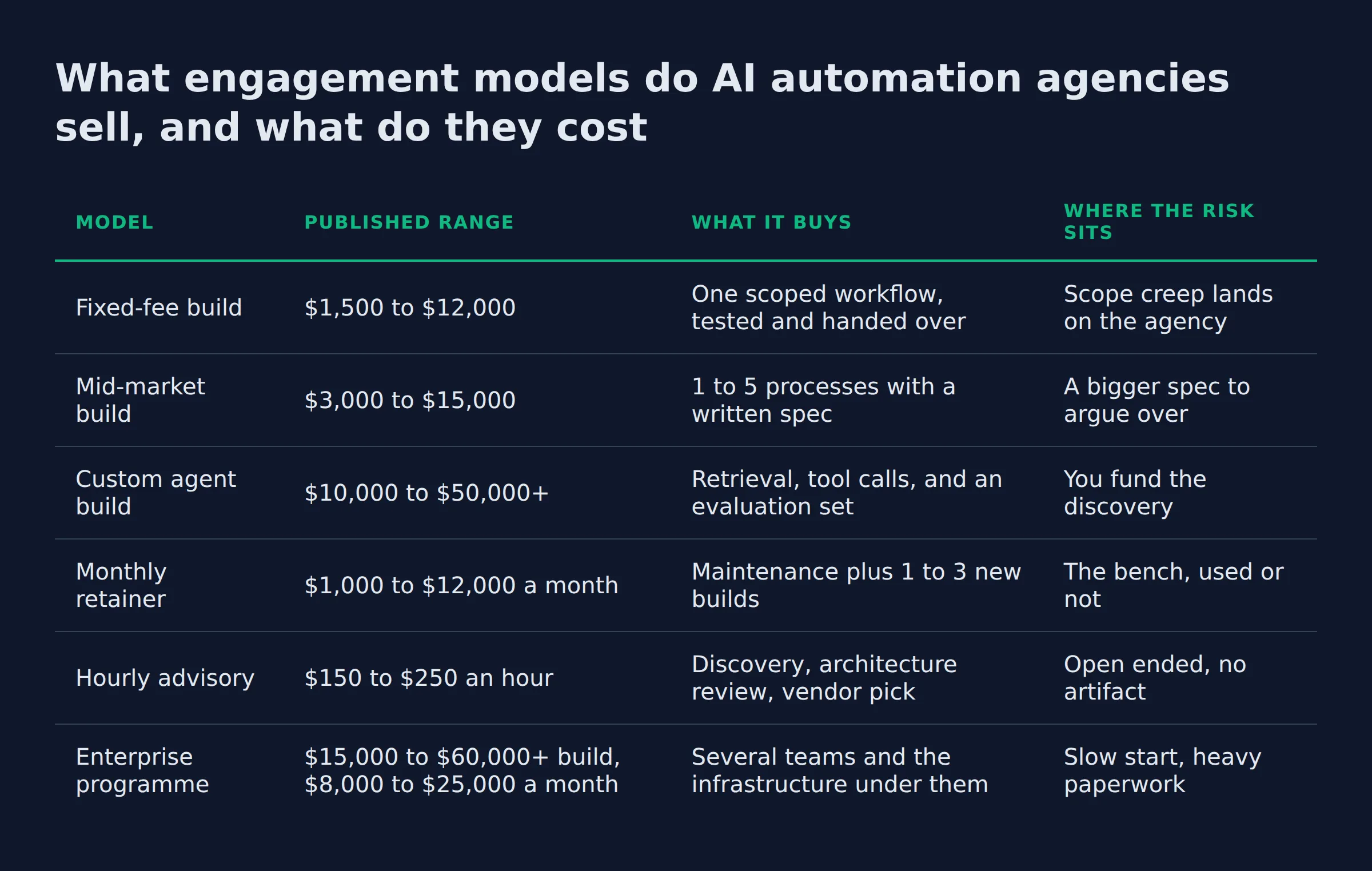
Agencies sell 4 shapes, and each one moves risk to a different side. A fixed-fee build runs $1,500 to $12,000. A retainer runs $1,000 to $12,000 a month. Custom agent work starts near $10,000 and passes $50,000.
One shop puts those first-build and retainer figures in its published agency pricing ranges. A mid-market shop quotes a second published price list. It puts builds at $3,000 to $15,000 and retainers at $2,500 to $8,000 a month.
| Model | Published range | What it buys | Where the risk sits |
|---|---|---|---|
| Fixed-fee build | $1,500 to $12,000 | One scoped workflow, tested and handed over | Scope creep lands on the agency |
| Mid-market build | $3,000 to $15,000 | 1 to 5 processes with a written spec | A bigger spec to argue over |
| Custom agent build | $10,000 to $50,000+ | Retrieval, tool calls, and an evaluation set | You fund the discovery |
| Monthly retainer | $1,000 to $12,000 a month | Maintenance plus 1 to 3 new builds | The bench, used or not |
| Hourly advisory | $150 to $250 an hour | Discovery, architecture review, vendor pick | Open ended, no artifact |
| Enterprise programme | $15,000 to $60,000+ build, $8,000 to $25,000 a month | Several teams and the infrastructure under them | Slow start, heavy paperwork |
Both lists are agency blogs that reviewed public rate cards, so read them as asking prices. Neither is survey data.
The build and the retainer usually arrive as separate lines. Setup fees run $2,000 to $12,000, and some shops waive one against a 6-month commitment. Read both lines.
A retainer that lists no deliverables is a fee with no output. The version worth signing names 3 things: maintenance, a set number of new builds each month, and a named contact. Get it in writing. The same source on what a standard retainer includes also expects monthly reporting and prompt tuning for the AI steps.
The tools bill separately. Zapier and Make run $50 to $500 a month at low volume, and that fee sits outside the agency invoice.
Most small buyers ask about AI agent cost for small business work. The answer sits at the low end of each row above. Token cost is the line most quotes leave blank. It grows with document volume. The API key holder pays it.
A savings share moves that risk to the agency. It also moves the argument to month 6, because nobody agrees on the baseline by then.
Ask for the year-one total. The build fee gets negotiated, and the retainer is what you actually pay.
Agency, freelancer, or in-house hire: which one fits?
An agency fits 3 or more workflows that need upkeep and a person to call. A freelancer fits one workflow on a fixed budget. An in-house hire fits steady volume at roughly $8,300 a month loaded, before the first workflow ships.
| Question | Agency | Freelancer | In-house hire |
|---|---|---|---|
| Who builds it | A team with a delivery process | One person, sometimes with a subcontractor | Your hire, learning your stack |
| What it costs | $2,500 to $8,000 a month at mid-market | One fixed build fee | About $8,300 a month loaded |
| Continuity | Survives one person leaving | Stops when they stop replying | Rests on one hire too |
| Breadth | Voice, RPA, and model work under one roof | One specialty | One person’s range |
| Best fit | 3 or more live workflows | A single well-specified build | Volume you will keep for years |
| Weakness | You are one account among many | No bench, no cover | Slow to start, hard to undo |
The $8,300 figure is the hiring shop’s own working estimate. Treat it as the floor for a loaded salary.
The choice usually turns on repair hours. A cheap build that nobody maintains costs more by month 4 than the retainer did.
How to build an AI agent for a small business is really a question about who builds it. One workflow is about a week of work for someone who has done it before. A beginner takes far longer.
A freelancer is the right call for build 1. Build 5 arrives with a maintenance load and no bench.
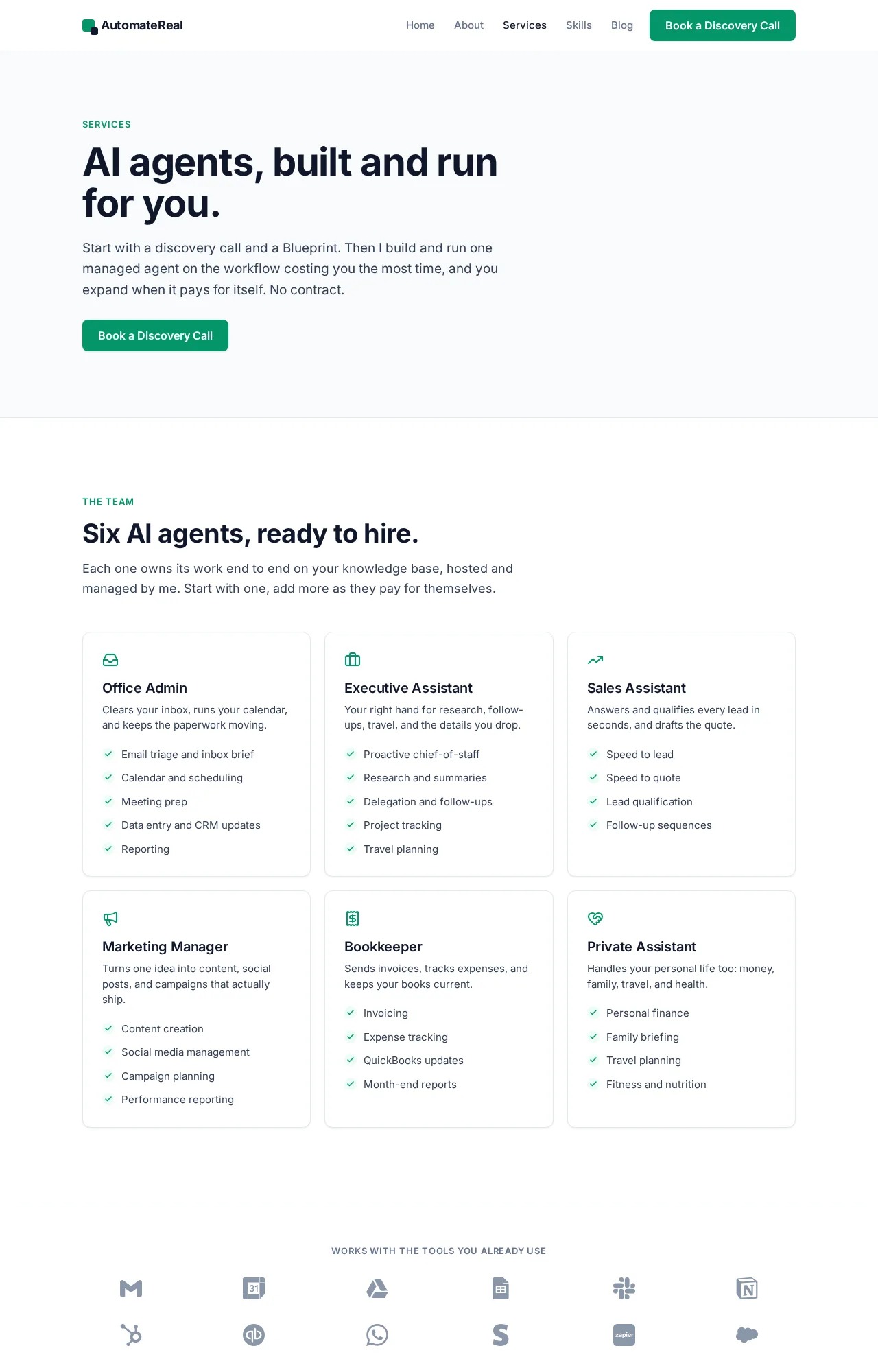
If you want to see how a build is scoped before you compare vendors, the AI services page sets out what an engagement covers.
AutomateReal services
Buy the option that includes the repair hours.
Reseller or builder: how to tell in one call
Ask what holds the instance. A builder names the platform and offers you the login. A reseller names their own account and moves the conversation to results. That one question sorts a shortlist faster than any demo.
- Who holds the n8n instance? Self-hosted on a server you rent, or cloud in your name. An instance inside the agency’s account leaves you renting the thing you paid to build.
- Can they show last week’s run history? A builder screen-shares it in a minute, failures included.
- What broke in the last build, and what changed? A shop that cannot name a failure has not run enough workflows to see one.
A reseller can still be a fair deal. The margin just has to be visible. Ask for it as its own line on the quote.
The agents that wrote this post run in a repo I control, on keys I hold. If I changed model vendor tomorrow, the workflows would still be mine. That is the test I would run on any shop holding my work.
AutomateReal skills
A builder can show you the plumbing. A reseller can only show you the invoice.
What belongs in the proposal before you sign?
A proposal should name the workflow, the tools it touches, and the data that crosses. It should also fix the definition of done, the monthly fee, and the fix window. Every security claim should arrive with a document behind it.
- Scope as one named workflow. Write a sentence you can test, like “a website quote request gets a first reply within 5 minutes”. Vague promises pass no test.
- Definition of done. Who tests it, with which exceptions, and what counts as a fix.
- Data map. Which fields leave which system, where they land, and how long they stay.
- Credential scope. A token per workflow at the narrowest permission. An admin password in a shared doc fails this check.
- Security documents. A SOC 2 report and a signed data processing agreement if personal data is in the flow.
- Fix window in hours. A service level agreement that says best effort is a window nobody can measure.
Data and oversight questions get easier with a reference point. NIST publishes the AI Risk Management Framework and a companion Playbook that a proposal can cite. That framework is under revision as part of the White House AI Action Plan. Name the version you relied on.
GDPR duties land on the buyer when EU personal data crosses the flow. The agency is the processor. You are the controller, and you answer for the data.
Put the data processing agreement on the table at the demo.
Who owns the workflows when the contract ends?
You should own the workflows, the credentials, and the run history. That means an instance in your name, every workflow exported as a file, and an admin login you control. A build inside the agency’s account hands them the advantage at renewal.
n8n ships two ways. Self-hosted runs on a server you rent, so patching lands on you. Cloud runs on their infrastructure, which is fine as long as the login is in your name. The first workflow in n8n is where most builds start.
Every workflow exports as JSON. Ask for the export with the final invoice, while the relationship is still friendly.
An exit clause needs 2 numbers: a notice period and paid handover hours. Retainers that promise new builds each month often say nothing about handover time. Write both numbers into the statement of work.
Rotate every credential the day you leave. A token that outlives the contract is a door with a friendly name on it.
The exit clause is cheap on day one and expensive on day 300.
FAQ
Which industries hire AI automation agencies most?
The buyers cluster where the paperwork repeats. Agencies and field service dispatch buy first. Insurance back offices and legal intake follow. Census sector data shows the pull. Information sits at 39.7% AI use, and Finance and Insurance at 33.9%, against a 19.8% national rate.
How long until the first automation is live?
A single workflow goes live in days once the scope is signed. The wait is testing, where real exceptions show up and the rules get rewritten. Give it a few weeks before it runs without someone watching.
Do I have to replace the software my team already uses?
No. The workflow sits on top of HubSpot, Salesforce, Airtable, Slack, or GoHighLevel and moves data between them through their APIs. A tool with no API and no export is the one case where a swap comes up.
Is an agency worth it for a business with fewer than 10 people?
Sometimes. The case rests on hours, and the retainer band is real. Small shops running 2 or 3 workflows should budget $1,000 to $3,500 a month. Below that, one fixed-fee build and no retainer is the honest buy.
What do agencies get wrong most often?
They build the demo and skip the exceptions. A workflow that holds on clean inputs still needs a queue for the rest, and a queue needs a name on it. Ask who reads that queue.
If you are weighing an agency against building it yourself, a discovery call maps the first workflow in about thirty minutes. Bring the job that eats your week. You will leave knowing which half is a model step and which half is plumbing.