Automation Consulting Services: What They Do and Cost
Automation consulting services find what to automate, price the fix, and stay to build it. What consultants do, how engagements run, and what they cost.
Three quotes sit on your desk and none of them says what you hold at the end. One is a discovery week. One is a retainer with no deliverable list. The third is a slide deck with a logo page.
Automation consulting services are advisory engagements that find the manual work in your business, decide what to automate first, and stay to build it. You pay for the judgment, the roadmap, and the first workflow that runs.
Search this phrase and the results are plant-floor consultancies, a B2B directory, a staffing page, and 2 Reddit threads. Almost none of them speak to the owner who has to sign.
This page covers the 2 things those results skip: what the work costs and what lands on your desk at the end.
TL;DR
- A consultant sells an audit, a ranked roadmap, and a first workflow that runs.
- Page one of the audit is the ranked list. If it needs a meeting to explain, ask for a rewrite.
- Fixed scope suits a first engagement, because the price lands before the build starts.
- The platform bill is the small line.
n8nlists 50 euros a month for 10,000 executions (n8n pricing).
What does an automation consultant do that an agency or a tool does not?
An automation consultant finds the manual work, ranks what to fix first, and stays to build and hand over the workflow. An agency runs the build. A tool sells the rails and leaves the design to you.
The line between a consultant and an agency comes down to who holds the map. A consultant writes it, then hands it to whoever builds. Most agencies do both halves, and the honest ones say which half you are buying. If you are weighing a build shop, what an AI automation agency builds and what it costs covers that side.
Plant automation is a different trade with its own words. That work runs on PLC logic and SCADA screens, reports against OEE, and logs every run in an MES. It gets sold as digital transformation, and its project paperwork is worth copying.
One choice comes before any tool. Buy a platform and you own the design. Buy a build and you own the result. The fee buys the second one, and the platform license is yours either way.
A consultant also covers the parts no demo shows. Integration with what you already run, dirty data, and the name of the person who gets called when a step fails.
You are buying the decision about what to automate first, plus a person who stays for the build.
The tools a consultant actually opens
The tool names show up early, because the audit is a map of what you already pay for. A consultant who arrives with one platform to sell has already answered the question.
- The workflow layer.
n8n, Make, Zapier, or Microsoft Power Automate. The pick follows volume and who maintains it. - The model step. OpenAI API or Anthropic Claude, for the part that reads or drafts.
- Systems of record. Airtable, HubSpot, Salesforce, Google Workspace, QuickBooks.
- The message layer. Slack for the team and Twilio for the customer.
- A desktop bot. UiPath, for the job whose only interface is an old Windows screen.
Integration is where a scope lives or dies. Every tool above has an API, and most have more than one way in. The audit should name the route it uses and what happens when a token expires.
Data quality decides how hard the model step is. A phone column with 3 formats needs cleaning before anything else runs. Where the workflow touches health or payment data, the contract work starts. Ask for the data processing agreement, and ask which vendor holds SOC 2 or ISO 27001.
IT support is a different invoice. Keep helpdesk hours off the automation quote.
The audit should name the tools you already own before it names a new one.
What happens in an automation consulting engagement, step by step?
Most engagements run 5 steps, from a discovery call to a handover. Each one leaves a document you keep, so you can stop at any point without losing the work.
- Discovery call. One conversation about what eats the week and where the data sits. You leave with a rough fit or a no.
- Process audit. One workflow walked end to end, with each handoff written down.
- Written assessment. The ranked list, the hours, and the first build named.
- Fixed-scope pilot. One workflow built and run in production, with an exception queue.
- Handover. The runbook, the credentials, and a named owner on your side.
The cadence of the automation consulting process matters as much as the step list. A weekly review with the internal owner keeps a pilot from drifting, and a short note after each one gives the next session something to check.
Before the pilot, the statement of work fixes the scope to one workflow. It also names the systems touched, the acceptance test, and who owns each side. That document is one page. A binder is the wrong shape.
Roles stay small on a 10 person job. The operations manager usually ends up as the internal owner, and a solutions architect appears only when the build half needs one.
The work on this lane is listed on the AI services page, which covers the build side as well as the advisory side.
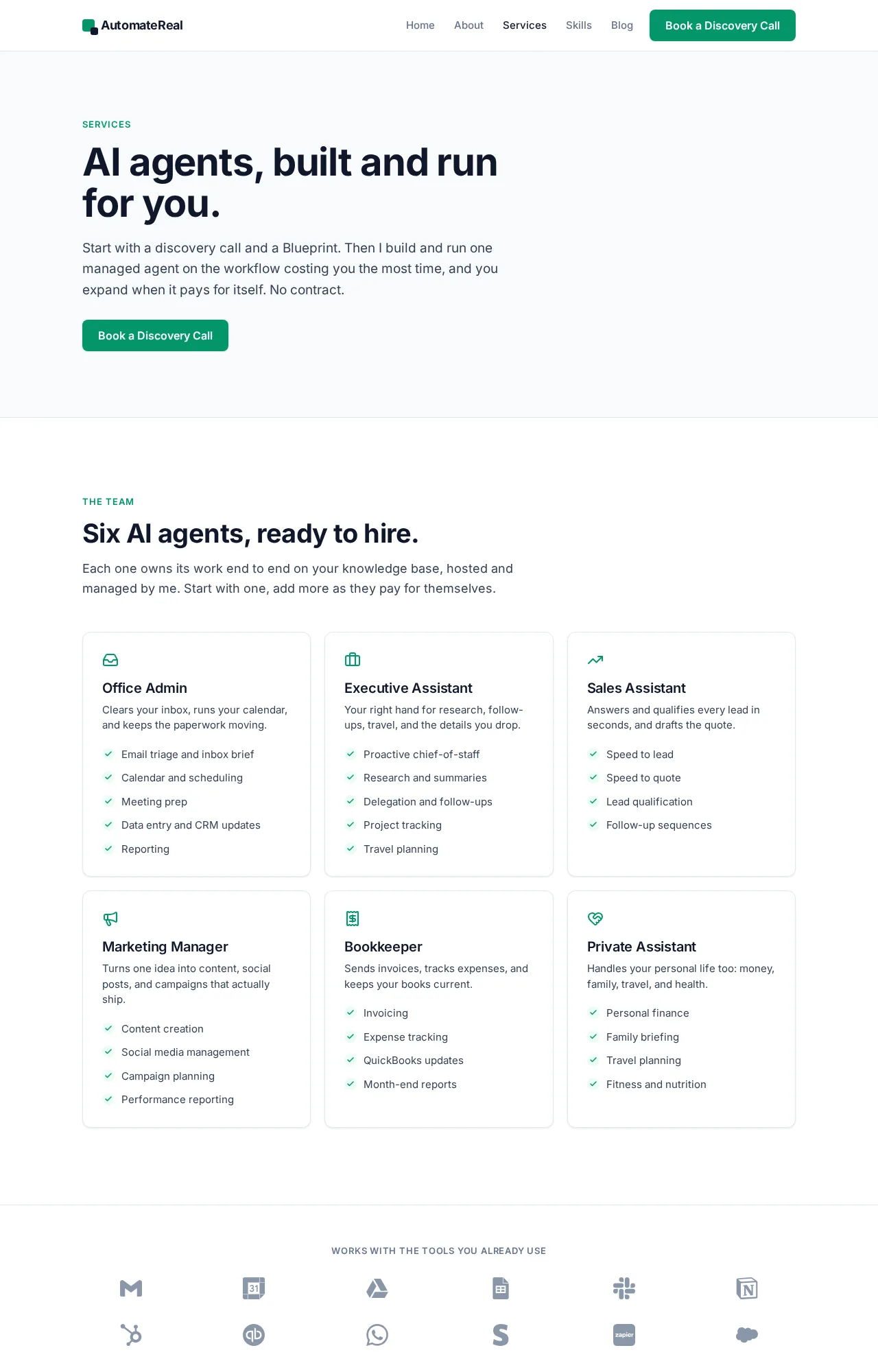
AutomateReal services
Every step should end with a file you own, or you paid for a meeting.
What should the automation audit contain, and what do you get in writing?
A usable audit names every process it looked at and the hours each one eats. Then it ranks the first 3 builds by payback period. Page one is the ranking, and the rest is the evidence behind it.
The template I use for page one of an audit is 6 rows. It is the test I would put to any audit handed to you. Each row answers one question, and the row fits on one line.
- The task, and what starts it.
- Hours it eats per month, counted from a real week.
- The systems it touches, and the owner of each.
- What a wrong answer costs, in money or in a lost customer.
- The rule a person applies by hand today.
- Hours saved per month, and the payback period in months.
Line 5 is the human in the loop gate, and most audits skip it. The rule a person applies by hand is the real spec, and it is the thing a model gets wrong first. Write it down and the build gets shorter.
The evidence part of the automation audit deliverable is where the judgment shows. How the hours were counted matters more than the total, and a sample week beats an estimate from memory.
I built the pipeline that produced this page, and it runs on the shape above. A task goes in, and something has to check what came out.
The pack also carries a RACI, a runbook, and an SLA for who answers when a run fails. Those 3 documents are what turn a recommendation into something your team can run.
Any AI step needs a risk practice around it. The NIST AI Risk Management Framework is a voluntary set of practices. It came out in January 2023 and is being revised under the White House AI Action Plan. Ask which of its practices your consultant follows, and get the answer in writing.
If page one needs a meeting to explain, the audit is not finished.
The handover pack, line by line
My rule for a handover is short. It arrives before the final invoice, and it works without a call.
- Credentials. The workflows sit on your accounts, on your billing.
- The runbook. How to restart a failed run, in plain words.
- The exception queue. Where bad runs land, and who clears them.
- Total cost of ownership. Platform fees, model tokens, and upkeep hours over 12 months.
Credential ownership is the line to check first. A workflow running on someone else’s account is a hold they have over you at renewal.
The runbook matters for one reason. The person who fixes the workflow in month 4 will not be the person who built it.
If the handover needs the consultant to explain it, you did not get a handover.
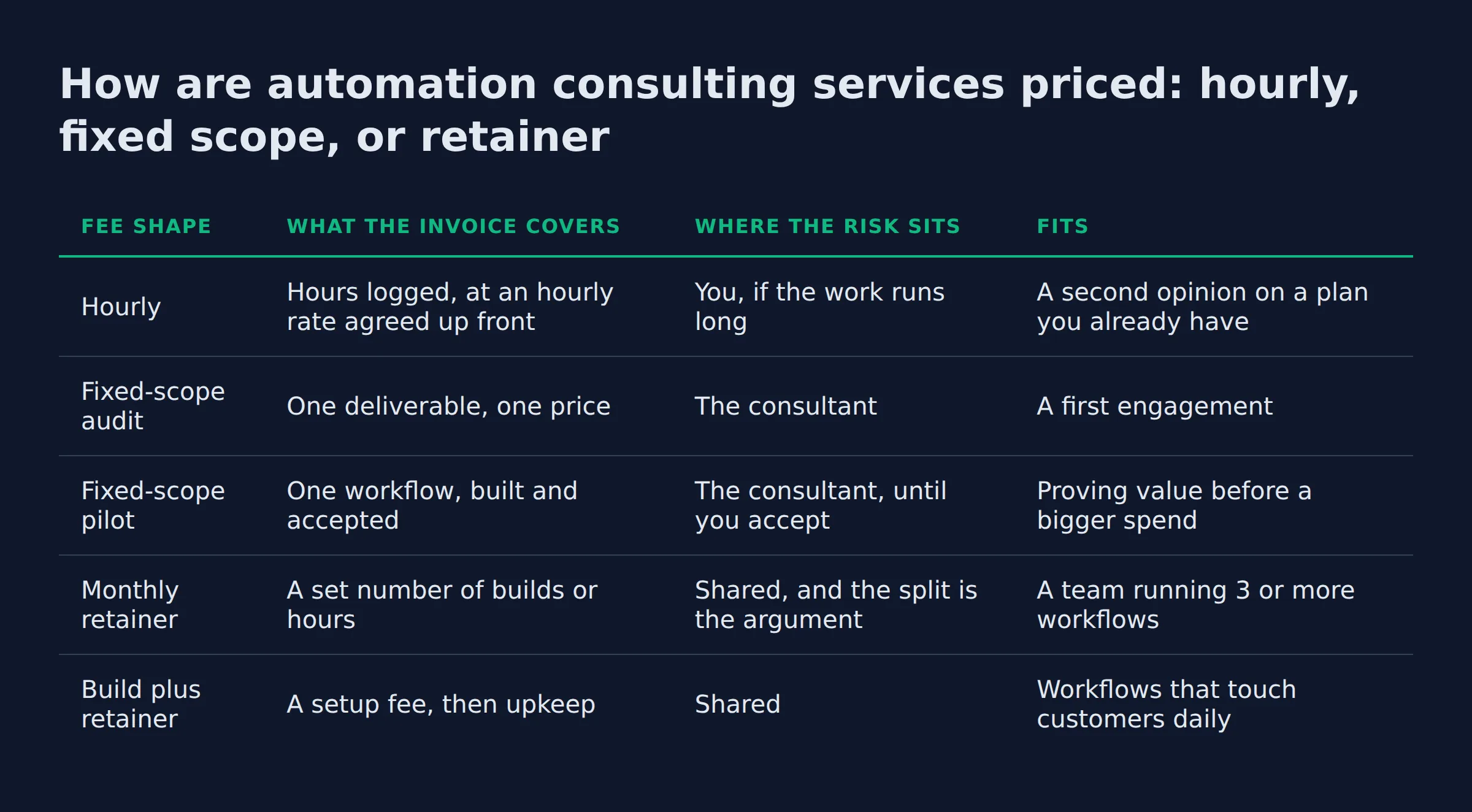
How are automation consulting services priced: hourly, fixed scope, or retainer?
Fees arrive in 3 shapes: hourly, fixed scope, and monthly retainer. A first engagement fits fixed scope, because the audit and the pilot get priced before the build starts.
| Fee shape | What the invoice covers | Where the risk sits | Fits |
|---|---|---|---|
| Hourly | Hours logged, at an hourly rate agreed up front | You, if the work runs long | A second opinion on a plan you already have |
| Fixed-scope audit | One deliverable, one price | The consultant | A first engagement |
| Fixed-scope pilot | One workflow, built and accepted | The consultant, until you accept | Proving value before a bigger spend |
| Monthly retainer | A set number of builds or hours | Shared, and the split is the argument | A team running 3 or more workflows |
| Build plus retainer | A setup fee, then upkeep | Shared | Workflows that touch customers daily |
The shape decides who pays when a job takes longer than planned. That is the whole difference, and it is the first line to read in a quote.
The tool bill is the smaller line. n8n lists its Pro plan at 50 euros a month for 10,000 workflow executions when billed yearly, n8n pricing. Zapier lists its Professional plan from $19.99 a month and a free tier at 100 tasks a month, Zapier plans.
Read the fee and the platform bill as one 12 month number. That number is the real automation consulting cost, and the platform is the part you keep paying after the work is done.
I do not publish a rate card here, because the fee moves with the stack. The order I quote in does not move. The audit first, priced before it starts, and the pilot priced after you have read page one.
The cost of running the work itself sits in what automation services cost per month. That post owns the monthly bill. This one owns the fee for the thinking.
Sign the audit before the build. It is the only document that can price the rest.
How long does an engagement take before the first workflow runs live?
Expect the audit inside 2 weeks and the first workflow live 3 to 6 weeks after kickoff. Nearly every delay comes from system access, test data, or a missing owner.
| Phase | Typical week | What has to be true to start |
|---|---|---|
| Audit | 1 to 2 | Read access to the tools and one sample week of data |
| Roadmap review | 2 to 3 | The internal owner in the room |
| Pilot build | 3 to 5 | Test credentials and a place for failed runs to land |
| Live run | 5 to 6 | A named person on call for the first week |
The automation consulting timeline above is the shape I plan against. Ask for the gate behind each date. A consultant who gives a date before seeing your stack is guessing, and the guess becomes your problem.
The first week live is the real test. Run the workflow beside the manual process for 5 days and compare the outputs before you switch anything off.
The date that matters is the one attached to a gate you control.
The week-one break I design for now
One of my own pipelines failed by writing a 0 byte file. Every agent in the chain reported success, and the run log looked clean.
The job finished and the output was empty. A reviewer read a blank page and sent it back, which is the only reason I found out.
The fix went into the process. The run now has to prove it wrote something worth reading before it reports success. That check sits at the top of the runbook.
The same shape shows up in a business workflow:
- An invoice that posts with a blank total.
- A lead that gets a tag and no owner.
- A quote that sends with last month’s price.
None of those throw an error. All 3 pass a status check, and all 3 cost money.
The person doing the task today should write the exception rules. They know which odd case matters, and that knowledge is the part a build cannot invent. Give them the exception queue for the first month and let them change the rules.
A green status on an empty file is the most expensive kind of success.
When is hiring an automation consultant a waste of money?
Skip the fee when the task runs less than once a week, or when 1 person clears it in a few minutes. Skip it too when nobody on your side can answer questions during the build. A workflow with no internal owner goes stale.
The do I need an automation consultant question usually answers itself once you count the runs per month. The monthly task rarely pays back a build. The daily one pays back inside the first month, and the fee stops being the big number.
You are also not late. Overall AI use sat between 17% and 20% from December 2025 to May 2026, per the Census Bureau’s Business Trends and Outlook Survey.
Size explains most of the gap. The same survey puts AI use at 37% for firms with 250 or more employees and 32% for firms between 100 and 249. A 12 person shop sits below both, and most demos you have seen came from a company with a department for this.
The tell in the first 15 minutes is simple. The owner cannot name the task in one sentence. When that happens I say so, and I point them at the skills bundle instead of a proposal. It holds the marketing, SEO and outreach skills I run myself, and all skills go for $99.
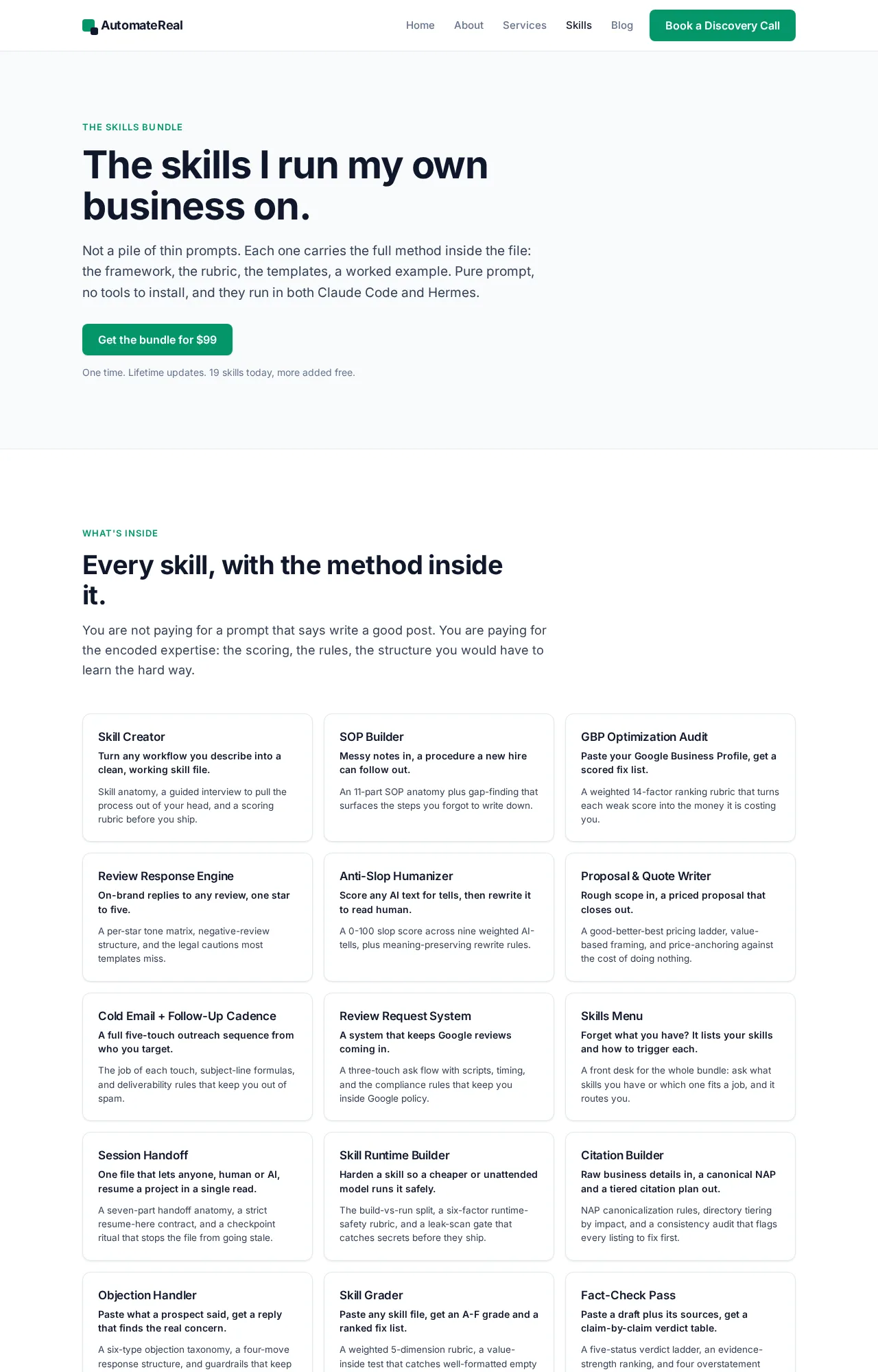
AutomateReal skills
Compliance is the other stop sign. A workflow touching health data, payment data, or EU residents needs a data processing agreement before it runs. HIPAA, GDPR and CCPA will shape the design.
If nobody on your team can own the workflow, the fee buys a demo that expires.
FAQ
Do automation consulting services replace the tools we already pay for?
They do not. A consultant works inside the stack you have and adds the connections between the tools. New software comes in only when the audit finds a gap nothing you own can fill.
Can a small business hire an automation consultant for one project only?
Yes. A fixed-scope audit or a single pilot is a normal first engagement, and it ends with a document and a workflow you keep. Stopping after either one is a fair outcome.
What is the difference between automation consulting services and an automation agency retainer?
A consultant is paid for the decision and the handover. An agency retainer is paid for upkeep and a set number of new builds each month. A first project usually needs the first one.
Do I need a technical person on staff to work with an automation consultant?
You need an owner who knows the task and can answer questions within a day. Engineering skill is optional. The runbook covers the rest.
What happens to the workflows if we stop working with the consultant?
They keep running if they sit on your accounts and use your credentials. Put that in the statement of work on day one, and keep a copy of the runbook with the logins.
Where to start if the task is already named
If you can name the task in one sentence and it runs weekly, the audit is the next step. A discovery call maps the first workflow in about 30 minutes, and the call costs nothing. The AI services page lists what happens after it.