Fiddler AI: What It Costs and Who Actually Needs It
Fiddler AI monitors agents, scores responses, and blocks unsafe output in under 80ms. What it costs per trace, and when a small business should skip it.
Every guide to Fiddler AI lists tools. None of them shows a bill. Here is the arithmetic, and the case for a 5-person shop skipping the whole category.
Fiddler AI is an enterprise AI observability and security platform. It records every step an agent takes. It scores each response for hallucination, toxicity and PII, and blocks unsafe output before a customer sees it. Observability is billed per trace.
TL;DR
- Fiddler AI is enterprise software for teams running agents at scale.
- At the published rate, 500 agent jobs at 8 steps each costs about $8 a month.
- The free tier blocks unsafe output but shows you no traces.
- A 5-person service business usually needs a workflow built, not monitored.
What is Fiddler AI, and what does it actually watch?
Fiddler AI is an observability and guardrail platform for AI agents. It traces each step from application to session to agent to action. It scores outputs for hallucination, toxicity, PII and prompt injection, and keeps an audit record of every decision.
That audit trail is what separates it from a log file. A trace is one request, and the spans inside it are the steps. Fiddler links those spans across applications, sessions, agents and actions. That is how it walks back from a bad answer to the decision behind it. The hierarchical tracing and OpenTelemetry support let it pull spans from the stack you already run.
The blocking layer is Fiddler Guardrails. Fiddler’s own Guardrails page calls it the fastest policy layer for agentic AI, catching a prompt or a response before it reaches the user or the model.
The Fiddler homepage lists what it scores, from hallucination and toxicity to PII and prompt injection. That page also claims inline enforcement under 80 milliseconds and 99 percent precision blocking jailbreaks in production. Both figures are vendor claims, so treat them as marketing until a third party repeats them.
Custom scoring is the other half. You can use Fiddler’s judges or bring your own, per the Fiddler pricing page. Fiddler Centor Models, formerly Fiddler Trust Models, run that scoring inside your network. Fiddler claims they cut evaluation TCO by up to 98 percent against calling a foundation model.
Fiddler scores answers on faithfulness, groundedness and answer relevance, and it can stop a bad response on the way out.
If you are comparing the best ai agents for business automation, this layer sits underneath all of them. Fiddler does not build the agent. It watches what the agent did. For the tools that sit above a layer like this, see our list of top AI agents.
How much does Fiddler AI cost?
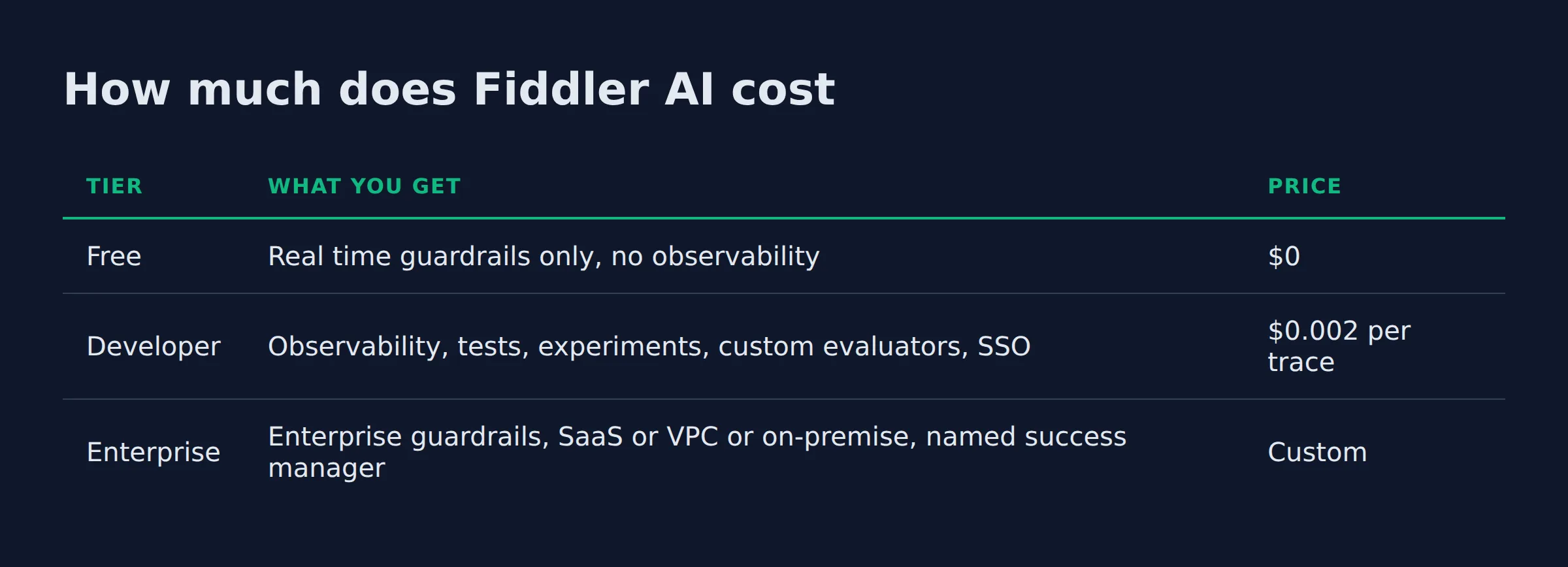
Fiddler publishes 3 tiers. Free is real time guardrails only. Developer is $0.002 per trace and adds unified observability, tests, experiments, custom evaluators and SSO. Enterprise is custom, with SaaS, VPC or on-premise deployment.
| Tier | What you get | Price |
|---|---|---|
| Free | Real time guardrails only, no observability | $0 |
| Developer | Observability, tests, experiments, custom evaluators, SSO | $0.002 per trace |
| Enterprise | Enterprise guardrails, SaaS or VPC or on-premise, named success manager | Custom |
Now the part the vendor pages skip. At $0.002 per trace, 500 agent runs at 8 steps each is 4,000 traces. That comes to $8.00 a month. A support flow of 200 conversations at 6 steps each is 1,200 traces, or $2.40.
Everything turns on what a trace is. The pricing page never defines the word, and one multi-step run can log several. Read the $8 as a floor, not a quote.
Metering by trace ties your bill to how many steps an agent takes. It has nothing to do with how many customers you serve, per this breakdown of trace-based billing. When you shop for ai agents for business, ask how many steps each run takes. That number sets the bill, and Fiddler ships no LLM gateway, so routing between models needs another tool.
Above Developer, price goes custom. Superblocks reports that enterprise tiers are set by the number of agents you run. A reviewer quoted on that page asked for a free version with a subset of features. Latitude’s developer guide is blunter, calling Fiddler priced for enterprise contracts and heavier than most teams need.
The published rate is cheap at small volume. The bill only gets uncomfortable when your agents take many steps per run.
Where Fiddler came from, and who it is built for
Fiddler started as classic machine learning monitoring, then rebuilt itself as a control plane for agents.
The company launched in 2019 as Fiddler Labs, with Krishna Gade as founder and CEO, per the launch post. The early product was model performance management, per Openlayer’s history of the tool:
- drift
- PSI
- Jensen-Shannon divergence
- SHAP attribution
- bias and fairness breakdowns
That version shipped no pre-deployment gates and no runtime guardrails, which is the gap the newer product closes.
Insight Partners led a $32M Series B in June 2021, per Fiddler’s announcement. That round brought in:
- Lightspeed Venture Partners and Lux Capital
- Haystack Ventures and Bloomberg Beta
- Lockheed Martin Ventures and The Alexa Fund
An $18.6M extension closed at the end of 2024, taking the total to $68.6M, per American Bazaar. New backers that round:
- Cisco Investments and Capgemini’s ISAI Cap Ventures
- Dallas Venture Capital and Alpha Square Group
- Samsung Next and Essence Fund
Krishna Gade and Amit Paka are the co-founders, and the company sits in Palo Alto. Today it markets itself as the control plane for enterprise AI agents, with automated root cause analysis and decision lineage across the agent hierarchy. The audit evidence maps to GDPR and HIPAA, including PHI handling. It also maps to financial rules like NAIC and SR 11-7, per Fiddler’s Arize comparison.
Security is standard enterprise fare, per the Fiddler security page:
- SOC 2 Type II
- TLS 1.2 or higher in transit
- AES-256 at rest
- Role based access control and SSO
- Separate development and production environments
Analyst houses have noticed. Gartner named Fiddler in its Market Guide for AI Evaluation and Observability Platforms. IDC put it in the ProductScape for Worldwide Generative AI Governance Platforms 2025, per Latitude’s comparison.
Fiddler connects to LangGraph and Amazon Bedrock, and Datadog ships a Fiddler AI license integration for teams already inside Datadog. Case studies on the site point at large deployments, including work with Nielsen and a financial services customer, per its customer pages.
Every round since 2021 paid for the same shift: moving from model monitoring to agent governance.
Does a small business need an AI control plane?
Usually no. A control plane pays off when many agents run at once and a bad output carries real risk. A 5-person service business owns 1 or 2 workflows, and the bigger gap is getting those built.
I run my own lead-gen system that pushes around 200 form submissions a day and follows up on autopilot. When something breaks in it, I want the single step that changed the outcome.
That is the trap with control planes at this size. A dashboard nobody opens collects dust. The fix for a slow follow-up or a missed quote is a built workflow that a person owns. That is the work on our AI services page.
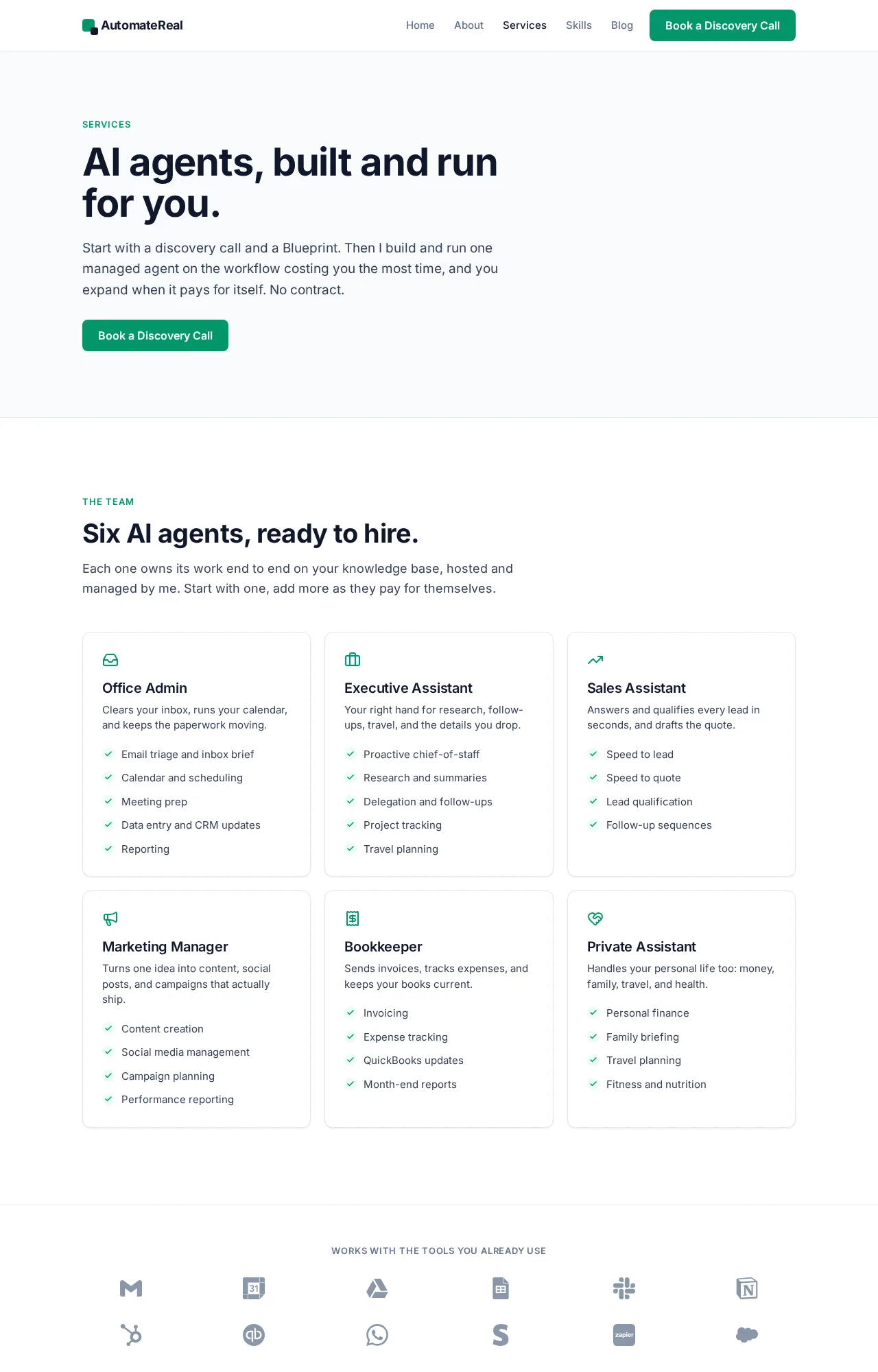 The AutomateReal services page
Most owners buying ai agents for small business want the follow-up to fire on time, not a governance console. There is a name for the hidden cost either way: the trust tax. It is the minutes you spend re-reading what the agent sent before you trust it. At 20 runs a day that is nothing. At 200 it is a job.
Monitoring stops being optional the day an agent messages a customer or moves a number you invoice on. Before that, a simple alert is enough.
A 5-person team gets more from 1 owned workflow than from any monitoring seat, so fund the build first.
The other Fiddler, and how to tell which one you want
Telerik’s Fiddler is a web debugging proxy. It shares this search phrase with an AI platform and nothing else.
Fiddler and Fiddler Everywhere capture HTTP and HTTPS traffic so you can debug a web app or an API call. If that is what you typed, you can stop here. The clash is real: on 2026-10-11 one search engine put Telerik’s pages in the top 3 for this phrase. Google’s exact page one is unverified from this box.
If you wanted a network debugger, Telerik’s Fiddler is the tool, and this page is not your answer.
What are the best Fiddler AI alternatives?
The alternatives split into 2 camps. Tracing tools such as Arize and LangSmith record runs and score them. Platform tools such as Datadog and Comet Opik fold AI monitoring into a wider suite. Fiddler’s difference is that it can block a response on the way out.
| Tool | Strong at | Entry price |
|---|---|---|
| Arize and Arize Phoenix | Tracing and evaluation | $50 per month |
| PromptLayer | Prompt logging and versioning | $49 per month |
| Maxim AI | Evaluation and data | $29 per seat |
| Braintrust | Evaluation and experiments | $249 per month |
| Raindrop | Monitoring for LLM apps | $299 per month |
Those entry prices come from a ten-tool entry price comparison published in August 2026. They move, so check before you buy.
Beyond the table, Langfuse and Weights and Biases Weave cover similar tracing ground. MLflow and Evidently AI carry the older model monitoring case. WhyLabs, Arthur Shield and Patronus AI sell guardrails of their own. Galileo, now Splunk Agent Observability, sits inside a wider platform along with Datadog LLM Observability.
You will find star ratings for these tools elsewhere. G2 returned a 403 to this box, so no rating on this page is copied from G2. Picking among the best ai agents for business is a separate job from picking the tool that watches them.
Cost, not features, separates these tools at small scale: entry prices run from $29 a seat to $299 a month.
Related: Agentic AI Explained for Small Business Owners
Related: Agentic Loop: How AI Agents Actually Work
Related: Agent SDK: What It Is and When to Build vs Buy
FAQ
Is Fiddler AI free, and what does the free tier actually include?
Partly. The free tier covers real time guardrails only, so it can block a bad output without charging you. It carries no observability, so you cannot inspect a trace to see why a run went wrong.
Is Fiddler AI the same tool as Fiddler, the web debugging proxy from Telerik?
No. Telerik’s Fiddler and Fiddler Everywhere are web debugging proxies that capture HTTP traffic. Fiddler AI is a separate company in Palo Alto, and the two share only a name.
How is Fiddler AI different from Arize, LangSmith or Langfuse?
Fiddler adds inline guardrails on top of tracing, so it can block a response before release. Arize, LangSmith and Langfuse center on traces and evaluation scoring.
Does Fiddler AI work with LangGraph, Amazon Bedrock or Datadog?
Yes. Fiddler connects to LangGraph and Amazon Bedrock, and Datadog publishes a Fiddler AI license integration, so events can land in a Datadog account.
How many traces does one agent run produce?
At least 1, and often more. Fiddler does not define trace on its pricing page, so a multi-step run may log several, and the bill scales with steps rather than users.
What should you monitor first when you run an agent?
Start with the failing step. Log every run with its inputs, its tool calls and the output it sent. Then watch the number that maps to money, such as wrong replies or dropped leads.
I built the agent team that writes and publishes posts like this one, and it runs without me. The first real failure was quiet. A step passed a malformed value to the next one, and the run still reported success.
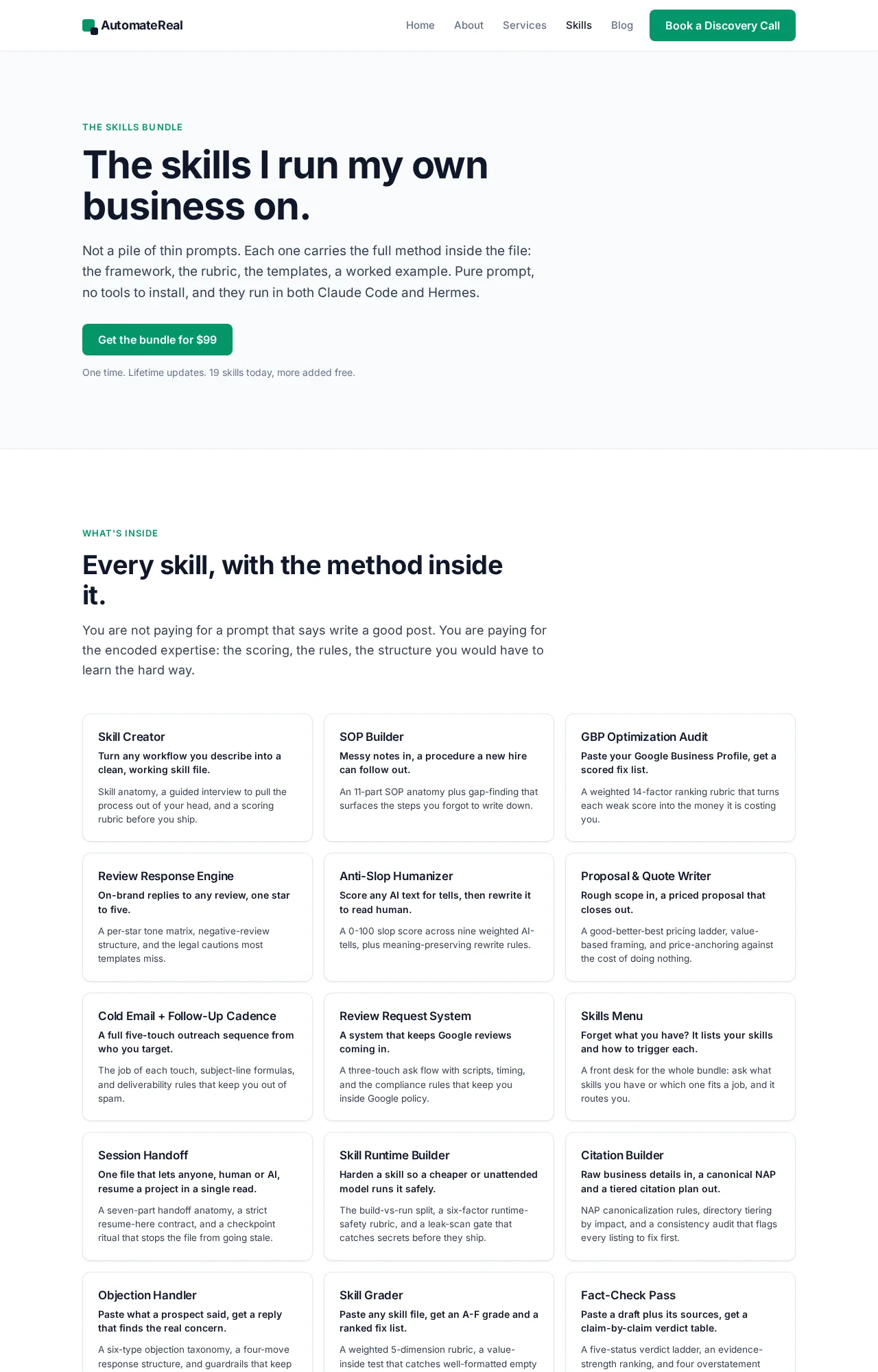 The AutomateReal skills page
3 checks cover most of what you need:
- Can you replay a run, step by step, after it goes wrong?
- Can you see the exact tool call that changed the outcome?
- Is there 1 named owner when the workflow fails?
The ai agents examples that hurt a small business are rarely dramatic. A follow-up that fired twice, or a quote that went to the wrong address. Our guide to AI agents for small business covers the ones worth automating first.
Here is where the tool question ends. A tool tells you a run failed. A person decides what the agent should have done and changes it. Without that person, alerts train you to ignore alerts.
Replay, the exact tool call, and 1 named owner come before any dashboard.
That is the whole decision. If you want help finding the first workflow worth handing to an agent, a discovery call maps it in about 30 minutes. That beats another month of comparing dashboards you will not open.