RPA Service Providers: What They Do and Cost (2026)
RPA service providers build and maintain the bots, but they bill three different ways. What each provider type costs and how to spot a reseller.
Ask 3 RPA providers to price the same process and you get 3 different shapes of bill. One sells a licence. One sells a project. One sells a monthly retainer.
Most pages ranking for this term are vendor shortlists with hourly rates and no project total. I price automation for a living, so this page does the part those lists skip. It shows the licence list price, then the bill that starts after go live.
A robotic process automation (RPA) service provider builds and runs software bots that copy what a person clicks inside systems you already own. You pay for three things: the platform licence, the build project, and ongoing maintenance. Platform vendors sell the licence. Integrators and boutique shops do the build, and only they take on the upkeep.
TL;DR
- RPA bots click through the software you already run, so no API is needed.
- You get billed 3 times: a licence per bot, a build project, then a retainer.
- List prices run from $25 a month (UiPath Basic) to $215 per bot per month (Power Automate Hosted Process).
- The provider model decides who fixes the bot when a portal changes its login screen.
What do RPA service providers actually do?
A provider maps one process, builds a bot that repeats it inside your existing screens, tests it, then keeps it running. The work is mostly integration and exception handling. The platform keeps ownership of the code.
A bot drives the interface the way a person does. It finds a field, types into it, and clicks save. Reading data off a screen is screen scraping. Driving that screen is UI automation. When the vendor publishes an API, the provider can skip the screen and use API automation instead, which runs faster and breaks less.
Attended bots sit on a person’s desktop and fire when they click. Unattended bots run on a schedule with nobody logged in. Automation Anywhere splits RPA into unattended, attended, and hybrid. It keeps human-in-the-loop review inside the attended case (Automation Anywhere’s RPA overview).
Microsoft’s desktop flows docs describe recording your own flows in a drag-and-drop designer. They aim it at people who do rule-based desktop tasks (Power Automate desktop flows). That low-code path lets a citizen developer build an attended bot without writing code. It is how many small teams test the idea before they hire anyone.
The deliverable is a short list, whatever the deck says.
- The bot, built inside a platform you licence
- An orchestrator that schedules unattended runs and keeps the log
- Exception rules for fields that arrive empty or wrong
- An audit trail someone can read after a bad run
The bot is the small part of the job. The exception rules and the audit trail are the product.
Providers also sell process mining and task mining, which read your system logs and find the steps that repeat. Document work needs intelligent document processing (IDP), which adds OCR and a model that reads a scanned invoice or form.
A Center of Excellence is the internal team that owns the standards once you run a handful of bots. Below that size, the CoE is usually the provider.
That split matters when you sort the shortlist. The boutique tier is long. WonderBotz, Artsyl, and AleaIT Solutions sit at the smaller end. Accelirate, Robiquity, and Roboyo run mid-market builds. Flobotics, Digital Workforce, Reveal Group, and BP3 fill out the rest.
The platform tier is shorter. UiPath, Automation Anywhere, SS&C Blue Prism, and Microsoft Power Automate sell the software. Enterprise suites from IBM, Appian, Pega, and SAP bundle RPA into a wider stack, and AutomationEdge sits in between.
How much do RPA service providers cost?
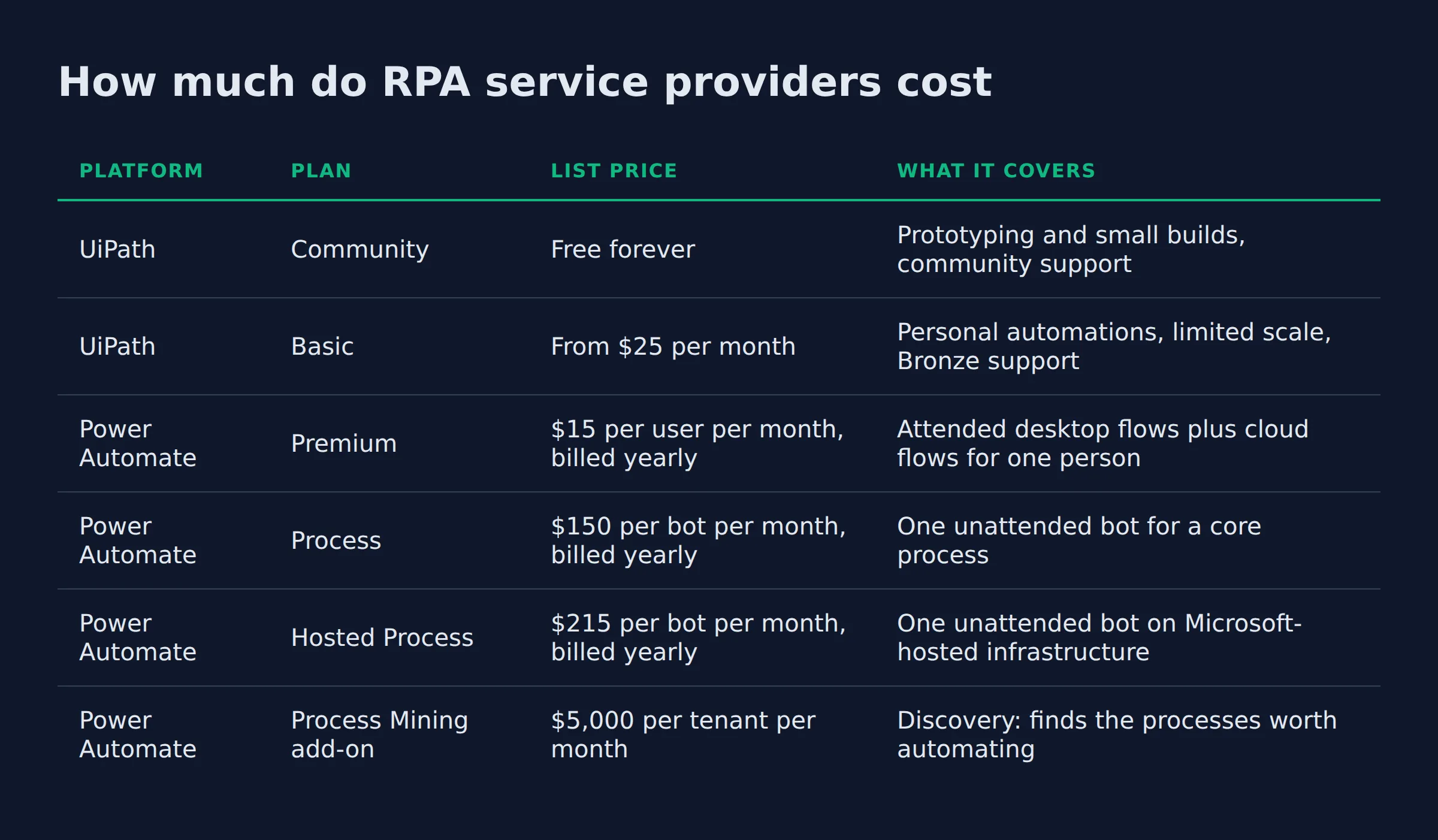
Three costs stack: a bot licence, a one-off build, and a monthly retainer. Licence list prices run from $25 to $215 per bot per month before a provider touches your process. The build and retainer prices come from the provider, and rarely in one quote.
Start with the licence, because it is the one number you can check without a sales call. UiPath and Microsoft both publish an entry price.
| Platform | Plan | List price | What it covers |
|---|---|---|---|
| UiPath | Community | Free forever | Prototyping and small builds, community support |
| UiPath | Basic | From $25 per month | Personal automations, limited scale, Bronze support |
| Power Automate | Premium | $15 per user per month, billed yearly | Attended desktop flows plus cloud flows for one person |
| Power Automate | Process | $150 per bot per month, billed yearly | One unattended bot for a core process |
| Power Automate | Hosted Process | $215 per bot per month, billed yearly | One unattended bot on Microsoft-hosted infrastructure |
| Power Automate | Process Mining add-on | $5,000 per tenant per month | Discovery: finds the processes worth automating |
Those rows come from the UiPath pricing page and the Power Automate per bot pricing as they read today. UiPath prices Standard and Enterprise through sales, so no public number exists for a large unattended estate.
Run the yearly math before the first meeting. $150 per bot per month is $1,800 per bot per year. The hosted version at $215 is $2,580. Three hosted bots come to $7,740 a year in licence alone. That is our arithmetic on Microsoft’s list price, not a quote.
UiPath Basic at $25 a month is $300 a year, enough to test a process before you commit. Community is free, which is how most small teams start.
The other public benchmark is hourly, and it comes from the shortlists. Abto Software’s roundup of RPA companies lists RPA provider hourly rates from Clutch profiles in three bands. Small firms list at $25 to $49 an hour. Mid-size firms list at $100 to $149. The top of the market starts at $300 an hour.
Hourly tells you what a person’s time costs. It says nothing about how many hours the build takes, or who answers the phone in year two.
Divide the yearly licence and the run and maintain retainer by the hours the bot gives back, and you have the payback period. That number, not the day rate, decides whether the project belongs in this year.
Price the licence yourself first. A provider who resells the platform has little reason to show you the list price.
Which provider type fits you: platform vendor, integrator, or boutique?
A platform vendor sells the software and stops. A systems integrator builds on top with a delivery team and a fixed scope. A boutique shop builds small, stays on a retainer, and answers the phone when a bot breaks on a Tuesday.
| Decision | Platform vendor | Systems integrator | Boutique managed service |
|---|---|---|---|
| What you are buying | The licence and the docs | A project with a scope document | A small build plus a monthly retainer |
| Who builds it | You, or a partner you hire | Their delivery team | The person who replies to your email |
| Who fixes breakage | You, through support tickets | A change request, priced separately | Covered by the retainer |
| Best fit | A team with a developer on staff | A multi-bot programme with a CoE | A few bots in one department |
| Weakness | Nobody owns the outcome | Slow start, heavy paperwork | Thin bench, one key person |
Read the third row first. Maintenance is where the models separate, and it is the row most proposals leave blank. A fixed-fee build often ends at go live, so the first broken selector arrives as a new purchase order.
A reseller is fine, as long as the licence shows up as its own line on the quote. When the platform, the build, and the support arrive as one monthly fee, ask for the split. A boutique RPA managed service that cannot separate them is marking up the licence and hiding it inside the build.
Grand View Research puts the RPA market at USD 4.7 billion in 2025 (RPA market size). The forecast reaches USD 35.8 billion by 2033, a 29.0% compound annual growth rate. Software took 70.7% of that revenue in 2025, and services is the fastest-growing slice. Every platform now sells a delivery team for that reason.
Two buying shapes sit on top of those models. Staff augmentation rents you a person by the hour and leaves the bot on your books. A fixed-fee build buys a finished bot plus a handoff document. Hourly gives the provider a reason to keep the build open. Fixed fee gives them a reason to finish it.
The model decides the incentive. Pick the one whose incentive points at the same thing you want in year two.
What the bill looks like after month one
Breakage is the part of RPA that nobody quotes at the start. A bot that drives a screen breaks when the screen changes, and screens change without warning.
A bot depends on the position, name, or label of the thing it clicks. When a supplier portal renames a button or adds a cookie banner, the bot stops or clicks the wrong field. A stopped bot is loud and cheap. A wrong-field bot is quiet and expensive.
I run my own lead generation on automation, roughly 200 form submissions a day through my own outreach system. The step that sends the email runs untouched. The step that reads a reply and decides what happens next is the one I have rebuilt most. It is also the step I check first thing in the morning.
Three checks before you sign. Run them on the process, not the tool.
- Does the bot live inside a screen someone else controls? A vendor portal can change its login flow without telling you.
- Does a person read the output? A bot that posts into a queue nobody opens hides its own failures.
- Who fixes it at 9pm? If the answer is you, put your own hours into the payback math.
That set of questions is the cheapest audit you can run, and it costs one afternoon. It also filters the shortlist faster than any demo, because the answers come from your systems rather than theirs.
The retainer is the real subscription. Ask for it in writing before you sign the build.
How long does an RPA rollout take?
Expect 4 stages: discovery, build, testing, and go live. One bot at a boutique shop runs weeks. A multi-bot programme runs quarters. The stage that eats the calendar is testing, because real exceptions show up there.
The stages break down like this.
- Discovery: process mining, or a week of shadowing, finds the steps, the inputs, and the exceptions.
- Build: the developer records or codes the flow against a test copy of the system.
- Testing: the bot runs on real documents while a person checks every output.
- Go live: unattended runs start, with a log and one named owner.
Two things stretch the timeline. Any process built on documents needs OCR and a model, which adds tuning time. A process with no test environment forces the build to touch live data, which slows every test round.
That shape is my own estimate from building automations, not a published benchmark. Ask a provider to price their quote across those 4 stages and the padding shows up at once.
Get the timeline split by stage. A single delivery date hides the stage the provider is compressing.
Should you hire an RPA provider or use AI agents instead?
Hire a provider when the process is fixed, repeated, and stuck behind a screen with no API. Build an agent when the input is unstructured and the next step needs judgment. Those are different jobs, and many small businesses hit the second one first.
RPA follows rules a person writes in advance. An AI agent reads the input and picks the next step, so the same message can take 2 different routes. I drew that split task by task in a post on automation that follows rules versus AI that decides.
Volume changes the answer. A bot earns its licence on steps that repeat every day. An agent earns its cost on the messages that never repeat, where a person would otherwise read each one and decide.
Vendors now sell hyperautomation, which usually means RPA plus process mining plus IDP as one programme. UiPath’s Standard tier lists agents next to robots on the same pricing page, and calls it agentic automation. In practice the bot can ask a model what to do with a messy field instead of failing on it.
The AI agents for small business hub covers the agent side in more detail, including where a person has to stay in the loop.
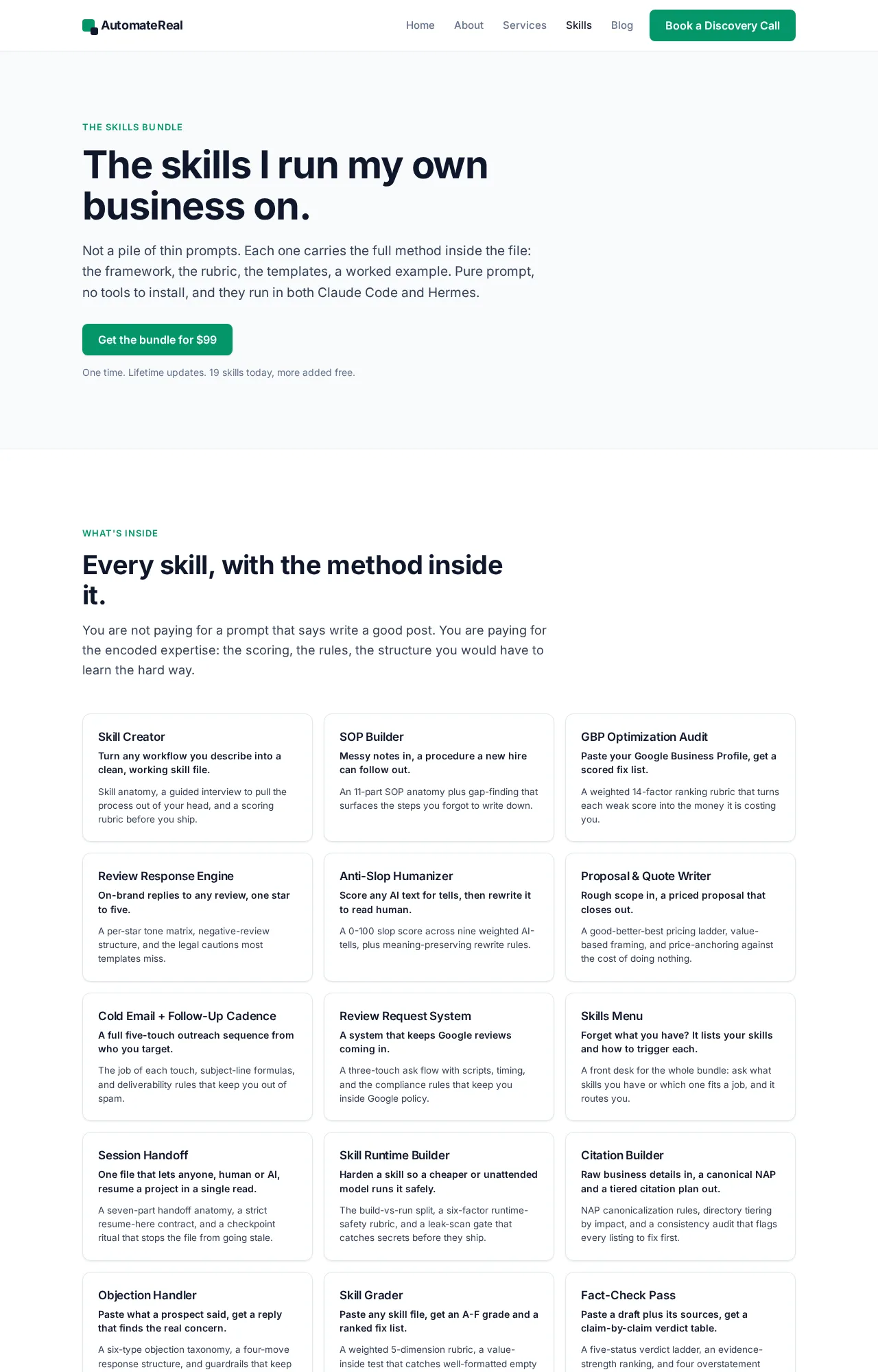
AutomateReal skills
Rules that never change belong in a bot. Anything that arrives as free text with a decision attached belongs with an agent.
What does RPA look like inside a small business?
In a small business the bot usually does one job. It moves data between 2 systems, files incoming documents, or checks a status by hand. The win shows up as hours back in one role. It rarely shows up as a new capability.
Three candidates come up again and again in small shops.
| Process | Bot fit | What breaks it |
|---|---|---|
| Supplier invoice entry | Strong, with IDP for scans | A new invoice layout or a handwritten total |
| Quote follow-up | Strong when the steps are fixed | A mailbox rule change or a shared login |
| Client portal data entry | Medium | Any change to the portal’s login or page order |
The pattern holds across all 3 rows. The bot is only as stable as the screen it touches and the login it uses.
One detail catches people. A bot needs a login of its own, with the right permissions and an audit trail back to it. When a client portal allows one seat per account, the bot competes with a person for that seat.
Compliance questions arrive with that login. SOC 2 wants a record of who touched the data. HIPAA, SOX, and GDPR want versions of the same proof. A provider that cannot show a per-run log fails that question, and a healthcare or finance client will ask.
If you would rather see the licence and the retainer priced in one place, the AI services page sets out what a build covers.
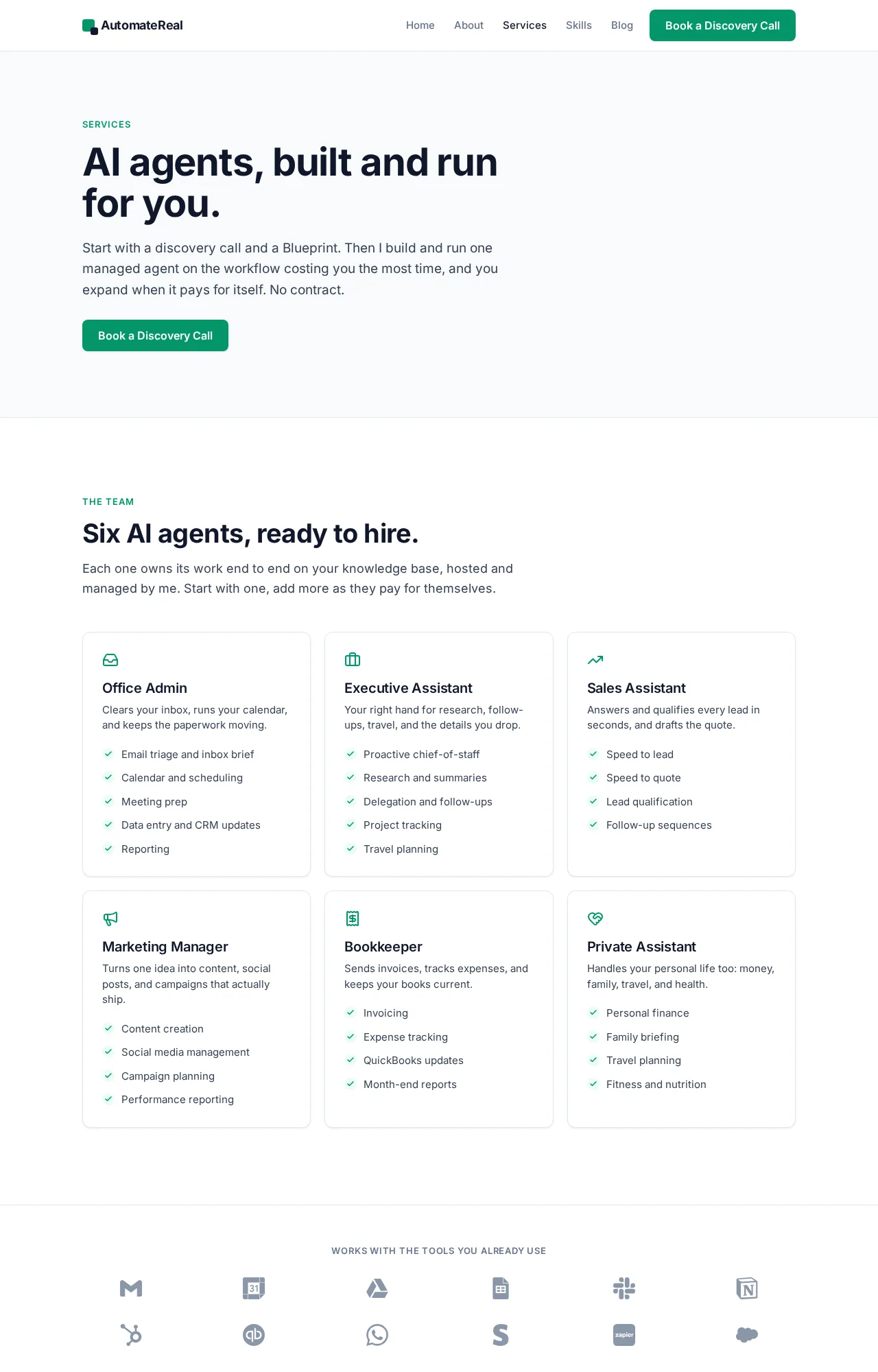
AutomateReal services
Pick the process with a stable screen and one named owner. The clever candidate is usually the one that breaks first.
Related: automation agency AI
FAQ
Are RPA service providers the same as RPA software vendors?
No. A vendor sells the platform licence. A provider builds and maintains the bots on top of it. Some companies do both, which is exactly why the proposal should show the licence as its own line.
Do I still need a provider if I can use Power Automate myself?
Only when the process is worth more than your hours to build it. Power Automate Premium is $15 per user per month, so one attended flow is cheap to try alone. A provider earns the fee on unattended bots, exception handling, and the year-two fixes.
What happens when a bot breaks after go live?
Whatever the contract says, so make the contract say something. A retainer covers fixes. A fixed-fee build usually ends at go live. Ask for a response time in hours, and for who pays when a vendor portal changes its login screen.
Can a business with 10 employees justify an RPA provider?
Sometimes. The test is hours, not headcount. If one person spends a full day each week on the same sequence, a bot plus a retainer can cost less than that day does. If the process changes every month, the bot loses.
What should I ask an RPA provider before signing?
Ask who owns the licence and what the retainer covers. Then ask what a fix costs outside the retainer, and what the exit looks like. Get those answers in writing, with the response time in hours.
If you are weighing a provider against building it yourself, a discovery call maps the first workflow in about thirty minutes. Bring the process that eats your week. You will leave knowing which half is a bot and which half needs a model.