What Is Automation? Definition, Types, and Examples
Automation is technology running work with little human input. Here is what it means, the main types, and how small businesses use it, with examples.
Automation is the most over-used word in software sales. It gets attached to a thermostat, a factory arm, a chatbot, and a whole AI team in the same week.
Most pages on this term come from vendor marketing desks and analyst sites. This one comes from someone who wires automation into his own business and watches where it breaks.
So what is automation? Automation means using technology to run a task, process, or system with little or no human input. The word covers everything from a thermostat holding a temperature to software moving data between apps. It exists to do repeatable work faster, cheaper, and more consistently than people can. If you would rather hire it out, automation services explains what they cost.
TL;DR
- Automation is a rule that runs a repeatable job without a person driving each step.
- US business AI use ran between 17% and 20% from December 2025 to May 2026, per the Census Bureau’s BTOS data.
- IBM sorts the field into 3 tiers: basic, process, and intelligent automation.
- The first workflow worth automating runs every week and ends in a number you track.
- The human checks do not disappear. They move later in the week.
What does automation mean in plain English?
Automation means a machine, a program, or a system runs a repeatable job without a person driving each step. The job fires on a rule, a schedule, or a sensor reading. The person still writes the rule and handles whatever the rule misses.
That is narrower than the word suggests. Dictionary entries call automation “the technique of making an apparatus, a process or a system operate automatically”. ISA’s definition of automation stretches further, describing the creation and application of technology to monitor and control the delivery of products and services.
So the meaning of automation turns on one question. Who decides what happens next?
Here is the plain test I use:
- A person wrote every branch in advance. That is automation.
- A model picks the branch. That is AI automation.
- The system sets its own steps toward a goal. That is an AI agent.
Automation is a rule that runs itself. The rule is the design, and the rule is what breaks first.
What are the main types of automation?
The main types are basic automation, process automation, and intelligent automation. Under those sit the labels you meet in vendor decks, including robotic process automation and business process automation.
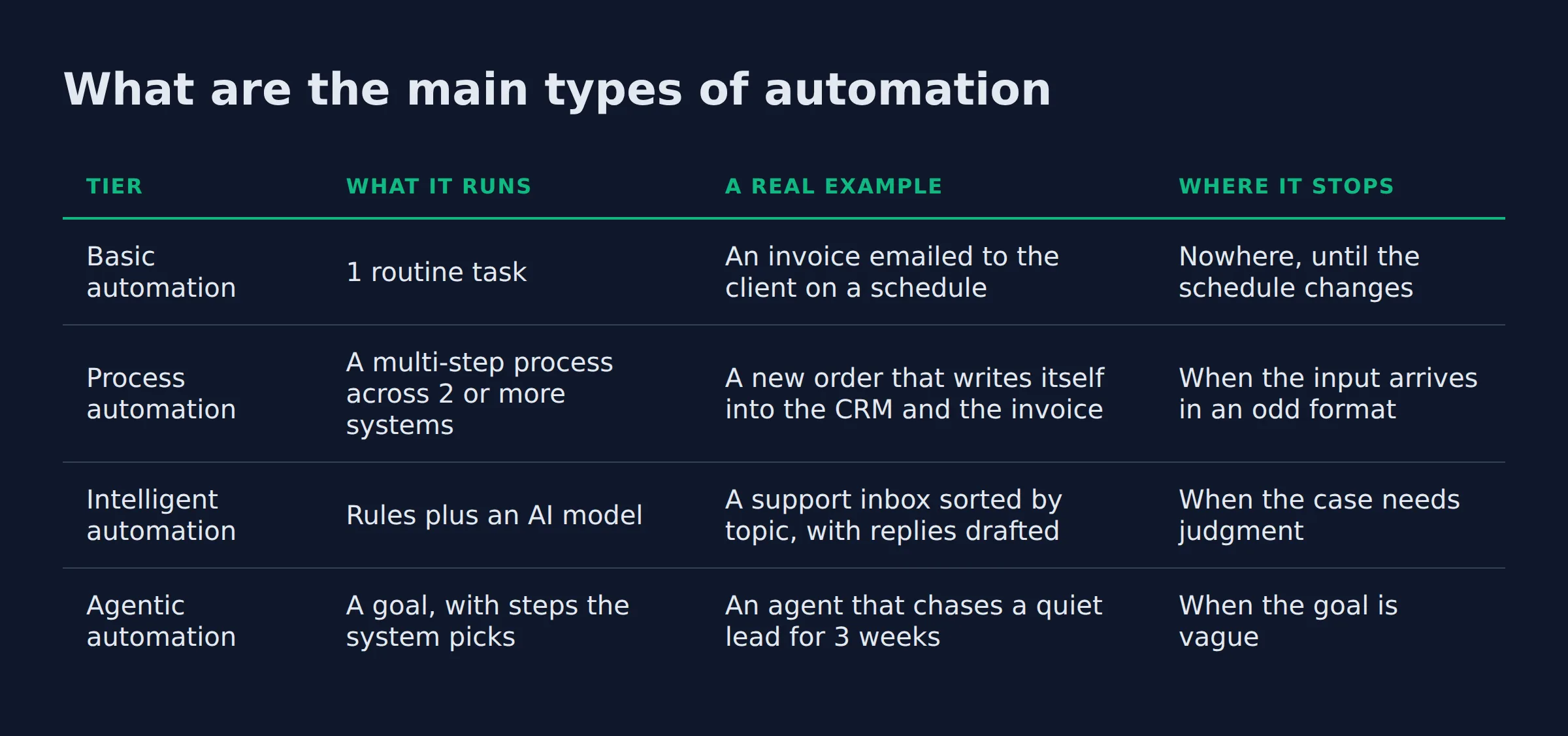
| Tier | What it runs | A real example | Where it stops |
|---|---|---|---|
| Basic automation | 1 routine task | An invoice emailed to the client on a schedule | Nowhere, until the schedule changes |
| Process automation | A multi-step process across 2 or more systems | A new order that writes itself into the CRM and the invoice | When the input arrives in an odd format |
| Intelligent automation | Rules plus an AI model | A support inbox sorted by topic, with replies drafted | When the case needs judgment |
| Agentic automation | A goal, with steps the system picks | An agent that chases a quiet lead for 3 weeks | When the goal is vague |
The 3 tiers come from IBM on automation types. Basic automation takes one routine task. Process automation chains a multi-step process across systems. Intelligent automation adds AI to the decision, and IBM lists AIOps as an example of it.
The same page defines hyperautomation as many tools merged across many processes, and the chief automation officer as a role that arrives once automation spreads.
The rest of the vocabulary maps onto the same field:
- Robotic process automation (RPA): a software bot that clicks and copies inside apps that cannot talk to each other.
- Business process automation (BPA): a whole internal process, from request to record.
- IT process automation (ITPA): the same idea pointed at servers, monitoring, and deployment.
- Workflow automation: a rules-based path through one task, with little or no human input.
- Low-code and no-code: build tools that skip most of the programming.
- Industrial automation: machinery, control systems, and robots on a factory floor.
- Home automation: thermostats, lights, locks, and speakers on one system.
- Retail automation: checkout-free stores and inventory systems.
- Cognitive automation: AI and machine learning reading unstructured data.
- Autonomous systems: vehicles, drones, and appliances that run without a hand on them.
Spiceworks groups the field into 8 automation types. Its RPA section cites a 2023 Gartner estimate that the RPA market would top $12 billion globally by 2025. The tool names you will meet are UiPath and Automation Anywhere for RPA, and Microsoft Power Automate for low-code work.
Computer vision, machine learning, and natural language processing feed the intelligent tier. All 3 read input that earlier systems could not touch.
Match the tier to the job. A small business can run on the first 2 tiers for years.
From factory floor to inbox
Automation started as a factory word, and the office borrowed it later. The center of gravity has moved twice since.
Mechanized production in the Industrial Revolution ran on hardware, and so did the control logic. Racks of relays and cam timers decided when a motor started. The history of automation records that those racks could number in the thousands inside a single plant. Rewiring a line meant moving metal.
Programmable logic controllers replaced the racks with one reprogrammable box, and ladder logic gave way to software you could edit in an afternoon.
Control engineering supplied the 2 words that still describe every system you buy. Open-loop control acts without checking the result. Closed-loop control measures the result and corrects itself, and a PID controller is the classic version of the second kind.
Industry 4.0, the German name for the Fourth Industrial Revolution, tied the plant to the network. Lights-out manufacturing is the far end of that road: a factory floor with nobody on it. General Motors tried it in 1982 and never reached a fully lights-out plant, as the same history records.
A machine that cannot see its own result cannot correct itself. Factory control learned that long before office software did.
What is business process automation?
Business process automation runs a whole internal process in software instead of by hand. It moves the data, triggers the next step, and keeps a record. Purchase approvals and invoice matching are common first targets.
BPA gets used as a synonym for RPA. Treat them as 2 different purchases. RPA is a bot that clicks inside apps and moves data. BPA is the process design that decides what the bot does and who checks the result.
IBM’s take on business process automation covers technology that automates repetitive tasks and processes across business workflows and IT systems. Business process management (BPM) is the discipline around it, and process mining is the audit that shows where a process actually goes.
The everyday jobs are unglamorous. A quote sits in a draft folder for 3 days. An invoice gets matched by hand. A new hire waits on a login.
My own version of that was lead intake. Every tool I bought before I wrote the steps down just moved the mess faster. Once the process existed on paper, the automation had something to copy.
BPA is a process decision first and a software purchase second. The written steps are most of the work.
What is the difference between automation, AI automation, and AI agents?
Classic automation follows rules a person wrote. AI automation adds a model that reads messy input and picks the next step. An AI agent works toward a goal across several steps and several tools.
| The question | Plain automation | AI automation | AI agent |
|---|---|---|---|
| Who writes the branches | A person, in advance | A person, plus a model | A model, inside limits you set |
| What input it reads | Clean and predictable | Messages, PDFs, and voice | The same, plus changing systems |
| What happens on a new case | It stops, or routes to a person | It takes its best guess, then asks for review | It plans a new path |
| Who owns the failure | The person who wrote the rule | The person who approved the output | The person who set the limits |
Anthropic calls all of this agentic systems and splits it on one architectural point. Workflows move through predefined code paths, and agents direct their own process and tool use.
5 words cover the rest of what you will read:
- Agentic AI: a system that plans several steps and acts on the plan.
- Large language model: the text engine under most of it.
- Orchestration: the layer that hands work between tools.
- Human in the loop: an approval step inside a running workflow.
- Exception handling: what runs when a case does not match a rule.
Underneath all of it sits integration, which is the plumbing that lets 2 apps share data at all. The middle column has its own page here, and AI automation explained covers the tools, the prices, and the failure modes.
Ask who decides the next step. That answer tells you which of the 3 systems you are buying.
What breaks when a small team stops watching
The failures are boring and they repeat. A duplicate record appears. A job gets booked at the wrong scope. A workflow stops and nobody notices for 3 weeks.
The more reliable the system, the less an operator sees of it, and the less practiced that operator becomes at catching a real error. Cognitive psychologist Lisanne Bainbridge described that trap in a 1983 paper called Ironies of Automation.
The paradox of automation is the name it kept. The guardrail questions are the ones NIST’s AI Risk Management Framework lists for free.
My own lead generation takes about 200 form submissions a day, and the follow-up on those runs without me touching it. The sending never broke. What broke was one person using 2 channels, which produced 2 records and 2 replies.
Automation fails in 3 shapes:
- A case the rule never saw, like a new job type or a new form field.
- A case the rule saw twice, like a customer who called and also filled in the form.
- A case the rule handled correctly after the business changed, like a price you raised in June.
Automation moves the checks later in the week. It does not remove them.
What automation looks like inside a home service business
In a home service business the automation that pays first is the reply to a lead. The tiers land on that job in a different order by trade.
A plumbing shop needs the quote chased. An HVAC shop needs the after-hours call answered. Both start on basic automation and reach the intelligent tier once the rules hold.
That is why AI agents for home service businesses start with lead response rather than a platform purchase. The same 3 tiers show up in marketing and in ecommerce, where the repeatable job is a campaign or an order instead of a dispatch.
If you would rather not wire it yourself, the AI services page sets out what a done-for-you build includes. The prompt skills I use daily sit in the skills bundle, all of them for $99.
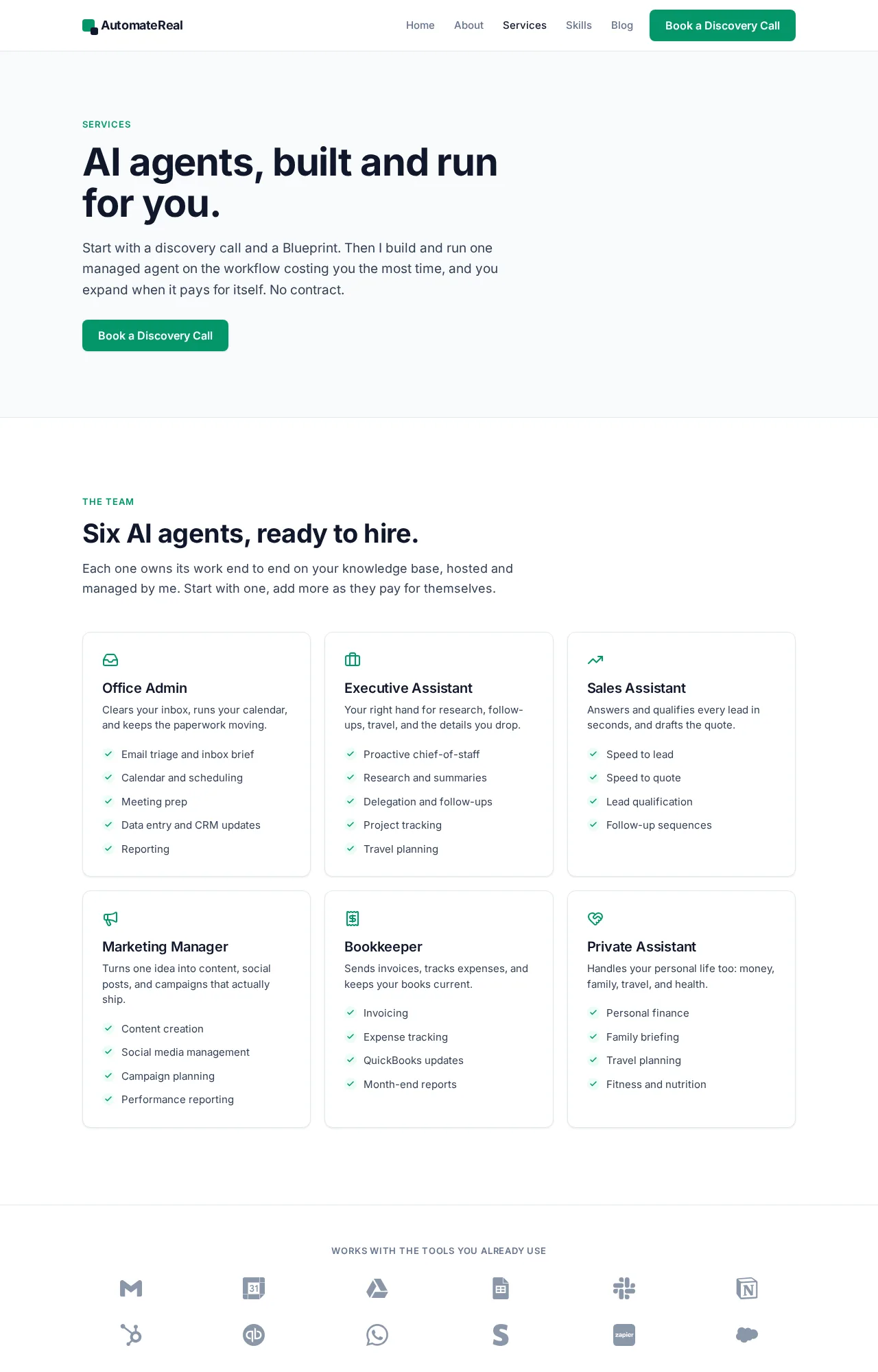 AutomateReal services
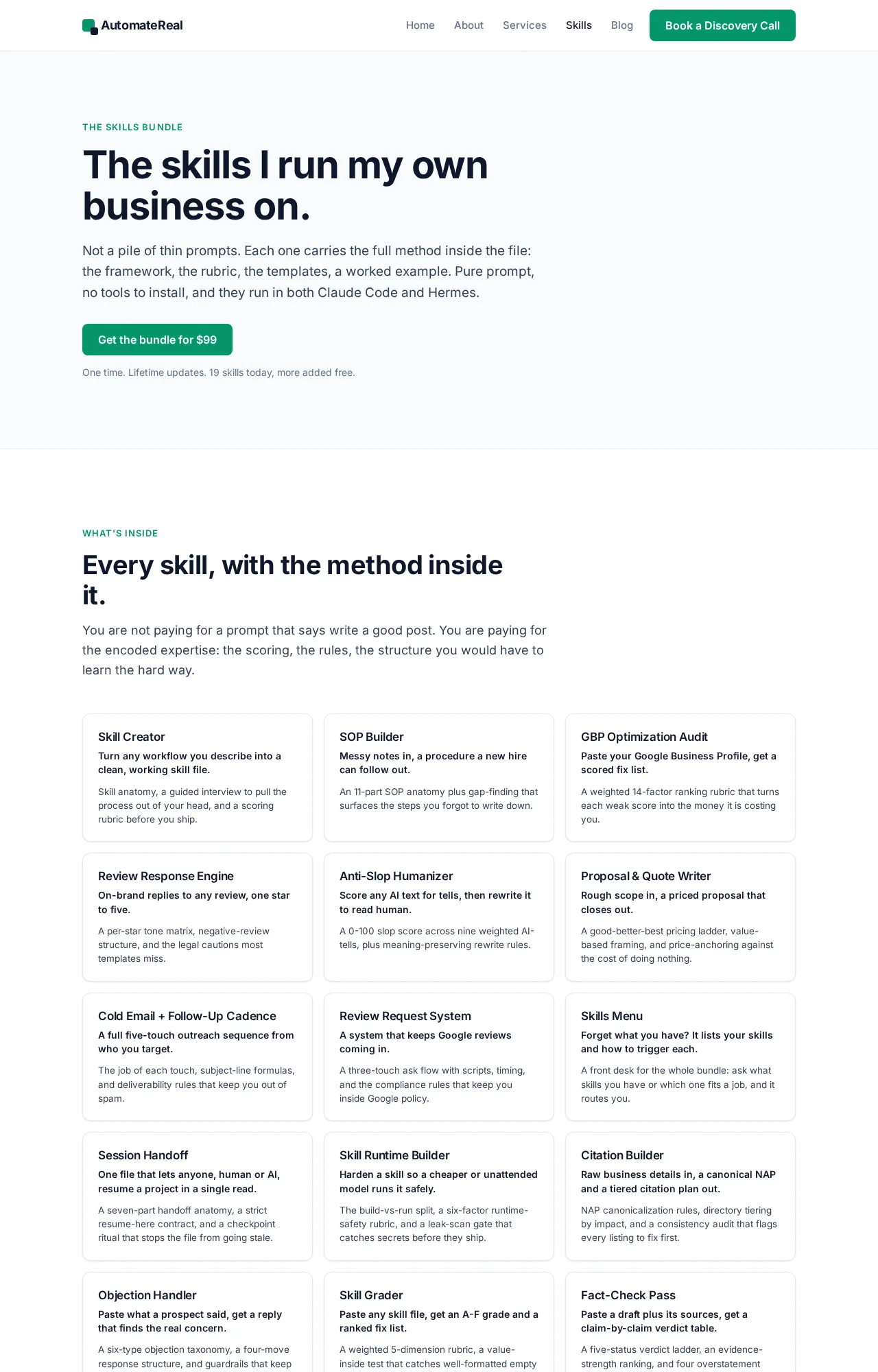 AutomateReal skills
The tier stays the same across industries. The first job changes with the trade.
How does a small business start automating one workflow?
Start with one workflow that runs every week, follows a written rule, and ends in a number you already track. Map the steps by hand first. Automate the middle of the process, and leave the first and last step with a person.
Automation in business is that definition pointed at a job you get paid for. Pick a job with no baseline and the build can never prove itself.
4 questions decide it:
- Does it run every week or more often?
- Is there a written rule for how the work gets handled?
- Does it end in a number you already track?
- Can you name the person who owns it when it fails?
3 yes answers make it your first build. 2 make it a candidate for later. Fewer than 2 means you are automating a guess.
Jobs I leave with a person:
- A price on work nobody has seen yet.
- A customer who is upset about a callback.
- Anything that needs a licence or a permit.
- A one-off negotiation.
The most common mistake I see is a tool bought to fix a process nobody has described. I build a free website for a prospect before they pay me, and that habit puts me inside their intake. The tangle is usually 2 people running the same step in 2 different tools.
Then pick 1 number and watch it for 2 weeks. On my own outreach that number is first reply time, measured per channel. It is the only reason I still open that dashboard.
Pick the job with a rule and a number attached. If you cannot name the number, you cannot tell whether the build works.
Related: How to Build an AI Agent
Related: AI Agents for Small Business: What They Do & How to Start
Related: What Are Automation Services? Small Business Costs Explained
FAQ
Is automation the same thing as artificial intelligence?
No. AI is one input into automation, and plenty of automation runs without it. The first of the month invoice email uses no AI at all.
What is robotic process automation (RPA)?
RPA is a software bot that works inside apps a person would otherwise click through. It copies data between systems, fills in forms, and moves files. The bot follows a fixed script, so it stops when the screen changes.
Does automation replace jobs?
Automation replaces tasks, and a job is a bundle of tasks. The repeatable slice moves to the system and the judgment slice stays. The person who ran the process usually ends up owning the exceptions.
What should a small business not automate?
Anything you cannot measure stays manual, and so does anything that needs a licence. A conversation where the customer is already upset also stays with a person.
If the choice is the hard part, a discovery call maps it in about 30 minutes. Bring the job that eats your week, and you leave with a plan either way.