Claude Subscription Pricing: What Each Plan Costs in 2026
Claude subscriptions run from $0 to $200 a month. Here is what Pro, Max, Team, and Enterprise seats cost, and which plan a small business should buy.
Claude subscriptions start at $20 a month and climb to $200. That range buys usage, and the tier you pick decides whether your day ends on finished work or on a stopped session.
The list prices take 30 seconds to find. Annual billing and the usage wall are what actually move the bill, and most plan write-ups skip both. I pay these bills on systems I run myself, so those 2 parts get written down here.
So how much does a Claude subscription cost? The line runs from Free at $0 to Pro at $20 a month, or $17 billed annually. Max starts at $100, and Team seats cost $25 each, or $20 annually. Enterprise adds $20 per seat on top, plus usage billed at API rates. Every step up buys more usage.
TL;DR
- The Claude line runs from Free at $0 to Pro at $20 a month, Max at $100 and up, and Team seats from $25 each.
- Pro is the only personal tier with an annual discount. You pay $200 up front against $240 across 12 monthly charges.
- Premium Team seats carry 6.25x the Pro per-session allowance. Standard seats carry 1.25x.
- Past a limit you have 3 moves. Wait for the reset, move up a tier, or turn on usage credits billed at API rates.
How much does each Claude subscription cost?
Claude costs $0 on the Free plan, $20 a month on Pro, and from $100 on Max. Team seats run $25 each per month. Enterprise charges $20 per seat plus usage at API rates. Every figure here was checked in September 2026.
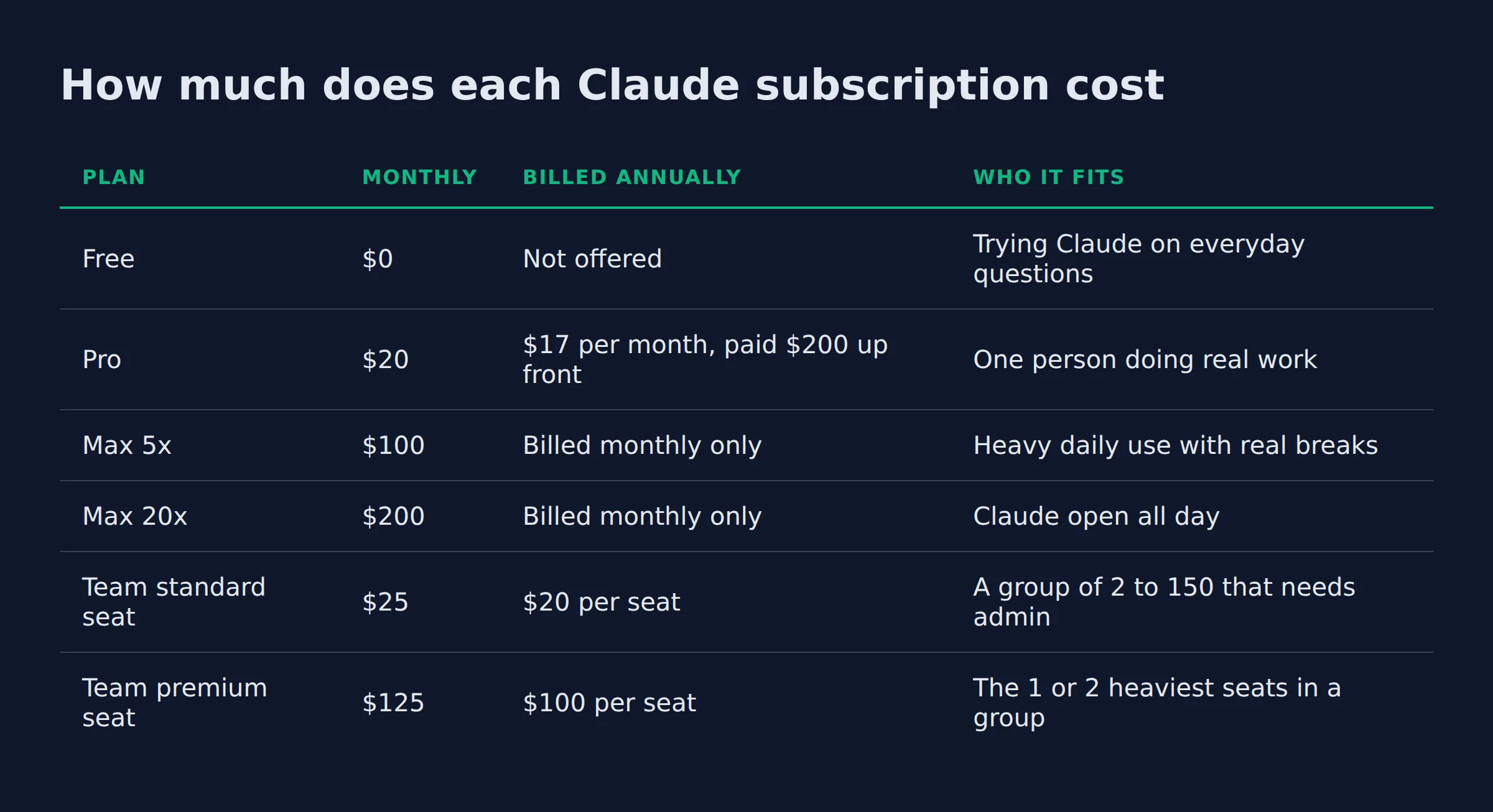
| Plan | Monthly | Billed annually | Who it fits |
|---|---|---|---|
| Free | $0 | Not offered | Trying Claude on everyday questions |
| Pro | $20 | $17 per month, paid $200 up front | One person doing real work |
| Max 5x | $100 | Billed monthly only | Heavy daily use with real breaks |
| Max 20x | $200 | Billed monthly only | Claude open all day |
| Team standard seat | $25 | $20 per seat | A group of 2 to 150 that needs admin |
| Team premium seat | $125 | $100 per seat | The 1 or 2 heaviest seats in a group |
The personal line and the seat line are 2 separate ladders. One prices a single account, and the other prices a person. Anthropic notes on the Claude plan pricing page that prices and plans can change at its discretion, so the month stamp on each row matters.
Read the price list as 2 ladders. The personal one runs from $0 to $200. The per-seat one runs from $20 to $125.
What do you actually get on Pro, Max, and Team?
Free includes chat, web search, file creation, memory, connectors, and the Sonnet and Haiku models. Pro adds Opus, Claude Code, projects, and more usage. Max multiplies the Pro allowance by 5 or 20 and lifts output limits. Team adds SSO, central billing, and admin controls.
The tier detail is worth reading before you pay:
- Free: chat on web, desktop and mobile, plus web search, file creation, memory, connectors, artifacts, and the Sonnet and Haiku models.
- Pro: everything in Free, plus Opus, Claude Code, Claude Design, Slides and Docs, projects, Claude in Chrome, and Microsoft 365.
- Max 5x and Max 20x: everything in Pro, plus higher output limits, priority access at busy times, and early access to new features.
- Team: Claude Code and Claude Cowork, enterprise search across your organization, one central bill, single sign-on, and admin controls for remote and local connectors.
Model access widens as you pay more. Haiku and Sonnet are on every plan, and Opus arrives with Pro. Fable 5.1 is the wrinkle. Pro lists it as usage credits, while Max 5x and Max 20x list it as 50 percent of your weekly allowance, per the Claude plan pricing page.
Claude for Small Business is a plugin you switch on inside Claude, and it ships ready-to-run workflows for the jobs owners do weekly. Anthropic’s Claude for Small Business page gives the plan answer in one line: Pro for one person, Team for a business with more than one. For the workflow list itself, what ships inside Claude for Small Business is the fuller read.
AutomateReal skills
Team seats sell administration. The extra usage rides along with the SSO, the single bill, and the connector rules.
Is Claude Pro enough, or do you need Max?
Pro fits one person with steady work and real breaks between sessions. Max fits someone who keeps Claude open all day, because it raises the 5-hour session allowance by 5x or 20x and lifts the output limit.
Anthropic defines Max as 5x or 20x the Pro plan’s per-session allowance. The Max plan usage limits article prices Max 5x at $100 a month and Max 20x at $200.
That gives you the whole decision as one number. Stepping Pro up to Max 5x costs $80 a month more. The question is whether $80 buys back more finished work than the interruptions cost.
My own rule comes from the pipeline that produced this page. Each of its 5 stages is a separate model call, and each one carries its own context. A long context is what pushes a session into its usage window. A bigger allowance buys one thing, which is a run that finishes instead of stopping halfway.
The $80 step from Pro to Max is worth taking the first week a session stops mid-task. Before that, Pro is the right buy.
How much is a Claude Team seat?
A Team standard seat costs $25 a month, or $20 billed annually. A premium seat costs $125 monthly, or $100 annually. Premium seats carry 6.25x the Pro per-session allowance against 1.25x on a standard seat.
Both seat types can sit in one group, so 1 or 2 heavy users take premium seats while everyone else stays standard. The Team plan help article sets the floor at 2 members and the ceiling at 150 seats. Past 150, the organization moves to Enterprise.
The seat limits are per member as well. One heavy user cannot eat the rest of the team’s capacity, because each person carries their own 5-hour session allowance and their own weekly limit.
The comparison that comes up most here is 3 Pro accounts against 3 Team seats. Administration settles it. Three Pro accounts cost less per month and come with 3 separate bills and no shared controls. Team seats cost more and come with one bill, SSO, and admin rules over who can connect what.
Team is the right buy once 2 or more people share the work. A premium seat is the cheapest fix for the one person who keeps hitting the wall.
The annual-versus-monthly arithmetic
Annual billing saves $40 a year on Pro, $60 on a standard Team seat, and $300 on a premium seat. Max bills monthly only, and Enterprise bills annually with no monthly option.
The arithmetic is the same at every seat, so it only needs writing out once:
| Plan | 12 monthly charges | Annual up front | You save |
|---|---|---|---|
| Pro | $240 | $200 | $40 |
| Team standard seat | $300 | $240 | $60 |
| Team premium seat | $1,500 | $1,200 | $300 |
| Max 5x | $1,200 | Not offered | n/a |
| Max 20x | $2,400 | Not offered | n/a |
Switching the cycle keeps the same subscription. The annual billing rules on Anthropic’s pricing page say you change the cycle under Settings > Billing, and any unused time is credited toward the first annual invoice. Cancelling runs through the same screen, and the plan stays active to the end of the period you already paid for.
Cancelling is easy to plan for, and refunds are not. Anthropic’s refund answers on the same page say payments are generally non-refundable, with the exceptions set out in the Consumer Terms of Service and local law.
I take the annual rate on any seat I am certain to keep for a year, and I stay monthly on everything else. On Pro the entire prize is $40, so handing over 12 months early buys very little and costs you the option to leave. The premium Team seat is the one place annual billing deserves a real look, because that discount is $300 on a single seat.
Annual billing pays on seats you are certain to keep for 12 months. The premium Team seat is where the discount is big enough to notice.
What does Claude Enterprise cost?
Enterprise costs $20 per seat per month, billed annually, plus usage charged at API rates. There is no flat Enterprise price, because the usage line scales with the models and the tasks your team runs.
Enterprise comes in 2 billing shapes, and the difference decides who watches the meter.
| Enterprise shape | How you pay | What caps the bill |
|---|---|---|
| Seat-based | $20 per seat per month, annual, plus usage at API rates | Five-hour and weekly limits, plan usage credits, and admin spend limits |
| Usage-based | Consumption, tracked in Settings > Usage |
No fixed limits, so admin spend limits do the capping |
A seat-based plan charges the seat and adds usage credits for work past the plan limits. A usage-based plan drops the fixed limits and bills on consumption, which the usage limit best practices article describes as having no specific usage limits.
On top of the Team feature set, Enterprise adds:
- SCIM provisioning from your identity provider
- Audit logs
- Custom data retention controls
- Role-based access with granular permissions
- Spend limits at the user and organization level
- A compliance API for monitoring
Enterprise is the only tier where the seat price is a floor. The usage line is the real bill, so that is the line to budget around.
What happens when the usage runs out
When a limit stops you, you have 3 choices. Wait for the reset, move up a plan, or turn on usage credits that bill past-limit work at standard API rates. Settings > Usage shows both meters.
Every plan resets on a rolling 5-hour session window, and paid plans add weekly limits on top. Chats, the mobile app, and Claude Code all draw from one pool, which Anthropic’s usage limits guidance spells out. The weekly limit resets on a fixed day and time tied to your account, and that slot never moves, per the Max plan usage limits page.
Anthropic’s Opus 5.5 announcement raised the five-hour limits on Pro, Max, Team, and seat-based Enterprise. The same announcement added a rate limit reset that subscribers can save and spend whenever they choose.
Usage credits are the overage path. Turn them on and past-limit work bills at standard API rates instead of stopping. Anthropic publishes those rates on the Claude model pricing per million tokens page.
| Model | Input | Output | Cache read |
|---|---|---|---|
| Opus 5.5 | $4 / MTok | $20 / MTok | $0.20 / MTok |
| Sonnet 5.5 | $2 / MTok | $10 / MTok | $0.20 / MTok |
| Haiku 4.5 | $1 / MTok | $5 / MTok | $0.10 / MTok |
One MTok is one million tokens. Prompt caching is what keeps an agent’s bill sane. A cache hit on Opus 5.5 runs $0.20 per million tokens against $4 for fresh input. A cache write on the same model costs $5 per million. Batch processing halves input and output for jobs that can wait.
Nothing scheduled in my own stack runs on a seat. My outreach system takes around 200 form submissions a day, and the follow-up that answers them runs on an API key with a hard spend cap. A seat is priced for a person at a desk, and a key is priced per token, so the cap is the number I choose.
A saved rate limit reset can clear a one-off overage before you pay for a bigger tier.
Is Claude Code included in a Claude subscription?
Yes. Claude Code is included in every paid Claude plan, and it draws on the same usage pool as your chats. The Free plan leaves it out.
The Claude plan pricing page puts Claude Code in every paid tier and states that terminal work and chats share one pool. A Console account is the other road in, and it bills per token with no Claude plan at all.
The full per-token picture, including which credential a session actually uses, sits in what Claude Code costs through a subscription or the API.
Claude Code adds nothing to a paid plan’s price. It does share the pool, so a heavy coding week shortens your chat week.
Which Claude subscription should a small business buy?
Start with Pro if you work alone. Buy Team seats once 2 or more people need Claude, because Anthropic names that split for small business. Move to Max when real work keeps hitting the limit.
The check I run before naming a tier has 3 questions, and each answer points at a different buy:
| The question | Answer | What you buy |
|---|---|---|
| Will more than one person use it? | One person | Pro at $20 a month |
| Several people | Team seats, premium for the heaviest 1 or 2 | |
| Can the work wait for a 5-hour reset? | It can wait | The tier you already have |
| It cannot wait | Max, or usage credits on the seat you have | |
| Is a person doing the job, or a machine? | A person | A seat |
| A machine on a schedule | An API key with a spend cap |
Most small teams land on Pro for the owner and Team seats for everyone else, with one API key for anything that runs on a schedule. That split keeps the seat count down and the predictable work off the per-person meter.
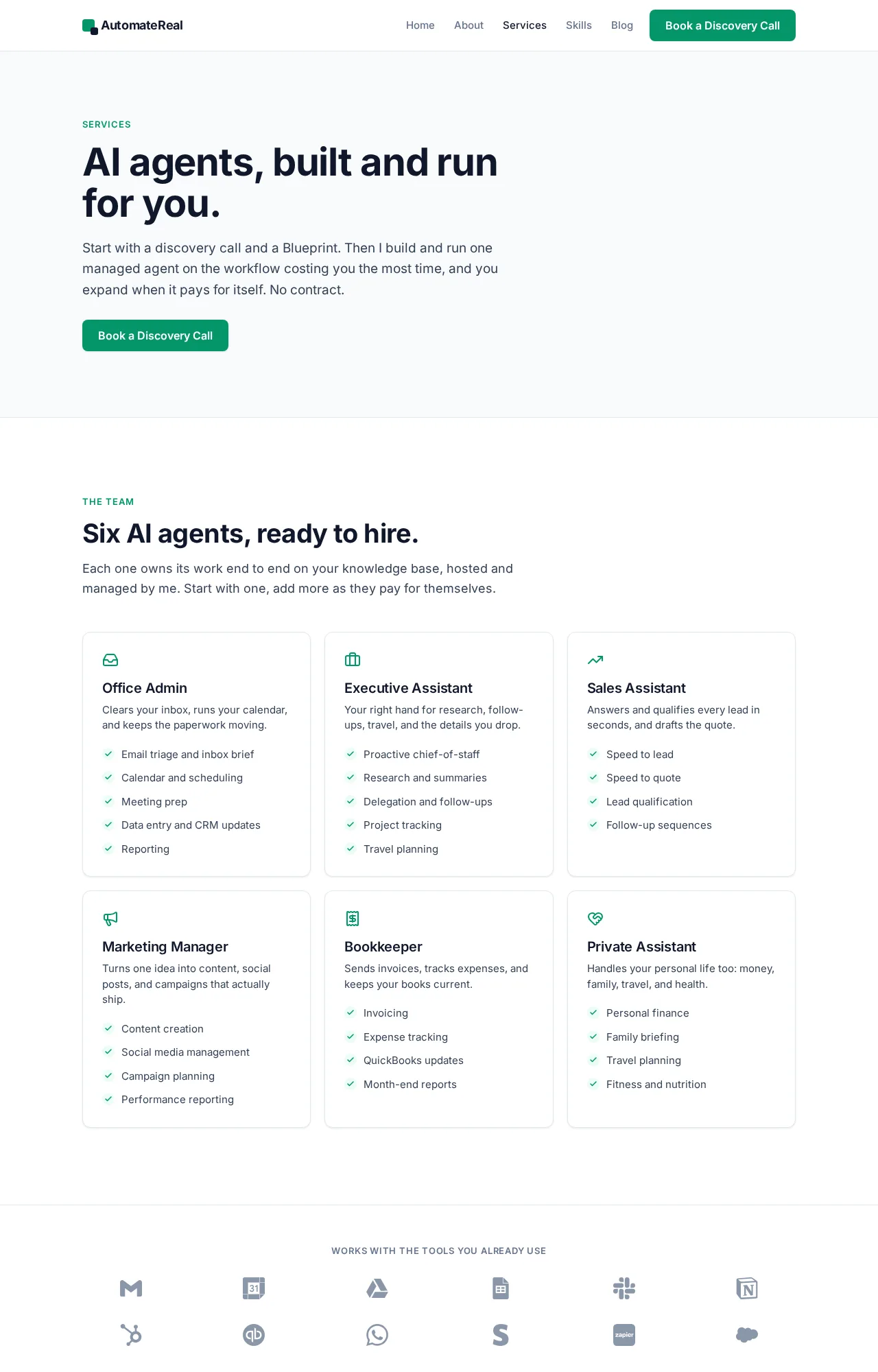
If the plan is the easy half and the workflow is the hard half, the AI services page is where we build the part that uses it.
AutomateReal services
Buy the smallest tier that covers real work, then move the scheduled job onto an API key instead of adding a seat.
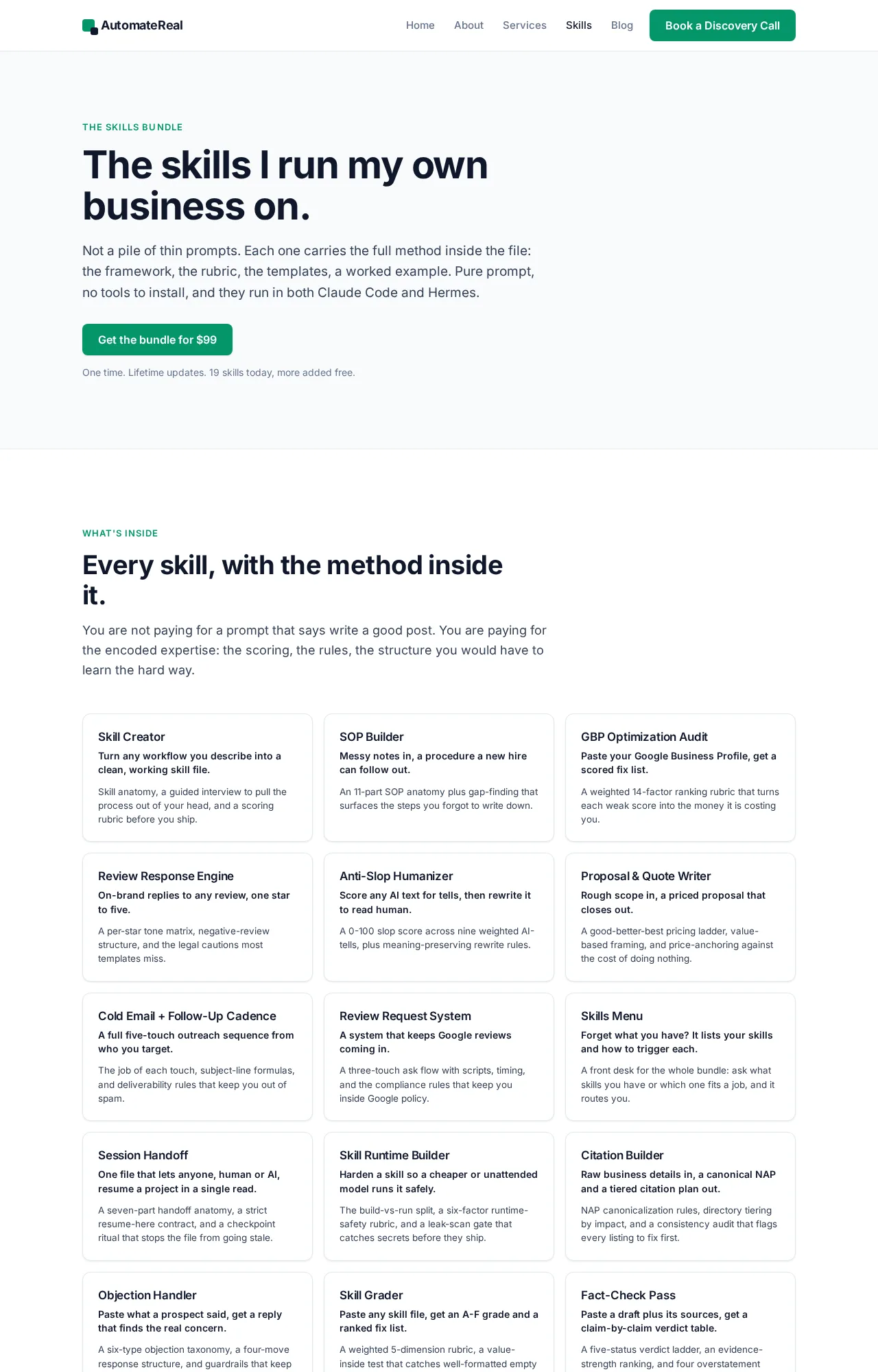
For a managed version, see the skills bundle.
Related: Generative AI for Small Business: What It Does and Costs
Related: Agent SDK: What It Is and When to Build vs Buy
Related: What Is AI Automation? A Small Business Guide
FAQ
Does Claude offer refunds?
Usually not. Anthropic says payments are generally non-refundable, except where the Consumer Terms of Service or local law say otherwise. Outside Europe, use the Claude Refund Request form under Get help. In the EEA and the UK, a refund is available in the app inside a 14-day withdrawal period.
How do I cancel my Claude subscription?
You can cancel any time, and the plan stays active until the end of the period you paid for. On the web or the desktop app, cancel under Settings > Billing. Cancel at least 24 hours before the renewal date to avoid the next charge.
Can I switch from monthly to annual billing later?
Yes. Change the cycle under Settings > Billing, and unused time on the monthly plan is credited toward your first annual invoice. Some upgrades also leave a credit balance that Anthropic applies to later purchases.
What happens if we outgrow 150 Team seats?
Anthropic sizes the Team plan at a minimum of 2 members and a maximum of 150 seats. Past 150, the organization moves to Enterprise, which is billed annually at $20 per seat plus usage at API rates.
Is Claude Code included in the Pro subscription?
Yes. Pro includes Claude Code at no extra charge, and terminal work draws on the same usage pool as your chats. A Console account is the other option, and it bills per token with no plan needed.
Do Claude skills cost extra on top of a subscription?
No. Skills show as available on every plan in Anthropic’s compare table, including Free, so there is no separate skills fee. Team and Enterprise plans add organization-wide skills deployment as an admin feature.
Picking the tier that fits your week
If the choice between these tiers is the sticking point for your own week, a discovery call settles it in about 30 minutes. Bring the workflow you want off your plate, and we will size the plan around it.